I believe followers of Jesus and the Family of God are inherently required to be transparent. In some cases this means being transparent with one other follower of Jesus or a select few trusted people, but other times it is required to be more publicly transparent. Because of this, while wisdom and discernment is required to navigate the tension on this issue, I think all followers of Jesus should err on the side of transparency and even public transparency. I do not believe this is a personal optional commitment that some believers make, I think this is part of being the Family of God.
To explain this further and respond to some of the concerns I want to explore three more ideas in more detail. First, I believe it is impossible for followers of Jesus and the Family of God to deal with sin and bring about change without being transparent. Second, followers of Jesus are simply not promised a “right to privacy” regarding their sins. Third, I believe that the fact that exposing and dealing with sin can be painful and embarrassing cannot be used as an excuse to maintain secrecy about an issue.
Occasionally I will be referring to an unlikely source that I have found helpful on this issue: Tertullian. Tertullian was a leader in the early church, around the close of the 2nd century AD, and his writing concerning why people avoided the public confession required in his day by the church proved helpful as I thought through this issue. So let’s begin.
To the first point, I believe transparency is always necessary to deal with sin issues and bring about change.
On a personal level if you are in denial about what is going in your life, if you are too arrogant to admit you are not perfect, if you are too fearful of the reaction of your community, or if you are for whatever reason unable to be transparent with at least one other person you will not change. If you confess your sins to God you may be forgiven, but you will probably continue to sin. Have we not all experienced times where sins we have confessed to Jesus only to continue to commit the same sin?
There is simply something that happens when we finally are able to swallow our pride or our fear, drop our pretenses and let someone else know what is really going on. Spiritually speaking, at the very least this fulfills the exhortation of James 3 to confess our sins to one another. Practically speaking, at the very least it invites accountability, support and a fresh perspective on the situation from at least one other person.
This is just as true on a communal level. If the Family of God maintains codes of silence and avoids talking about issues, if followers of Jesus refuse to talk about and deal with what is going on in their community, the issues and evils within the community will persist. Ask any dysfunctional family: secrecy is not the pathway to change.
Tertullian’s writing highlights two important points in regards to this issue…
First, Tertullian writes…
I give no place to bashfulness when I am a gainer by its loss…Grand indeed is the reward of modesty, which the concealment of our fault promises us! If we do hide somewhat from the knowledge of man, shall we equally conceal it from God? Are the judgment of men and the knowledge of God so put upon a par? Is it better to be damned in secret than absolved in public?…
Many shun transparency for fear of what others people will say or think. Yet God already knows what we did and it is God who will ultimately judge us and God to whom we are ultimately accountable. So why not confess our sins and be forgiven? Even if the worst should happen, and people around us shun us, ridicule us, break-friendship with us over what we have done, it would still be better to confess our sins and be reconciled to God than to maintain the approval and acceptance of other humans through deception but continue sinning against God.
Later Tertullian adds…
Miserable it is to be cut, and cauterized, and racked with the pungency of some (medicinal) powder: still, the things which heal by unpleasant means do, by the benefit of the cure, excuse their own offensiveness, and make present injury bearable for the sake of the [healing they will eventually bring].
Tertullian points out that the pain of transparency is far outweighed by what we gain from it. Tertullian does not suggest transparency will be fun or easy, but like a medical procedure that is painful or repulsive, transparency is worth it because of the healing and forgiveness it brings. What we have to gain by transparency far outweighs anything that would hold us back from it.
In short, while secrecy may be easier or help us avoid the pain of embarrassment or exposure, it invites stagnation and our sins will most likely continue. What we push away and deny we are doomed to repeat. Transparency may not be fun or easy, but it is required to bring about the forgiveness of our sins and change in our lives. What we acknowledge and accept we can deal with and God can work in our weakness and brokenness.
Second, the scriptures never talk about a right to privacy and they certainly do not suggest followers of Jesus have a right to privacy regarding the sins they have committed.
A right to privacy is a modern concept. Not surprisingly nothing is said about it in the scriptures. We are not guaranteed that we have a right to run our personal affairs however we see fit, with no commentary or intervention from the family, and we certainly are not promised that we have a right to privacy to sins that we commit. I would actually suggest that a follower of Jesus should expect less privacy if they join the Family of God. Let me explain what I mean.
If I saw a random stranger at the supermarket cuss out their children I’m probably not going to talk to them about it. However, if my cousin cusses out their children, we are certainly going to have a talk about it. What is the variable that changes my reaction? The answer is simple: ownership.
With my family I have a stake in the lives of my family members and they have a stake in mine because, like it or not, we are blood and we are in this together. How they live their life inherently impacts and reflects upon me and vice versa. With a stranger I feel no such ownership and at the end of the day the consequences, good or bad, of how they choose their life will be on them and theirs. This is why I would address the issue with my cousin but not with a stranger.
If you join the Family of God, you are no longer some stranger, but a member of the Family. More people, not less, will have a vested interest in how you live your life. Now I’m not saying other followers of Jesus a right to install hidden cameras in your house or read your diary (healthy families have healthy boundaries), but you cannot brush off the concerns of other followers of Jesus or leaders by suggesting you have a right to privacy, by accusing them of meddling in your affairs, and by stating they have no right to involve themselves in how you conduct your personal business. Your affairs are now family affairs. If you do not want the added scrutiny and involvement, don’t get baptized.
I almost feel it does not need to be said, but nowhere in scripture does it suggest that Followers of Jesus have a right to privacy about the sins they have committed. Obviously I would expect the Family of God to be loving in how it deals with evil, and this would not mean exposing sins without any purpose or in an unloving manner, but Jesus does not say that we can sin and that are owed some right to secrecy regarding those sins. This just is not part of following Jesus or being the Family of God.
Third, the fact that exposing and dealing with sin can be painful and embarrassing cannot be used as an excuse to maintain secrecy about an issue.
Some might suggest that certain sins should be kept secret because exposing the sin may cause more harm than good. For example, what if you caught your pastor in an affair? Exposing this affair might lead to divorce(s), children growing up in broken homes, a split church and a tarnished reputation of the church and of Jesus. Should you keep this sin a secret because exposing it might hurt too many people? Should transparency be compromised to avoid the pain and consequences of exposing sin? Let us say a sin is exposed against the wishes of the perpetrator. In a similar vein, could the perpetrator ever hold the person who exposed them accountable for the emotional pain or other consequences of having their sin exposed?
Tertullian again wrote something that I think is helpful…
But you say [in objection to going to public confession], “It is a miserable thing thus to come to [public confession]” yes, for evil does bring to misery; but where repentance is to be made, the misery ceases, because it is turned into something salutary. (Emphasis mine.)
Evil does bring misery. Dealing with evil is painful and messy. It is a horrible feeling when our evil deeds are exposed. It is horrible to see other followers confess things that wrench your heart. It is horrible to see a secret sin exposed against the wishes of an unrepentant perpetrator. But this is part of the devastation of sin.
Part of the pain of sin is the pain it causes when it is exposed and dealt with. Sin gets you coming and going as it were. Not only is there a right guilt about committing an evil act but there is a second cut as it where when we decide to deal with it.
Because part of the pain of sin comes from dealing with it I do not believe one can ever use this pain as a rational for continuing to keep issues secret. To suggest that an evil should be kept secret in an attempt to avoid the full consequences of that evil is, in my mind, trying to do evil that some good may come. This sort of logic has no place in the Family of God.
Additionally, I believe this means that ultimately the responsibility for the pain of the sin being exposed or any consequences of sin is on the people who perpetrated the sin. You cannot commit a sin and then blame the person who exposes it for the consequences of the sin that you committed. I could not have an affair, destroy my marriage, destroy the lives of my kids, destroy my church and then blame the person who exposed it. There might be a situation where a sin was unnecessarily exposed or exposed in an unloving manner, but even in these situations, if the accusation is true, if you had not sinned there would never have been a problem in the first place.
In my next and final post on this subject I want to talk about some barriers to transparency in the Family of God I have seen and hopefully provide some constructive thoughts on how to overcome them.




 Speakfaithfully
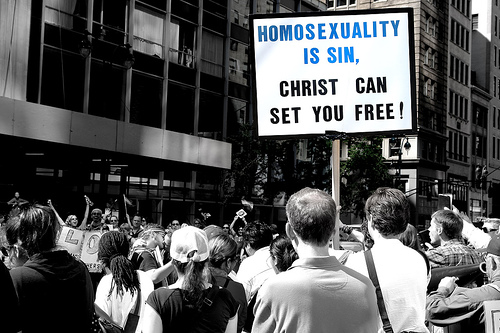
Is Homosexuality a Sin?: Approaching this is issue through the “Revelation and Invitation” Approach.
[Disclaimer: This blog and the posts contained within it are solely the representation of my personal thoughts and beliefs. They are in no way representative of the thoughts or beliefs of communities or organizations I am involved in or discuss. Such communities would include, but not be limited to, Fuller Theological Seminary, the Pasadena International House of Prayer, the School of Supernatural Ministry, the Live Bones student prayer group, Christian Assembly Church, etc.]
In my previous two posts I hope I have shown how if one seeks to answer the question “is homosexuality a sin” by reading the Bible as a “Truth-mine” the answer one arrives at is the standard condemnation of homosexuality. However, the interpretation and application of the verses investigated on this issue in that approach are highly problematic if not outright incorrect.
In contrast, what happens if one reads the Bible as Revelation about God and about an Invitation to join His ongoing story as He interacts with humanity? How does this impact how one reads the Bible regarding the issue and how does this impact the end result?
To recap this way of approaching the Bible, reading the Bible as Revelation and Invitation means reading the Bible as it is and not as we would have it. This means reading the Bible as a collection of case-studies, or testimonies, of people’s experience of God that invite us into a relationship with God. This means acknowledging and working within tensions of the text and our limitations when studying it. This means we should humbly approach the scripture, seek to admit and understand our bias, admit all of the textual and interpretive issues at play, and seek the guidance of the Holy Spirit.
To begin I want to present some of my presuppositions and bias that inform me and my reading of the scripture and my approach to the Bible and faith even before I begin discussion the specific issue of homosexuality because acknowledging these beliefs is part of reading the Bible in this manner.
First, there is truth outside of the Bible. I believe the Bible is true and contains truth but it is not an exhaustive account of all truth. The Bible is not the sum total of all knowledge humans can and should know. This means that there is truth beyond the pages of the Bible that followers of Jesus can and should seek out. For example, 2+2=4 is true, but it is not found in a verse in the Bible. The law of gravity was established by God and widely recognized in the scientific community as true, but the law of gravity is not expounded upon in our Bible. Germs exist but they are never mentioned in the Bible. There are a multitude of examples but I think you get my point.
Because the Bible is not an exhaustive account of all truth, this means that humans can and should learn things about our world, about the human condition, about psychology, about sexuality, about science, about math, about God and about faith that are not written in the Bible.
Second, I believe the Bible is authoritative, but this authority is limited in scope. I believe the Bible is authoritative on what it is communicating to the human race about God, His story, our relationship to Him and to one another. I do not think the Bible is authoritative about astronomy, cosmology, science, human psychology, chemistry, technology, design, entertainment, engineering, etc. While God’s authority is absolute, I do not think this should be confused with giving the Bible (or more accurately, our interpretation of the Bible’s words) that same absolute authority. So just because the Psalm 104:5 suggests that the foundations of the Earth can never be moved, does not mean that Christians must deny everything that has been learned about our heliocentric solar system, the rotation of the Earth, or force us to go back to an ancient Jewish understanding of the world that looked something like this.
Third, I believe the Bible was communicated through an ancient culture. All of the material in our Bible was shaped by the culture that communicated it. Sometimes this may be a good thing but this also means that there are elements that should be recognized to be a reflection of that culture at that time and not a divine truth that applies to all Christians throughout time. They are to be understood as descriptive of the Hebrew and Greek culture and not descriptive commandments or aspects of the Family of God. While truth was communicated through cultures that once existed, this does not mean that we have to replicate or reproduce the values and customs of those cultures today as we follow Jesus. So for example, just because the people of God practiced Levirate marriage does not mean all followers of Jesus should practice this today.
Fourth, the morality and ethics of the people of God change over time. Many Christians believe that there is some timeless code of morality and ethics in the Bible that all Christians must adhere to. This is simply not true. While some morals and ethics appear to be constants, morality and ethics do change over time.
This happens in the Bible. For example, the Levitical laws are updated several centuries later when Deuteronomy was written. The changes in the laws reflect changes in the society. The people of God were no longer a semi-nomadic agrarian society but an urban society that increasingly relied less upon crops and more upon currency and debt. The heart of these laws did not change, but their application did. God for centuries required His people to be circumcised, celebrate certain festivals and eat only certain foods. Suddenly He no longer requires these practices of His people.
Morality and ethics have continued to change since then. For example, several hundred years ago it was seen as completely compatible to own slaves and be a Christian. Several decades ago it was completely compatible to be racist and sexist and be a Christian. Did the Bible change? No. Society evolved and our morality and ethics expanded to changed with it.
Fifth, the standard Christian understanding of human sexuality and sexual ethics is far too narrow. Most Christian teaching on these subjects boil down to two things: If you are married and heterosexual, sex is a gift from God to be enjoyed. If you are not married or not heterosexual, sex is a sin that nailed Jesus to the cross. Human sexuality is a much more complicated subject than this and I think a much broader understanding of it is needed. Additionally this understanding of human sexuality leads to a ridiculously narrow, simplistic and useless sexual ethic. I am not advocating for laxer sexual ethics because it is hard to remain celibate, I am advocating for a the development of sexual ethics that are actually useful to people.
Let me provide an example of why I think this narrow understanding of human sexuality and sexual ethics is problematic: I know of married Christian men in recovery for sexual addiction who are “acting out” in their marriage. They treat their wives as “their vagina” and use sex as a way to avoid intimacy and avoid emotions they do not want to deal with. This dehumanize their wives and their spouses are understandably hurt. However, the standard Christian teaching is that they are married and heterosexual, so their sexual union is a gift from God. I have heard Christians rebuke the wives in this situation for being frigid. The thought is that such women should submit to her husband more because “their body is no longer their own.” This is a sick situation that slips by and is even enabled by the standard Christian teaching of sexual ethics.
We need to think more about these issues.
Sixth, I believe sexual orientation exists along a spectrum and a homosexual orientation may be natural and biological in origin. I believe it may also be seeded by some sort of dysfunction or abuse. While I think at times homosexual attraction is caused by sexual abuse or broken relationships with parental figures, this is not always the case. I believe that sometimes people are born with an atypical sexual orientation somewhere along the spectrum. While rare, I believe a person can be born homosexual or bisexual. There are an increasing number of studies that back this up but really this opinion comes from my experiences with homosexuals who have shared with me both types of stories.
Continue onto the next page for more…