The Spirituality of the Beloved Princes and Princesses

The healthiest model of the spiritual dynamics of those following Jesus Christ I know of comes from Dr. Chuck Miller in his book The Spiritual Formation of Leaders. Also, buy this book.  It is worth $100.

This model is called “Pitcher, Cup, Saucer, Plate.”

The Pitcher represents God  and it is filled with all His infinite resources, His infinite power, His infinite love, His infinite forgiveness, etc. The Cup is the follower of Jesus.  The Saucer is that follower’s immediate relationships and context (your work environment, Brian from the gym, Susan your friend from college, etc.). The Plate is the wider world and the larger systems and issues in this life (war, the city you live in, pollution, child slavery, government, etc.).

The way it is supposed to work is that God, with all His infinite resources, pours into us His love and His power, His forgiveness, His Spirit, and all His infinite resources. He never stops and He never runs out. We, the Cups, are positioned to receive and are easily filled up to the brim.  The Cups do not have to try, they do not have to strive, they do not have to earn this filling. Cups simply receive and keep their hearts always tuned to receiving because that is what they were made for.The thing is after we are filled, God does not stop pouring out into us and we cannot help but overflow with the love and power of God that we continue to receive.  The Saucers, those in relationship with us, are the first to receive this overflow as they are touched and directly impacted by the love and power of God that naturally and continually overflows out of one of the Cups in their life and onto them.  The Plate, the wider world, is then impacted as the Cup and the Saucers continue to overflow with the love and power of God.  This whole process truly transforms people, places, and institutions.

This is an ideal picture. While I admit in this fallen world things will not go as smoothly and we Cups are bound to sin and mess it up from time to time, I believe this is possible to achieve and should be normal for followers of Jesus. Where this is not the case there is a problem that should be identified and dealt with, preferably sooner rather than later.

Many times where there are problems with this whole paradigm, it is with the Cups, the followers of Jesus.  If we are not firmly rooted in our identity as the beloved of God our focus tends to shift from receiving from God to the impact we are having in our relationships and the wider world. The world is obsessed with production and results and we can grow concerned if we do not see “enough” fruit in our lives. Maybe if there is no fruit God is not pouring out? Maybe we are not doing enough for God to keep Him pleased with us?  Maybe we could be doing more? Often in a desire to “help God out” and make our own fruit we pour ourselves out onto our relationships and ministries. We give away from our finite resources, and usually do so way beyond what was ever asked of us and far more than we have.

Christians often call this “ministry” or “service.”

The problem is that when we pour ourselves out, we are no longer in a posture to receive and this prevents us from being filled up by God.  What God wants to give us is lost in the shuffle of our busyness and striving to serve Him. When we have poured ourselves out so completely, and are not receiving from God, we feel taken advantage of, we feel used, we feel empty, we feel burnt out. Serving God was never meant to feel like this, even in the midst of severe trials!

The solution to this is often as simple as changing your thinking from aligning with the wordly preoccupation with results and success to the teachings of God.  John 15 promises us that if we abide in Christ the fruit will come. God is the one doing the heavy lifting, not us.  God thoroughly has things under control and while we are to do our part we are not responsible for the vast majority of things we often think we are responsible for. John 15 also promises that apart from God we can do nothing, yet we often try very hard to make things happen through our plans, our ministries, our service and our effort. People who spend time abiding in Christ are often written off as lazy, or loafers, or “mystics” who serve no real purpose. This is an old problem.  In the Bible we find the story of  Mary and Martha which captures it well. We must live in the tension of having things to do, but not getting caught up in the pre-occupation with results that the human hearts appears bent towards.

Another common problem is that we Cups have been so broken by past hurts that our hearts are like a sieve that cannot receive what God is lavishing on us.  While those around us might experience the love of God through us, we ourselves never get filled up, are never happy, never feel secure in our identity, and are never fulfilled in following God.  The need then is for healing, often of deep emotional, psychological and spiritual wounds.  The cure for this is not a two-week retreat or some more spiritual disciplines (which may just be another burden) but stopping and figuring out what is broken and bringing the healing power of Jesus into the situation! The journey to inner healing will probably be very different for everyone who is in need, but it is worth it and it is necessary to receive all that God has for you.

This type of spirituality is also not possible if a follower of Jesus is stuck in the identity of a sinner or a slave.  Someone stuck there will perpetually wonder why God would want to pour out on them and is always looking for the fruit they think they are responsible to make happen through obedience.  This type of spirituality is possible when followers of Jesus understanding their friendship with God, their adoption by God and ultimately their identity as a lover of God who are called Beloved by their Creator.

While a follower of Jesus should acknowledge their sin and where they came from, and also humbly and honestly admit that they still do fail, their identity should that of an adopted son or daughter of Christ.  They should see themselves as someone who is loved by God, part of the family of God, and a co-heir with Christ, whom God wants to lavish all of His infinite resources of love and power upon.  We are princes and princesses in the Kingdom of God and we should live and act from that identity.  If we do not feel like this, we need to press in through prayer for a deeper understanding of the heart of the Father towards us. Most likely this will also involve dealing with past emotional, psychological and spiritual wounds that hinder our understanding of God’s love for us. To put it another way we need to move from having Romans 3:23 as our life verse to having Romans 8:18-19 as our life verses.

I know to some followers of Jesus this might sound like the cliché advice, “Just have your identity in Christ and that will solve your problems.”  I write this post knowing full well the challenges of knowing this advice, believing it to be true, but not knowing how to ever “have my identity in Christ.”  A few months ago I wrote posts on this very issue and suggested I identified more with dogs that were intentionally shocked with electrodes to test out theories regarding helplessness than with Jesus Christ. It is often not often a journey that is easy and it is often very difficult to even know where to start, but if you do not feel like you are a beloved son or daughter of God in His Kingdom something is wrong and it needs to be corrected.  Seek the face of God in this matter candidly, sit in silence and invite God to share with you how He sees you on a daily basis and talk to people who seem to “get it” about your struggles.  This is a reality even when we do not behave like it. Even the messed up members of the church in Corinth, where a man was sleeping with his step-mom and they were boasting about it, were called Holy Saints by Paul. The more we believe it the more we behave like it…naturally…without striving, and our new behave reinforces our new identity.

I firmly believe understanding God’s love for us is the most powerful thing a follower of Jesus can come to understand. It transforms how we live in this world like nothing else can. This is why Paul prays for the Ephesians to get it.  He does not pray for them to understand the best practices for their ministry or how exactly to deal with conflict, he prays for them to know the fullness of the love Jesus has for them, so they can receive all of God.  This is why the only disciple who made it to the crucifixion of Jesus Christ, the only disciple who risked all by showing up, was John, the disciple who is known famously for referring to himself as “the disciple whom Jesus loved” or “the Beloved Disciple.”  I do not think this was an arrogant statement, I think John just “got it” like none of the other disciples did. The sons of thunder abandoned Jesus.  Simon Peter who would have fought Jesus’ captors abandoned Jesus and denied Jesus three times.  But the disciple who got how much Jesus loved him showed up, risking everything.

Do not let this identity that is your birthright as a believer in Jesus Christ be seen as a lofty ideal that others have been able to achieve. It is for every follower of Jesus!

When followers of Jesus “get” this reality they become rooted in knowing God’s love for them, the spirituality outlined above flows through them and they change the world. Such followers know they are accepted, are secure in their identity, acknowledge their strengths and destiny and from this place they are launched into world changing action.

Posted in Faith, Personal Commentary | Tagged , , , , , , , , , , , | 2 Comments

The Christian Spirituality of Try Harder you Sinner

Dr. Dale Ryan, a professor here at Fuller who was a pastor for a number of decades suggests that if you took all of the sermons preached on Sunday in American and put them in a giant pot, and boiled them down to distill them to their basic elements, and then looked at the bottom of the pot you would read one clear message:

“Try harder.”

I could not agree more.

Indeed I think this is the spirituality on offer to most Christians. This is the spirituality of a slave. Christians are obsessed with laws and commandments, from God and from the church, written and unwritten, and must work hard to earn their identity and hopefully feel accepted, by God and by other Christians.

Often this slave identity is fed by a fake humility.  Many Christians intentionally disparage humanity, as if mocking God’s masterpiece somehow honors God. Humans are trash or dirt or rubbish or a vapor.  While these all sound biblical and spiritual and are in one sense true, this is only part of the truth. This reinforces a very low view of Christians that suggests all Christians are only, “sinners saved by grace” or “beggars who were lucky enough to find food” or something else that sounds pious but is a deep misunderstanding of who the people of God are. This fake humility often reinforces or seeds self-hatred disguised as pious humility.

Compounding this situation is the fact that Christians are barraged by a list of things to do, a list of things to have and a list of things to be by the Church. The unspoken message is that one must be moral and ethical enough, known enough of the right theology, have enough of the right experiences, be involved in enough of the church’s programs, etc. to be good enough.

Christians are inevitably met with their failure to live up to all of these expectations and can become concerned about their acceptance before others and before God. They may begin to wonder if their failure is a sign that they are not a Christian or God is not helping them.  They may begin to wonder if God does not like them, for if God liked them, He would help them more.  Many Christians at this point embark upon a quest to obtain God’s acceptance and favor and help through religious performance, turning into human’s doing instead of human beings. Some Christians are truly burdened by this and take their religious performance to the extreme. Christians often call these people “pastors” or “missionaries.”

However, there is never enough religious performance in this world to make you feel secure in your identity and accepted by God.  I know this because I have tried.

To make matters worse are the inherent contradictions within Christianity, a powerless civil religion. The ideals of Christianity are constantly laid out before Christians, but the only means by which followers of Jesus are to achieve these things, through the power of God and a relationship with the Holy Spirit, is absent.  To use a quotation from C.S. Lewis this is like “castrating the gelding and bit it be fruitful.”

Christian spirituality sets people up for failure. Christians must try to achieve the ideals of Christianity on their own willpower instead of through a deep rootedness in God’s love and the power of the Holy Spirit. Trying to live the Christian life without walking in fellowship with the Holy Spirit and starting with a deep rootedness in God’s love for you is like to trying to fly by flapping your own arms; it’s not just hard, it’s impossible.

The inevitable big and small failures that come sadly only reinforce the self-hatred disguised as pious humility and highlight how far Christians have yet to go. This often contributes to so much of the deception and mask wearing that goes on in church.  Christians, embarrassed by their inability to perform to the expectations before them, hide their failures. They try to put their best foot forward in the Christian community instead of talking about their experience. I am convinced that the highest levels of self-deception in American happen on Sunday from 8:00am to 12:00pm.  So many people pretend it creates a fake atmosphere of perfection and peace.  People who are not experiencing this feel an unspoken pressure to not rock the boat, and feel like they are the only ones struggling. Their only hope is that they can get their life together by keeping secret and trying harder.

For some people this spirituality actually works and the variety of church programs and the never-satisfied need for volunteers provides ample opportunities for them to serve even if it is not fulfilling for them.  For others, burn out is the inevitable end and their Christian life ends after they look back and feel used.  I am convinced many examples where the careers of Christian leaders end in financial or sexual scandal, their spirituality is the primary culprit.

Posted in Faith, Personal Commentary | Tagged , , , , , , | 7 Comments

Signs that Make you Wonder: My Prophetic Words from Pihop


Last July a large part of my journey of faith was receiving prophetic words and words of encouragement at the Well, a ministry that Pihop runs every Saturday night. The accuracy of these words and the situations they spoke to really emboldened me to continue stepping out in faith and confirmed to me that I was on the right path.


Just a couple months later I am now involved at Pihop and at the School of Supernatural Ministry that is being run there.  God has been slowly but surely building my confidence in my own prophetic gifting and my ability to speak into people’s lives encouragement from God and also receive accurate words of knowledge.  “Words of knowledge” are just a fancy term for knowing something you should not be able to know through the Holy Spirit. An example of this is when Jesus tells the woman at the Well that she has five husbands; He did not know her and there was no way He could have know her past apart from the Holy Spirit. One of the biggest principles being drilled into my head is that you have to give away what you have received.  When Jesus sends out His disciples he says “Freely you have received, freely give.” (Matt 10:8 )With all of this in mind it was a no-brainer that I should start volunteering at the Well and now serve regularly twice a month there.


On the 16th of this month I experienced a lot of breakthrough in this area.  The prayer servants pray for an hour before we begin ministering to people and A.J., the overall leader of the Well ministry, brought up Romans 12:6, specifically the part where Paul encourages believers to “prophesy according to the measure of faith God has granted you.” A.J. encouraged us to pray for a new measure of faith and boldness that night.


God had been slowly building my faith in the prophetic and my spirit was really moved by what A.J. shared.  I realized that I was scared I would share a bad prophetic word and it would turn people off from Pihop, from God, from the Holy Spirit or prophesy and I might look like an idiot.  This fear was keeping me from sharing things that could have been incredibly encouraging and faith-building words for other people. So I just went for it.  I prayed, “God I want accurate words of knowledge and the boldness to take a risk and share them.”


That night I had several very specific and accurate words of knowledge.


To a man in his later years I felt that he was judging himself and his life by worldly values and standards for success. I shared that God wanted to remind Him that God intentionally chooses the ignoble and unwise of this world to be His people in order to shame the wise of this world, that God wanted Him to accept and stand firmly in His place in the Body of Christ, whatever that was and that he should not continue to judge him by worldly standards of success because these standards come from people that do not know God.  Of course a follower of Jesus might feel like a failure if they judged themselves by the values of other people.  While this word was general in that I think a lot of people could apply it to their own lives, to the person I was ministering to it was truly impacting and right where he was at and he told us as much as he was leaving.


To a woman I told her that I saw her in a classroom and I just knew it was an ESL classroom.  I really thought I was making this up or confused because my mother is an ESL teacher.  However, sure enough, at the end of the session she confirmed she had taught ESL.


The craziest actually probably happened with the second person we were ministering to that night.  Immediately as a young man sat down I felt his brother had died.  In my head I said, “Are you kidding God?  Am I seriously going to share that with this person? This is not slow-pitch anymore…”  For me this was exactly what I had prayed for, an accurate word that required faith and boldness to actually share.  The loss of a sibling is not a general thing that everyone can connect to.  As I continued to pray I got the sense it might not have been a blood brother but a Brother in Christ, that is a close friend.


Eventually I shared that I felt he had lost a brother, and that while I was unsure if this was a blood brother, or a brother in Christ, and I was not even sure if this was a physical death or a painful separation, the message God was conveying is that He too has lost loved ones and knows what it feels like and God would comfort this young man in that loss.  The man’s facial expression did not change and I was all but certain I had just given an inaccurate word.


As the man got up to leave we handed him a feedback form and he asked if he could just give us immediate feedback.  We agree and he said, “You’ve all been right on…” And then he pointed to me. I was certain he was going to continue “…except for you…I don’t even have a brother!” But what actually happened was that he shared he had lost a friend and confirmed that the word was accurate.


I literally fell back in my chair relieved and excited. I am continue to serve at Pihop and want to receive more accurate words that speak encouragement into people’s lives.  I hope to eventually feel very comfortable and confident enough to do this outside of the Well and use the words of knowledge God gives me to minister outside of Pihop and in the highways and byways of life.


Posted in Faith | Tagged , , , , , | 1 Comment

To hallmarks of following Jesus: a life altering allegiance and being empowered by the Spirit of God

So if following Jesus was not supposed to look like what is on offer in most of Christian, what was it supposed to look like? While this is a much larger topic, I want to just bring up two of my convictions regarding what following Jesus can and should look like in order to contrast it to Christianity.

First, I think followers of Jesus should live different lives from their non-Christian peers because their life and values have been radically altered by an allegiance to Jesus Christ and the Kingdom of God.

An allegiance to Jesus Christ and the Kingdom of God should be the first and central priority for every one of Jesus’ followers.  This allegiance should come before any allegiance to family, nation, politics, ideology, job, personal bias, opinion, TV shows, news channels, cultural values, level of comfort, sports team, traditional norms, favorite hobbies, personal safety, etc. This allegiance to Jesus should shape how a follower of Jesus sees and understands everything else. Such an allegiance will lead to a life very different from people who do not follow Jesus because the values of the Kingdom are very different from those of the world.

One simple example of what I am talking about came from college years. One of my professors shared with us how he and his wife sold their home to a younger man in their church family far below the market price. This violated many values in culture and I know very few Christians who would have done this. The standard narrative for success in American culture and most Western Christians is to play a never ending game of “bigger and better.”  My professor and his wife should have, according to cultural values, sold that house at the highest market cost to make sure their family was well taken care of. Maybe with the additional money, a raise or an additional loan, they could have moved to a bigger house in a nicer neighborhood, or they would have had more for their upcoming retirement or in case of emergency.

However, shaped by their allegiance to Jesus Christ and the values of the Kingdom, they acted differently. They knew they had a younger brother in the faith who was just starting out in life who could use a leg up from people who were already well established, fantastically wealthy by global standards and had more than they needed.  They valued him and the Body of Christ more than the tens of thousands of dollars they could have gotten if they had sold it at market price to him or to someone else.

Far too often I have seen people claim to be followers of Jesus but their behavior and beliefs make it clear that they are actually have divided loyalties.  They follow Jesus to a point…the point where it begins to interfere with their other allegiances. Or worse yet, instead of their allegiance to Jesus shaping how they see everything else, they protect, enshrine and give spiritual backing to their other allegiances by tacking on Jesus’ name and some Bible verses to it.  This is how you end up with “Christian” support for all kinds of cultural and political agendas, many of which are actually directly contrary to the teachings of Jesus and the Gospel.

To be clear, I am not saying that every follower of Jesus needs to do the exact opposite of culture to be different.  For example, just because people who do not know God have families, work jobs, and wear clothes, I do not believe every follower of Jesus should take vows of singleness, be homeless, and never wear clothes just to be counter-cultural.  Following Jesus is not about needlessly offending non-believers or being counter-cultural for the sake of being counter-cultural. It is about letting and ensuring that our allegiance to God wins out over all other allegiances, a difficult project which can lead to choices that are foolish, costly or incomprehensible to those around us.

I think this is an issue that even many within Christianity are beginning to recognize.  Francis Chan and Shane Claiborne are just two examples of popular Western Christian leaders and teachers who advocate for a faith that leads to a life beyond the American Dream. However, while these leaders espouse something that is a dramatic improvement over Christianity, I really think this is only half the solution.  While it is admirable and more in line with the Gospel to live in community, work against oppressive economic, religious and political systems, protest ecological destruction and wars, take up the cause of the homeless and live lives without safety and comfort as the ultimate end, non-Christians can do all these things.  Also, these things are “sexy” right now.  Being socially conscious is in. Have we really been stirred to justice by re-connecting with the heart of God and many of our scriptures or are we just being relevant (a.k.a seeker-sensitive) to a new generation’s tastes? I fear without something else, while these changes are for the better, at the end of the day they may simply boil down to being a new cosmetic layer over the same old rotten core.

I do believe there is something more to following Jesus, and that brings me to my next point.

Second, I believe the supernatural power of God is to be a daily reality in the life of followers of Jesus and their gathered communities.   Followers of Jesus are completely dependent upon the supernatural power of God to follow Jesus in all of His commandments and ways.

I think it is impossible for followers of Jesus to obey the commandments of Jesus or follow His ways without the power of God.

Followers of Jesus are commanded to love our enemies, love the less fortunate and love others as ourselves.  While this may sound like something that a human can do through their own effort, I think people who have actually tried to do this realize how impossible these things truly are.  Considering the command to love the less fortunate alone, I can share a story about how I helped out at a Habitat for Humanity event or helped a homeless person now and then, but how consistent have I been and with what motives have I done these things? How many of the poor have I treated as invisible and worthless, walking by them without a second thought just like everyone else does?  How much of my charity was really self-serving, and was motivated more by my need to be a good person, than out of a love for the homeless? Forget about loving people who are actually violently attack me, I routinely fail to love people because just because they are poor, dirty and smell bad.

If this were not enough for us to recognize our need for something beyond ourselves to follow Jesus, followers of Jesus are also commanded to do that which is clearly impossible without supernatural power.  We are commanded to heal the sick, cleanse the leper, speak prophecy, speak in tongues, raise the dead, and cast out demons.

Now many Christians ignore these commandments and large swaths of scripture because the supernatural is not regularly experienced in Christian churches.  Instead of asking why these things are not seen, Christians develop theologies like cessationism and dispensationalism to explain away why they do not experience these things.  These beliefs are very common in Christianity despite the fact that they have no biblical basis.  In fact, Jesus said that his followers would do greater works (signs, wonders and miracles) than He did (John 14:12) and Acts appear to bear this out as even Peter’s shadow could heal the sick.

I used to believe in these doctrines as well.  Then I began experiencing the supernatural power of God and re-read the Bible as if with new eyes.  In 2009, I received an accurate prophetic word concerning the young adult group I was involved in.  The central point of the prophetic word I received came to pass within a year and a half.  Then, in 2011 I experienced supernatural healing of trauma and deep-seated spiritual and emotional wounds that a year of counseling and three years in recovery had not resolved.  These happened even though I was still in Christianity and part of churches that denied that these things happened.

I am so glad that God does not obey Christian theology.

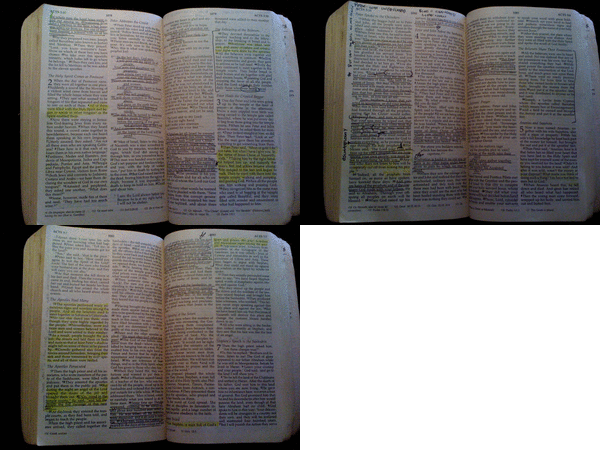
After these experiences I re-read Acts with one goal in mind: I wanted to see how common the supernatural was to be in the life of followers of Jesus and our gathered communities. I saw no reason to differentiate between what was available to the followers of Jesus today and the followers of Jesus in Acts.  I highlighted everything that was clearly and undeniably supernatural. This is what I found…

I hope that anyone can see that visions, angelic visitations, people directly being talked to by God, miraculous healings, the resurrection of dead bodies, the casting out of demons and all other kinds of supernatural experiences are common in Acts and I would suggest are to be expected in the life of anyone who follows Jesus.

If you are a follower of Jesus and are not experiencing the supernatural I believe something is wrong.  You may need to repent of bad theology, receive healing, spend time with followers of Jesus who do experience the supernatural and learn from them humbly or a variety of other things. I believe every follower of Jesus who has received the Spirit has the power and authority of an adopted son or daughter who is now a co-heir with Christ.  I think any follower of Jesus, no matter how new, can heal the sick, raise the dead, cast out demons, speak in tongues, speak prophecy, etc. Only when we realize this can we follow all of Jesus’ commands, live out or destinies and offer the world something no altruistic atheist can.

As I have become increasingly open to the Holy Spirit’s work in my life, the supernatural in general and praying with more faith I have been experiencing a lot more of these things in my own life.  In a new series, “Signs that Make you Wonder,” I will be recording some of my supernatural experiences on these blogs.

In my next post in this series I want to bring up the issue of Christian spirituality, why it is so sick, and what it was supposed to look like.

Posted in Faith, Personal Commentary, Why do we believe... | Tagged , , , , , , , , , , | Leave a comment

Christianity is a highly secularized civil religion.

[In my initial post on why I left Christianity I stated that I wanted to discuss four core issues I have seen within Christianity.  In my last several posts I have discussed how the most widespread approach to the Bible is wrong. Where the Bible is read as a Truth mine, where we hunt for timeless truths to guide Christian thought and behavior, the Bible inevitably devolves into the source of shaky rules and doctrines that are often used to bludgeon, judge and exclude other people with the full weight of divine authority.

I suggested despite the many abuses the Bible has suffered it still has a place in the life of a follower of Jesus and should be read as Revelation and Invitation. I truly believe the Bible, when read this way, can be a window into the character and heart of God, an invitation into the people of God and an invitation to participate in His ongoing story of redemption and grace through Jesus Christ.

In my next series of posts I want to discuss how Christianity is highly secular, and suggest how this was never meant to be the case for followers of Jesus.]

At its best, Christianity is a highly secularized civil religion.

What I mean by Christianity being “secularized” is that over the centuries Christianity has consistently required less faith and less God to operate.  Currently, beyond a handful of miracles that are begrudgingly accepted, the spiritual realm is denied or ignored and Christianity is for the most part godless and powerless.

What I mean by labeling Christianity a civil religion this is that Christianity is now for the most part Western cultural values and beliefs that have been dressed up with phrases and concepts from the Protestant Bible. In this compromising situation cultural values, many of which are completely antithetical to direct teachings of Jesus, are given spiritual authority and approval by selectively reading, ignoring or twisting the words of Christ and the wider scripture. Instead of us joining the people of God, being personally transformed, and then transforming our culture, we have conformed the message of the Bible to affirm what is already there. While I am aware non-Western expressions of Christianity exist, I believe this deeply compromised Western Christianity is what most people are familiar with and is what has been exported for by Western missionaries for a very long time.

Christianity has been like this for centuries.  I am not here critiquing just conservative evangelicalism in the United States in the early 21st century.  This is the Christianity that affirmed slavery, called for the crusades, baptized colonialism, went along with Nazi Germany (80% of the Nazi’s were Lutherans) participated or ignored more contemporary genocides (the vast majority of Rwanadans were Christian as were many in the world who watched it on TV) and has been used as a tool to forward political agendas.

These are some rather large claims.  I want to highlight just four major issues that have come up for me recently that have shaped my beliefs about this issue:

First, God’s power is almost completely absent from Christianity: In my reading of the Bible it seems abundantly clear that the followers of Jesus will have access to the supernatural power of God.  This supernatural power is the only way followers of Jesus will be able to meet, if imperfectly, the radical call to love that runs throughout the scriptures.  This supernatural power is the only way followers of Jesus will be able to heal the sick, raise the dead, and do all other kinds of signs and wonders that bring freedom and confirm their testimony to God.

H0wever, from all of my time in Christianity it appears that this supernatural power of God is almost completely absent. While many Christians may be nice to those who think and act like them most Christians fail to love people different from them, let alone their enemies. Prayer is treated as a way to wish someone well and miracles do not happen or are even directly denied.

Second, God is not required for Christianity:  This brings me to my next point.  Because Christianity is so powerless Christians have had to develop theology, practices and methods around their lack of access to God’s power.  They either affirm their lack of power as normal or attempt to develop programs and ministries to do what only the supernatural power of God can. I am convinced that much of contemporary Christian writing, programs and thought are simply trying to equip Christian pastors, communities and individuals to live the Christian life without God.

This has led to a self-sustaining religious system that does not require the supernatural power of God. Dr. Charles Kraft once said, “Most of what we do in church is secular,” and from all my time spent in Christianity I have to agree with him or lie. Most of what happens in Christianity can be accomplished through human effort and willpower. I would dare say that if God were to vanish from the churches I have been a part of, the seminary I am at, and the lives of many of my Christian peers, all of these things could continue the next day unchanged. God may be the object of Christian worship, Christian studies, or even Christian affection and devotion, but this is not the same thing as being in a relationship with and dependent upon God and His power.

Third, there is very little in Christianity that one cannot get elsewhere: Just because Christianity is a secularized civil religion doe snot mean that Christianity does not have anything to offer. Involvement in Christianity often provides people with a worldview, a code of morality and ethics, a sense of belonging, a support system, a path to self-improvement, a sense of moral superiority, a sense of direction in life, etc.  While I do not want to discount these benefits of being involved in Christianity, I also see the problem that any of these things can be found in communities, resources and teachings that have no connection to any sort of spirituality, let alone a direct connection to the one true God of Israel.

For example, in my time in the West Side of Modesto I learned that a primary draw of gangs is the fact that they provide a sense of belonging, a basic human need, to youths from broken homes and broken neighborhoods.  It is no surprise then that the most at-risk youth for gang involvement are second generation immigrant children who speak their native tongue at home, English at school, and do not fully fit in either place.  Gangs, regardless of the dangers and violence that go with that way of life, provide a sense of community for these rootless youth.

Yet how many Christian communities fail to provide this very basic sense of belonging? In my experience it is only a select handful of people who fit a very specific mold of race, socioeconomic status, and acceptable Christian thinking and behavior that are truly welcomed and supported at any specific church.

Fourth, Christianity often leads its adherents into lives that are all but identical to the lives lived by non-Christians: I have many friends who strive to be moral and ethical, remain faithful to their spouses, raise their children right, work hard at their jobs and provide for their family and their family’s future. The problem I am highlighting is not in these behaviors. The problem is this description fits many of my Christian friends and many of my non-Christian friends.

Let me be clear: I do not think it is wrong to have a family, go to school or have a stable job. My issue is that it appears most Christians have an idolatrous attachment to these things and pursue them more than they pursue God.  Their lives are oriented around attaining comfort, respectability, family and security in worldly things.  To be blunt, most Christians I know pursue the American Dream and then go to Church on Sunday. If God is in the mix at all, God is a means to the ends of attaining the real goal in mind.

I am convinced that an encounter and relationship with Jesus will lead to a life-altering transformation.  I am highly skeptical that Jesus transforms so many people and leads them into lives that look exactly like people He has not touched in any way.

Indeed, even statistically Christians are almost identical to non-Christians.  Why is it that people who claim to have the Spirit of God have almost the exact same divorce rates and rates of addiction to illegal drugs as people who are neither spiritual nor religious?

Conclusion: These are but four points that I have chosen to bring out to highlight how Christianity is a highly secularized civil religion. If Christianity serves a God, why is that God’s supernatural power largely absent from Christianity? If Christianity is a religion devoted to following a God, why is that God not necessary? If the Christian community claims to represent the one true and ever living God, why are they not offering anything unique? If Christians claim to have the hope of the Resurrection and the very Spirit of God in them, why do they live almost exactly like people who do not?

For my Christian readers who want to think about this issue further or would disagree with me, I would like to ask some questions as you think about this.

What, exactly, does your church do that requires God? What happened the last time your church got together that absolutely required and necessitated the power of God to happen?

What, exactly, do you do that requires God? If God were to abandon you for a day or a month or a year, what would change in your life?

What exactly does your faith offer someone that they could not get elsewhere?

What marks your life as different than non-Christians around you?

[In my next post, I want to suggest how following Jesus is radically different from this.]

Posted in Faith, Why do we believe... | Tagged , , , , , | 1 Comment

Addendum: Is the Bible the “Word of God” that is “God-breathed” and “useful for teaching, rebuking, correcting and training in righteousness?”

In the course of writing my last series of blogs two issues came up that I could not fit into my previous posts, but I believe deserve consideration. The issue is that there are two scriptural passages that I have seen misused with alarming regularity.

First, people have equated the phrase “word of God” in Hebrews 4:12 with the Protestant Bible.  This belief has been supported by the widespread belief that the Protestant Bible is the “Word of God” and in circular way, this verse has also been used to support that very belief.  

I think calling the Bible the “Word of God” is problematic where it is not outright wrong.  Often when the Bible uses the phrase “word of God,” in Hebrew 4:12 and many other places, it is not referencing the Protestant Bible.

To support this statement I am going to take scriptures where the exact phrase “word of God” or “God’s word” is used and replace it with “THE BIBLE.”  I encourage my readers to evaluate for themselves if equating “the word of God” with “the Bible” makes any sense in these passages.  Keep in mind that when these scriptures were written, some of the letters that came to be part of our New Testament were not even written yet.  Additionally the biblical canon was not established for decades and people did not have personal copies of the Bible until centuries later after the invention of the printing press.

  • “The Revelation of Jesus Christ, which God gave Him to show to His bond-servants, the things which must soon take place; and He sent and communicated it by His angel to His bond-servant John, who testified to THE BIBLE and to the testimony of Jesus Christ, even to all that he saw.” (Rev 1:1-2)
  • “I have become its servant by the commission God gave me to present to you THE BIBLE in its fullness (Col 1:25) [Apparently Paul was charged with dropping off a book that did not exist yet.]
  • “Remember Jesus Christ, raised from the dead, descended from David. This is my gospel, for which I am suffering even to the point of being chained like a criminal. But THE BIBLE is not chained.” (2 Timothy 2:8-9)
  • “For you have been born again, not of perishable seed, but of imperishable, through the living and enduring BIBLE.” (1 Pet 1:23)
  • They forbid people to marry and order them to abstain from certain foods, which God created to be received with thanksgiving by those who believe and who know the truth. For everything God created is good, and nothing is to be rejected if it is received with thanksgiving, because it is consecrated by THE BIBLE and prayer. (1 Timothy 4:3-5)
  • “But they deliberately forget that long ago by THE BIBLE the heavens existed and the earth was formed out of water and by water.” (2 Pet 3:5) [Apparently a copy or copies of the Bible were floating around before the creation of the world and the world was created by the Bible.]
  • “The apostles and the brothers throughout Judea heard that the Gentiles also had received THE BIBLE.” (Acts 11:1)
  • ” He (Jesus) is dressed in a robe dipped in blood, and his name is THE BIBLE.” (Rev 19:13)
  • “It is impossible for those who have once been enlightened, who have tasted the heavenly gift, who have shared in the Holy Spirit, who have tasted the goodness of THE BIBLE and the powers of the coming age, if they fall away, to be brought back to repentance, because to their loss they are crucifying the Son of God all over again and subjecting him to public disgrace.” (Heb 6:4-6)
  • “Did THE BIBLE originate with you? Or are you the only people it has reached? If anybody thinks he is a prophet or spiritually gifted, let him acknowledge that what I am writing to you is the Lord’s command. If he ignores this, he himself will be ignored.” (1 Cor 14:36-38)
  • “And we also thank God continually because, when you received THE BIBLE, which you heard from us, you accepted it not as the word of men, but as it actually is, THE BIBLE, which is at work in you who believe.” (1 Thess 2:13) [Not only was receiving a book that did not exist yet of paramount importance, but it was active and at work in those that believed.]
  • “Unlike so many, we do not peddle THE BIBLE for profit. On the contrary, in Christ we speak before God with sincerity, like men sent from God” (2 Cor 2:17) [Apparently people produced copies of the Bible before books even existed and were selling them for profit.]
  • “For the THE BIBLE is living and active. Sharper than any double-edged sword, it penetrates even to dividing soul and spirit, joints and marrow; it judges the thoughts and attitudes of the heart.” (Heb 4:12) [I was not aware a book could judge the thoughts and attitudes of the heart.  This is something that scripture elsewhere reserves for God alone]

It seems to me abundantly clear that we cannot simplistically equate the Bible with the “Word of God” when this phrase is used in scripture. Often this phrase appears to refer to either the Gospel or Jesus Christ Himself.  I think we need to stop calling the Bible the word of God and refer to it as scriptures or simply as the Bible.  When we call the Bible the word of God or God’s word, we often (intentionally or unintentionally) call down divine authority onto our highly subjective, contextual and biased interpretations of certain passages. This often gives divine authority to things that never should be seen as authoritative or divine.

An example of this is that I recently heard a Christian teacher reinforcing chauvinistic, complimentarian, sexist and distinctly Western ideals for families as the one acceptable way to understand and approach family life.  He invoked Hebrews 4:12 and suggested that he was “sticking” less mature male Christians with the “Word of God” like a sword who had not been told what it was to be a man yet.  I wanted to vomit.

Second, 2 Timothy 3:16 is regularly referenced when discussing the nature of inspiration of the entire Bible. It is from this verse that the Christian mantra that, “All Scripture is God-breathed and is useful for teaching, rebuking, correcting and training in righteousness…” comes from. 

I think this is a misuse of scripture.  In context, Paul was referring to the Hebrew Bible (what many would call the Old Testament). We should not use this scripture as a proof text when discussing biblical inspiration, or at least not use it in reference to the New Testament.

This is pretty straightforward. Paul was a Jew and for him “the Scripture” would mean the Hebrew Bible.  I do not think it is in any way feasible to suggest that Paul believed his letters, including 2 Timothy, were on par with the Scripture or that Paul in some way anticipated his letters would later become considered scripture by other Christians.  If Paul did know somehow by divine revelation, he does not appear to express that in any of his writings. Paul also, in verse 15, refers to the fact that Timothy knew the Holy Scriptures from his (Timothy’s) infancy.  Considering the fact that the spiritual writings that would become the New Testament were not all written yet, and Timothy would have known the scriptures Paul is talking about from infancy, it seems abundantly clear that Paul has in mind the Hebrew Bible.

This means the Paul is encouraging a Christian leader under his tutelage to see the value, divine inspiration and practical uses of the Hebrew Bible. Pretending this passage refers to the Bible as it is now understood may be useful, practical, and a cliché way to express the belief that the New Testament and Old Testament are divinely inspired and useful but I think Christians should find a way to express these sentiments in ways that do not fundamentally misuse the scriptures.

Posted in Faith, Why do we believe... | Tagged , , , , , , , , , , | Leave a comment

Accepting an invitation to follow Jesus…

At the first night of the School of Supernatural Ministry (SSM) I felt led to go “all in” with my involvement with the School of Supernatural Ministry and at Pihop.  Since my own experiences in inner healing prayer I have felt like I need to start praying with others for inner healing in their lives and Pihop needs more male team members for its inner healing prayer ministry. My own experiences at the Well were incredible, and I want to give back to others what I have received. After my own experiences of physical healing and my conviction that followers of Jesus should be regularly involved in seeing miraculous healings I want to volunteer at our healing services on Friday.  I am even considering participating in worship at Pihop despite my reservations about playing music and leading worship again. Part of the drive to be so involved is that SSM and Pihop are places where I am seeing the miraculous happen.  I know the more I see this, the more I will be encouraged in my own faith and the more I will be able to pray, act, and move in the Holy Spirit in ways I am convicted followers of Jesus should, but I do not.

However, being so involved on top of part-time school and part-time work is simply not sustainable. Towards the end of the night I felt convicted to quit my job at Fuller.  While it is a small step to give up fifteen hours of work when I am really living off student loans anyway God is posing several questions to me.

First, leaving a job in a down economy is not the smart thing to do.  My cost of living are going up and my school debt continues to increase as I am less and less sure of what I am going to do to actually get paid after graduating from Fuller and the SSM.  While I want to be a good steward of the financial resources God has given me, I have seen the reality that there is no such thing as financial security. When I stop and think about it, I know God is bigger than my student loans or the recession. I have decried how many Christians seek to find security in their salaries and followers of Jesus should find their security in their relationship with God. By inviting me to quit my job God is asking me, “Do you really trust me in this?”

Second, I instantly realized God was testing me by my own words.  That morning I had just written that the Kingdom of God was worth everything I am and have. I had previously told people at Pihop that if returning to ministry meant returning to poverty and receiving food from a food bank, it would be worth it.  I had told the interviewers at SSM that if I had to drop something, school or work would be the ones to go, not my involvement at SSM. By inviting me to quit my job God is asking me, “Did you mean it?”

Finally, I realized that God was testing my willingness to be shamed by my family…again.  My father has constantly dismissed my call to ministry, encouraging me to get a “real job.” He has told me for years that I will never be able to support a family on a minister’s salary and sown seeds of doubt into my ability to financially make ends meet for years.  Additionally, while I was serving God in the ministry I started in Modesto I reached out to family for financial support as I raised support to stay as a local missionary.  One of my cousins essentially told me I was not a real man because I was not working a “real job.” He went onto tell me that he knew my family needed money and I should be helping my family with finances, not asking for donations.  I don’t know if he realized that I had offered my parents the $14,000 I had made at Costco and they had refused it.  That money instead went to funding my ministry where I was essentially paying to volunteer. By inviting me to quit my job God is asking me, “Is following me worth being shamed and rejected by your family…again?”

I talked to my boss at the library on Tuesday about this and told him I would get back to him today about it.  I did not want to do anything impulsive as I know this has been one of my character defects.  I have prayed about it but reading my devotionals today really confirmed my decision.

In Psalm 4:8 the Psalmist records “I will lie down and sleep in peace, for you alone, O LORD, make me dwell in safety.”  In my Bible I already had “alone” circled and the words “God-security” written in the margins.  Trusting that God loves me and is powerful to act on my behalf, not my job, my career, my bank account, or the opinion others have of me, is the only true source of security in this life.

Then later in Matthew 4:18-29 Jesus comes up to two brothers, Peter and Andrew, who were fishermen. He says to them, “Come follow me and I will make you fishers of men.”  They “at once” left their nets and followed Him.  I know from my studies that being a fisherman in that day was a relatively stable middle class type job, so this was no less dramatic than someone leaving a stable job as  teacher, a doctor, or a businessman “at once” t the call of Jesus.  Leaving a part-time job began to feel like a very small step of faith – but the small one I am being invited to take today – so it’s really the only one that matters. Additionally, I have just recently pressed again into Jesus’ dual invitation to “come to me” and “come follow me.”  I need to accept Jesus’ invitation to follow Him again. He has led me to Pihop and SSM, not to work part-time at the library.

So I just sent an email to my boss confirming that I will in fact be quitting my Job at the Fuller library. I will be in the library less, have less to live on, and probably will not be able to cook expensive feasts for my friends like I want to.  However, I also know this year I will be more able to receive the love God has for me, available to pray with others, and confident that as I pray for the supernatural intervention of God in people’s lives, He will show up in amazing ways. Overall, I think I am coming out way ahead in this very small sacrifice.

May this be a year where I can say as Peter said to the cripple, “Silver and gold I do not have, but what I have I give you.  In the name of Jesus Christ of Nazareth, walk.”

Posted in Faith, Personal Commentary | Tagged , , , , , , , , | 6 Comments

A new paradigm: The Bible as “Revelation and Invitation.”

[I have written at length as to why the dominant approach to the Bible in Christianity is highly problematic and suggested some reasons why we continue to use it.  In this post I want to present an alternate way to approach the Bible for followers of Jesus.]

If Christians are not going to treat the Bible as a “Truth mine,” how are we to understand and approach the Bible?

This was, and is still, a difficult question for me to answer and articulate. I left Christianity but I still follow Jesus and it appears the Holy Scriptures (at very least the Hebrew Bible) were very important to Him. Also, I do not want to discard the baby with the bath water. Just because the Bible has been historically abused and misused, does not mean the Bible itself is the problem.  So even after I left Christianity I still had to answer the question, “So what about the Bible?”

I have recently come to some convictions about how a follower of Jesus should understand the nature and purpose of the Bible and the way we should approach it. I hold this paradigm very loosely as it is very knew to me (even if it is old news to others) and (as always) welcome any critique or comment that my readers may offer.

I will refer to this paradigm as, “Revelation and Invitation.”

First, how I think followers of Jesus should understand the nature and purpose of the Bible…

The Bible’s Nature: The Bible is a series of case-studies of God’s interactions with people.  All of these case-studies add up to what God has chosen to reveal about Himself and this world, while each individual case-study (contained in story, narrative, poetry, and all the other genres in the Bible) may contain some of this revelation, no piece by itself is exhaustive.

While there are many ways to describe the content or nature of this revelation as a whole I am partial to the view suggested by one follower of Jesus. Dr. Chuck Miller suggests that Bible is God’s story, God’s message and God’s way. The Bible reveals God’s story, a record of His ongoing interactions with His creation and humanity.  The Bible reveals God’s message, an invitation to join this story of ongoing redemption and love, a story of pardon and process, not of performance and perfection, through Jesus Christ. The Bible reveals God’s ways, as it shows time and how God acts in ways often contrary to how human beings would normally act.  God’s way is to use the foolish to shame the wise, God’s way is to constantly surprise us and dash our expectations, God’s way is to love our enemies and bless those who curse us, God’s way is to constantly be doing something new among His people even as He Himself never changes.

What is the purpose of the Bible?: The primary purpose of the Bible is not to give you all the answers to life’s questions, or provide exact rules for holy living, or help you determine who is a good Christian or not.  The primary purpose of the Bible is to introduce you to its Author and invite you to join His ongoing story through Jesus Christ.

Second, how I think followers of Jesus should approach the Bible…

I believe we need to approach the Bible as it is, not as we would want it to be, that means that…

The Bible is an invitation to get to know God and join His story:  If the Bible’s purpose is to introduce us to its Author and invite us to join His story, these two things should be central to our reading of the Bible. This means we should consider what the Bible reveals about God, if we have experienced that God, and if we believe that God is who He says He is.  We are not to read the Bible just to know about God but to know God.  If the reading the Bible does not lead or go in hand with an actual relationship with God it is pointless.  I do not care how much you know or how much you understand, if you are not accepting the invitation, you’ve missed the point.

Additionally, the Bible reveals God’s story, and how we can join it.  The Bible makes some incredible claims about God, this world, humanity, and God’s current and future plans.  If these are true, then I think it warrants at least examination by even the most critical skeptic.  Additionally, if one believes this story and wants to join it, the Bible explains how one can join it through faith in and relationship with Jesus Christ.  The Bible reveals the dual invitation of Jesus: to “come to me” and “come follow me.”

Reading old case-studies to encourage us to live our own case-studies:  I have said the Bible is not a Western systematic theology text-book (because it is not) and suggested it is a series of case-studies of God’s interaction with His people (because it is). So what are the implications of this for our approach to the Bible? Case-studies are basically an in-depth examination of one issue through a close examination of one particular case or story. So, for example, when we read the stories of the Patriarchs we can learn a lot about how God interacted with the Patriarchs.  These case studies are like chapters of God’s much larger story and contain some, but not all, of what God has to say. These case studies, which reveal what God did back then, should spur us on into our own interactions with God today.

In addition to this, from reading even some of these case-studies it is clear God does not interact with everyone in the same way. How God interacted with the Patriarchs is not exactly how he interacted with Moses, or the kings of Israel, or the prophets or the disciples, etc.  So while we certainly can learn a lot about God from the case-studies, we should not turn what we learn into hard-set rules or exact predictions of how God will interact with us today. Can you imagine if Moses rebuked God for the giving of the Law because Abraham did not have the Law?  Can you imagine the disciples refusing the baptism of the Holy Spirit because Moses and King David did not have access to that?  In same way, let us not be afraid of God doing a new thing today just because we do not see an exact precedent in scripture.

We need to approach the Bible with humility: Followers of Jesus should acknowledge all of the issues regarding the development and nature of the Bible, all of the issues regarding interpretation, and all of the issues regarding the practical implications of what we are doing. Because the Bible has contradictions, we should be careful that what I am touting as “biblical truth” is not contradicted elsewhere in the Bible.  If every human being who reads the Bible does so with their own personal bias, we should be careful to understand what our own bias is and how it impacts our reading.  We also need to be open to alternative interpretations that may be equally legitimate.  If we claim the Bible comes from God and carries divine authority, we should be incredibly careful when making declarations about what the Bible reveals. While there are some things we can know for certain, things that are clear throughout the whole of God’s story, in many areas there are limitations to how much we can know and how clearly we know these things. This should force us into a place of humility and self-examination.  We need to be far more humble and far more careful when we proclaim something from the Bible is an eternal and divine truth.  We need to be far more willing to examine our own faith and practice.

We need to approach the Bible acknowledging both gray areas and areas of freedom: While there are some black and white issues, there are some gray areas.  While there are some things no follower of Jesus should think or do, there are areas of freedom where one follower of Jesus is free to do something another follower of Jesus is not free to do. We should not assume our experience or our expression of faith is the one acceptable experience or expression of faith for everyone.  We should not automatically assume how the Holy Spirit convicts us is how the Holy Spirit should or will convict others.

We need to approach the Bible in community: Followers of Jesus should all read and understand the Bible, not just a select few pastors and teachers.  When the many go along with the teaching of a few, abuses are bound to flourish.  Additionally, the Bible reveals that there are times where we cannot see the error of our own ways and we need fellow brothers and sisters in the faith to reach out to us and teach us our error, including our errors in reading the Bible.  Additionally, our brother and sisters might have insights and experiences we need to have or could benefit greatly from. In many cases, dialogue should abound where dogma has often ruled.

We need to seek the guidance of the Holy Spirit: Letting go of the absolute certainty, clarity, stability, and moral authority offered by the “Truth mine” approach is certainly a high cost for many Christians.  However, this should not be alarming to followers of Jesus.  Followers of Jesus are promised the Holy Spirit and it is She, not human wisdom, who will guide us into all truth. She will enable us to hold two contradictory statements in the Bible together and make sense of it. She will enable see if any given particular behaviors are part of a holy life and which ones are not, regardless of if they have any biblical precedent. She will help us see if any particular doctrine is a local expression of following Jesus or an eternal and divine truth for all the followers of Jesus. It is She who will help us distinguish what is a legitimate expression of freedom in Christ and what is someone cloaking their sin in that very freedom.

In conclusion…

That is about it. In many ways this approach to scripture is similar to a meta-narrative approach to scripture that is common among Postmodern/Emergent/Emerging Christians and some further reading might be helpful on this point.  However, while maybe I am too vain to admit I am just a product of my generation and one of thousands who are gravitating towards a different use of the Bible, I do think it is odd that my primary influences have come from very non-Emerging/Emergent/Postmodern people.  I have primarily been influenced by Dr. Chuck Kraft and Dr. Chuck Miller among others.  These two followers of Jesus, leaders and writers are senior citizens in the Kingdom that have literally decades of following Jesus and wrestling with these issues.  They hardly fit the bill of Postmodern or Emerging/Emergent.

I admit that this paradigm might seem very nebulous and general to some.  To fully flesh out how the “Revelation and Invitation” paradigm is different and produces different results than the “Truth mine” approach I promise to do an in-depth examination of one area of Christian faith and practice at a later date.

More specifically, I will explore the question, “Is homosexuality a sin?”

This is an incredibly divisive and multifaceted topic that has very serious consequences for both followers of Jesus and those within the homosexual community.  I realize this is an area of deep pain and deep confusion for many people, both those inside and outside of the Christianity. I do not pick it lightly or without reason.

In a very short time here at Fuller we will be re-examining our statement regarding homosexuality.  A very high level Fuller professor and employee is retiring and he has an openly homosexual daughter. This person will be writing an article calling for reform on our statement regarding homosexuality and this will be a highly publicized event. The issue is that our current community standards make it very difficult for our homosexual students. They have to hide their homosexuality or face expulsion. This has led to some ridiculous and unjust situations.

Therefore, I have chosen to explore this divisive topic as it is a ripe one to compare the “Revelation and Invitation” approach with the “Truth mine” approach and it will also hopefully contribute to the conversation that is going to be happening here at Fuller.

Posted in Faith, Personal Commentary, Why do we believe... | Tagged , , , , , , , , , , , | 2 Comments

More

A little over ten years ago, as a seventeen year old kid, I saws of the Kingdom of God and the Body of Christ when I was on a short term missions trip to Mexico.  This look was very brief as it was quickly snuffed out when we returned home to our church and the way things were done there.

However, the Kingdom of God is so valuable this brief glimpse was enough to convinced me that the Kingdom was worth everything I am and have. Even as I carried many wounds with me from my childhood, feared God hated me, was four years into my addiction to pornography, and was easily one of the most legalistic, judgmental and powerless religious young people you could meet, I had always felt there was something more to following Jesus and I saw it for the first time.

In my heart I said “I want this for the rest of my life.”  Almost immediately God tested my new found desire to follow Him by inviting me to attend a Christian college I had previously never heard about.  This would mean letting go of a full-ride scholarship to my first choice college, UC San Diego, and for years in the Marine Corps afterwards.

I did not have much as a 17-year-old kid but I was raised in an upper-middle class home and the standard story for success was, “Do well in school, so you can get into a good college, so you can get a good education and get into a career doing what you want to do.  Then get married and raise kids in a stable home so they can do the same.” This was the central way to measure if you had succeeded in life or not.  I had worked my whole life towards this goal and years of academic excellence and extracurricular had paid off. Just as the fruits of all these efforts was apparently in my reach, God invited me to give it up to follow Him.

Jesus said, “The kingdom of heaven is like treasure hidden in a field. When a man found it, he hid it again, and then in his joy went and sold all he had and bought that field.” (Matt 13:44)  Even in the midst of my festering wounds, my doubts, my addiction, and the religion that dominated my approach to God, the Kingdom of God is indeed this valuable.  That brief glimpse was enough to convince me of its worth and I did choose to follow God, giving up everything that I as a 17-year-old kid had.

Ten years later, I am more convinced than ever that the Kingdom of God is worth everything I am and have.  In this last year I have been freed through the power of the Holy Spirit from the addictions, wounds, and religion that so controlled my life and kept me in bondage to a life far less than the one God had planned for me. This last year was a journey that ultimately led me to a place where I finally “got” God’s radical love.

Today, I am starting upon another year-long journey.  One that I think will lead to getting to know His power in ways far beyond my imagination.

Later tonight is the first night in a year-long internship with the School of Supernatural Ministry, a class/internship/community that is devoted to teaching and imparting the gifts of the Spirit and miraculous/supernatural expressions of faith like prophecy, supernatural healing, and signs and wonders.

A year ago I would have laughed at someone participating in such a class.  Five years ago I would not have believed any of this.

I am filled with excitement and anticipation.  I think this is what the disciples must have felt right when they were given authority drive out evil spirits and to heal every disease and sickness and were about to be sent out.  I am hungry and thirsty to see God move in ways that I have never seen Him moved.  I want to see signs and wonders to confirm my faith.  I want to be trained to do these things because the world is on fire with pain and suffering and I don’t think Jesus came to bring management or control of what binds us, but freedom through the power of the Holy Spirit.

Another part of me is scared and a little embarrassed.  This year I am going to intentionally put myself in situations where if God does not come through and answer prayers, my faith could be shaken or I could be written off as a madman or an idiot.  Also, I have come to some convictions about what the life of someone following Jesus Christ should look like and know that I am still very far off from that life.

My prayer when I was doing ministry in Modesto was very simple.  “God, if you are there, I need some help.”  I then did everything I could to follow Him. After the life-transforming experiences of last year my prayer for this coming year can be encapsulated in one word:

“More.”

Posted in Faith | Tagged , , , , , , , , , | 1 Comment

If the “Truth mine” approach to the Bible is so broken, why is it so widespread and why do Christians keep using it?

[In my previous posts I have suggested approaching the Bible as a “truth mine,” to be excavated for eternal and divine truths that are applicable to everyone, is problematic for several reasons. The development and nature of the Bible itself makes it hard to use in this manner and it is also problematic in practice.  In this post I want to suggest some of the reasons why despite these issues, this continues to be the dominant way most Christians approach their Bible.]

Despite its flaws, Christians appear Hell bent on continuing to use the “Truth mine” approach to scripture.  If you were to listen to any sermon in Christianity, listen to the conversation of the congregation afterwards, or crack open a Christian book at a book store, I can all but guarantee the “Truth mine” approach would be there, if not be foundational to what was being said.  Why do Christians keep forcing a round ball (the Bible) into a square peg (the “Truth mine” approach)?

From my own life and my experiences in the church I would suggest there are five common reasons why this problematic approach of the Bible continues to dominate the landscape.

1. Western Culture: The “Truth mine” approach to the Bible is a distinctly Western approach to the Bible. Western Christians (and often those impacted by the missionary work of Western Christians) are deeply influenced by Western culture and the Western worldview. Westerners, myself included, are heirs of the Enlightenment and Modernity and our culture values clear statements and rational answers.  We like charts and grids.  We do not like the unknown. Mining the stories of the Bible for “biblical truths,” no matter how problematic, is in our nature. We are culturally pre-disposed to treat the Bible like this.

2. The desire to establish boundaries for the Christian community: Communities tend to want to create boundaries and limits to their community.  These boundaries help determine who is part of the community in question and who is not. Christians often use the “biblical truths” their specific sect of Christianity adhere to in order to create boundaries for their community. The “biblical truths” mined get turned into very useful ways to distinguish people who are “in” from people who are “out.” I will return to this in a later post.

3. Ignorance:  Many Christians honestly do not know any better. On one hand, I do not think we should fault newer or younger Christians for the failure of their parents or church leadership to instruct them.  When I was raised up as a Christian, no one at St. Joseph’s Catholic Church, Modesto Covenant Church, or Big Valley Grace Community Church ever told anything about the development of the Bible, discussed its nature as a collection of widely different spiritual texts, or discussed issues of inspiration and interpretation. I was not in a place of power, nor did I know there were even issues taht were being ignored.  I was just told the Bible was the Word of God and it was authoritative for our lives. While the consequences of my ignorance of these issues were great and regrettable for myself and others, I think we can see that at least for a time my ignorance came from a failure in those above me in Christianity. On the other hand, many Christians are adults or have been in Christianity a long time and yet continue to remain ignorant.  We live in an era where there are unprecedented amounts of information about the Bible available to us. Where adult Christians persist in their ignorance and continue to misuse the Bible, they should be held responsible.

4. Maintaining stability and the status quo:  People usually fear and resist change.  Christians are no different.  The “Truth mine” approach enables a black and white worldview and clear answers on everything.  This gives people a lot of answers regarding how they should live and think and a false sense of control, security and often moral superiority.To let go of the “Truth mine” approach, Christians know they must also let go of these benefits, which may have served them for well for years. Additionally, this approach might be all they have ever known and there is nothing different to be seen around them.

Christian churches are also no different.  Like a family system, the Church fights for homeostasis and stability. The “Truth mine” approach is so deeply seeded and wide-spread in Christianity it is part of what keeps the whole Christian religion afloat. Any threat to the stability of the system, which any questioning of the “Truth mine” approach certainly would be, is downplayed or attacked. People who do “rock the boat” by critiquing the “Truth mine” approach, or doctrines and systems it leads to, often find themselves standing alone, being silenced, or being ushered out the door.  Is it easier to expel a handful of people who point to issues most people would rather ignore or for an entire congregation to do some deep soul-searching  and question long-held beliefs, a process that may lead them to unknown conclusions and maybe even a different approach to faith and life altogether?

5. Control and Power: In the movie the Book of Eli, the main story line is a huge critique of how the power of the Bible is wielded.  In the story the world is destroyed after a religious conflict engulfs the world.  In a response, every copy of the Bible is destroyed to keep it from happening again.  However, one copy, carried by a man named Eli escapes destruction and a man, Carnegie, craves to possess the book to possess its power.  Two quotations from the book stand out:

Carnegie: I need that book, I want that book, I want you to stay but if you make me have to choose I’ll kill you and take that book
Eli: Why, why do you want it?
Carnegie: I grew up with that book, I know its power.

and later…

Carnegie: To his men “Put a crew together, we’re going after ’em.”
Redridge: For a fuckin’ book?
Carnegie: IT’S NOT A FUCKIN’ BOOK! IT’S A WEAPON. A weapon aimed right at the hearts and minds of the weak and the desperate. It will give us control of them. If we want to rule more than one small, fuckin’ town, we have to have it. People will come from all over, they’ll do exactly what I tell ’em if the words are from the book. It’s happened before and it’ll happen again. All we need is that book.

In the “Truth mine” approach, the Bible is a shortcut to incredible power and it certain people to wield incredibly spiritual and political power, at least when they are addressing Christians.

If you are addressing people who believe the Bible is the Word of God, you can tell them to think or believe in any way you want them to, “if the words are from the book.” By invoking the words of the Bible you are invoking divine authority. If someone disagrees with you they are disagreeing with God himself. You, and those you speak to, do not have to even understand what the words meant or were supposed to convey in your original context. You don’t have to spend hours in prayer.  You don’t have to have a relationship with God.  You don’t have to live as an example. You don’t have to spend any time studying the Bible, its development or nature. You can use passages completely out of context. You don’t have to have any connection with the Holy Spirit. As long as your audience recognizes that the words are from the Bible, or sounds vaguely like something in the Bible, they will often accept it uncritically. This is especially true if other people around them are nodding along in agreement. 

Why would Christian leaders and teachers, those uniquely situated to expose the issues with the “Truth mine” approach and teach people about the development and nature of the Bible, ever critique the “Truth mine” approach when it gives them such power?

[In my next post I would like to be constructive an offer an alternative paradigm for understanding the Bible.]

P.S. I must take this opportunity to confess my sins and ask for forgiveness from many people. I have mentioned that my legalism has often hurt others but to be very specific, a lot of this came from my own use of the “Truth mine” approach to the Bible.

By searching the Bible for divine and eternal truths that apply to everyone I read the Bible highly subjectively and selectively, trusted a lot of what was taught to me by other Christians without question, and blindly went along with other Christians. I benefited greatly.  I was given black and white answers to many of life’s challenging questions, a stable worldview, and a false sense of moral superiority. I hope people grace for me in a number of ways.  Because my home environment was chaotic and unstable I really looked for safety and stability and found that in Christianity, a religious system that was stable, even if it used the “Truth mine” approach. I also desperately needed to feel morally superior because I felt I was morally inferior; guilt over my secret addiction and self-hatred gnawed at me for years.

However, my peace and stability came at a cost, and I exported this cost to others.  My “Truth mine” approach to the Bible meant that I judged people, often very harshly, either in my heart or to their face from the Bible.  This meant that I was thinking or telling people that God said what they thought or what they did was wrong.  This was spiritually abusive, and often incorrect.  This also persisted way too long. Not even a year ago, in my posts on sexual ethics, you can see how I invoked the clear moral authority of the Bible. I made it say things it never said to support my pre-existing beliefs, and left absolutely no room for grace. I am deeply ashamed of this. You all deserved to be treated much better and a lot of what I said with divine authority was incorrect.

Posted in Faith, Personal Commentary, Why do we believe... | Tagged , , , , , , , , , , , , , , , , , , | 1 Comment