Cliven Bundy and The Myth of the Free Ride

clivenbundy

For decades, a white rancher in Nevada named Cliven Bundy has refused to pay taxes to the Federal Government for allowing his cattle to graze on public land. Few took notice of this issue until Bundy actually started paying consequences for this illegal action in the form of the Bureau of Land Management beginning to seize his cattle.

Bundy quickly became a cause celeb and was a convenient rallying point for anti-government sentiment. Several armed militia groups (whose membership seems almost exclusively white) flocked to his aid and the U.S. government ultimately backed down from an armed standoff . The reason Bundy refused to pay the taxes is because he claims his family has a sovereign right to the land (due to all of four generations of his family living there) and he did not recognize the authority of the Federal Government.

A few days ago, while with a New York Times reporter, Bundy expressed his beliefs about black people.

“I want to tell you one more thing I know about the Negro,” he said. Mr. Bundy recalled driving past a public-housing project in North Las Vegas, “and in front of that government house the door was usually open and the older people and the kids — and there is always at least a half a dozen people sitting on the porch — they didn’t have nothing to do. They didn’t have nothing for their kids to do. They didn’t have nothing for their young girls to do.

“And because they were basically on government subsidy, so now what do they do?” he asked. “They abort their young children, they put their young men in jail, because they never learned how to pick cotton. And I’ve often wondered, are they better off as slaves, picking cotton and having a family life and doing things, or are they better off under government subsidy? They didn’t get no more freedom. They got less freedom.” (Emphasis mine)

The Larger Issue: The Myth of the Free Ride

The belief that people had freedom under slavery is in itself logically incoherent. The belief that black persons had a family life under slavery is simply not aligned with history. Black adults could not legally marry and lived under the constant danger of their children being sold off as property. The belief that he and his family have some sovereign right to land that originally belonged to Indigenous Nations because they have lived there for a whole four generations is also absurd.

Regardless of how offensive or amusing one finds this situation, the fact that one old white man could hold such logically and historically twisted views in the age of the internet and easy access to information is not the real issue. The much larger issue is that Bundy is not alone in his beliefs, he just happened to air his opinions openly while a national spotlight was on him.

Bundy’s ideology and comments stem from a widespread narrative subscribed to by many in the U.S. Specifically, this narrative suggests that minorities are getting more than their fair share in the U.S. system by mooching off the welfare system or benefiting from outdated Civil Rights legislation that is no longer needed. I call this narrative the “Myth of the Free Ride.”

I have encountered this myth many times and I call it a myth very intentionally. This myth is as disconnected from the real situation and dynamics at play in the United States as Bundy’s comments on race are from logic and history. Despite evidence that it is wrong, this myth is still held onto and pushed because it supports people’s larger attitudes towards race and justice in the United States.

The importance of talking about and critiquing the Myth of the Free Ride

While there are many other issues to talk about in our society I feel this is one we probably should have a few town halls about, or at least some serious dinner table discussion.

While some might think Bundy represents a mere fringe element, I do not think that is the case. In this day and age most people feel they shouldn’t say such things openly, but that doesn’t mean they are not believed or espoused in private, and that doesn’t mean there are not people who are unafraid to espouse these ideas openly. Political correctness might muzzle what we say, but political correctness alone doesn’t change our beliefs.

This myth is strong enough and widespread enough for it to act as a cornerstone to some people’s ideology. This myth it is a strong enough and widespread enough for politicians to evoke it, albeit not stating it as directly as Bundy did, in the hopes of galvanizing their base around this issue. This myth is strong enough and widespread enough to shape how we perceive our society, shape how we engage or disengage politically, and ultimately shape public policy.

After all, neither Michigan’s ban on Affirmative Action in higher education in 2006 (that 52% of its citizens voted for) nor the very recent Supreme Court approval of this ban (that passed in a 6-2 vote) came without the support of a lot of U.S. citizens who think a lot more like Cliven Bundy that we’d care to admit.

In my next post I’m going to start Debunking the Myth of the Free ride with statistics, reports and peer-reviewed studies.

Posted in Culture, Politics, Race | Tagged , , , , , , , , | Leave a comment

Trinity Western University’s Law School, Discrimination, and the Need for Change

twu

Recently my alma mater, Trinity Western University, had its law school approved by the B.C. Law society. However, there is controversy surrounding this issue because TWU is a private Christian university and it requires all its students to sign a Community Covenant. This covenant prohibits and condemns a number of stance and behaviors that are identified as sinful or unorthodox in many Evangelical Christian communities. Violating this covenant can lead to discipline and even expulsion. The covenant includes things like pornography, drinking alcohol, and any sexual intercourse outside of a marriage between a man and a woman.

Some in the queer (LGBTTQQIA2S) community raised concerns that this was a discriminatory practice against people who were not heterosexuals. Specifically they claim that because of the Community Covenant, members of their community would not be able to attend the law school at TWU or would be at risk of being expelled for their sexual orientation.

As both an alumnus of TWU and an ally of the queer community I am rather conflicted in this situation. For what it’s worth, I want to propose three things for consideration.

First, TWU is both more tolerant than some would believe and more intolerant than the official stance would suggest.

TWU correctly claims that no student has been expelled for being a member of the queer community. While I attended TWU there were openly gay students, though this was a new thing. Members of the queer community that were not public with their identity have also been part of TWU community. Rumor had it that at one point and time there were so many closeted queer students in attendance there was an underground newspaper run by this community. The overall attitude towards such students was not (at least from my perspective) overtly hostile. When another peer came out to a group of fellow students, we all embraced them and there were no lectures on “what Leviticus says” or things like that. There were (and I would bet are)

This, however, does not mean that TWU is a welcoming place for queer students and staff or that no discrimination has ever happened. A queer peer of mine was removed from leadership for pursuing a relationship with another student of the same sex. In hindsight, the concept of disciplining a student of any orientation for pursuing a romantic relationship is absurd. My gut instinct is that over the years similar instances have occurred. I suspect that queer students and alumni/alumnae might have their own experiences of microaggressions and discrimination that I have invited them to share here. (See the note at the end of this post.)

Overall, the wording of the Community Covenant and the actual culture at TWU lead to a problematic situation where it is technically okay to be queer, but you are not allowed to act queer (or at least act on any romantic impulses stemming from your alternative sexual/gender identity).

Second, while I am not opposed to a Law school at TWU, I think TWU has some deep issues to address that go far beyond the Community Covenant.

Currently, I am not categorically opposed to a Law school existing at TWU. Canada appears to accept that TWU, with its current Community Covenant, can exist as an accredited university that prepares people for a variety of professions, graduate schools and positions within society. I’m not exactly sure why the addition of an accredited Law school is fundamentally different from the current situation, although I am admittedly uninformed about the nature of Law school accreditation and applications in Canada. That being said, I believe TWU has issues deeper than the wording of its Community Covenant to address.

The Community Covenant at TWU is a product and expression of Evangelical Christian culture. I believe many in this culture have confused participating in and defending Evangelical Christian culture with actually following Jesus and living out a robust and nuanced understanding of the Gospel. This culture has increasingly become focused on hot button issues that received little or no comment in scripture or from Jesus, while basic teachings of Jesus are rarely discussed or taught, or even casually ignored.

I firmly believe the Evangelical Christian community needs to undergo intense soul-searching and a radical reformation in order to accurately reflect the teachings of Jesus. I do not believe the Community Covenant will change until this large issue is addressed (and funding realities at TWU become less dependent on an older, far less tolerant, generation of Christian donors).

Third, a challenge to my Evangelical Christian peers at TWU and elsewhere

While much more could be said about my last claim, in regards to this issue at TWU, I would encourage members of the Evangelical Christian community at TWU and elsewhere to consider two things that were actually instilled in to me during my training at TWU.

First, Evangelical Christians should consider if, who and how they are marginalizing different groups of people, especially in regards to our stance on some of these controversial issues. One thing instilled into my teachers at TWU was that the God of Israel was and is very concerned with the case of the marginalized, the oppressed and those with no advocate. Just because we believe we are defending a point of truth from the scriptures, does not mean we are categorically above God’s judgment if we are marginalizing and oppressing people.

In regards to the queer community, Evangelical Christians should not disconnect how the “issue” of the existence of queer persons and calls for marriage equality is talked about from issues faced by the queer community.  For example, we should not disconnect the experiences of homeless queer youth, and the heightened risks they face (most of whom cite severe family conflict over their sexual/gender identity as their reason for being homeless) from how homosexuality is talked about in the Evangelical Christian culture.  Condemnation of homosexuality, regardless of the volume or rhetoric employed, always carries the weight of divine condemnation because it is coming from spiritual leaders. This has consequences.

Second, I invite Evangelical Christians to take the sacred texts very seriously. Many Christians are dependent upon, and content to be dependent upon,the word of their pastor, a small group leader, or “pew-wisdom” passed around the congregation in regards to learning what the Bible says and means. This is a lazy attitude that ultimately shows a low value for the scriptures that we profess are divinely authored and authoritative for our lives today. It takes effort to understand an ancient text that is composed of various genres, written over centuries by different authors, in two different language, situated in two ancient cultures. However, if we believe these texts are sacred and authoritative, we should make that effort.

In regards to the queer community, I invite Evangelical Christians to actually consider the alleged scriptural foundations for the traditional condemnation of homosexuality for themselves. At TWU, I was a Biblical Studies major. I received the tools and training to truly read and interpret the scriptures for myself and to determine if something that was being taught was based on solid biblical scholarship or weak biblical scholarship. After the patient challenging of some friends, and my friendship with queer Christians, I eventually examined the scriptures that I had previously just assumed had been interpreted and taught correctly.

The result was that broke ranks with TWU, and the larger Evangelical Christian culture.  I have written at length why I do not believe being a member of that community is inherently sinful and opposed to Christianity. I have written why even if Christians believe homosexuality is a sin, they should be okay with homosexual marriage. You may not come to the same conclusions, but at the very least I’m sure you will appreciate that the “clear” condemnation of homosexuality so many talk about is not so clear, and perhaps not even about homosexuality.

Note: While I am an alumnus of TWU and an ally of the queer community, I am not the ideal person to speak on the experience of queer persons at TWU.  If any queer students or alumnus/alumnae of TWU would like to share their experiences or have already written about them, I would gladly repost them here on my blog.

Posted in Christianity, Personal Commentary | Tagged , , , , , | Leave a comment

Letters Between Friends: To Jeremy C. on White Privilege (Part 2)

My friend recently linked and article on the topic of white privilege and asked:

“I don’t feel bad for having what we call ‘white privilege.’ What I hate is that it isn’t a universal privilege.

From my experience, this list seems absolutely correct. But I still don’t fully understand the issue because I have never, to my knowledge, been the victim of racial discrimination. I’m interested to see what others have to say. Do you agree? What have been the worst issues that you’ve noticed?”

Dear Jeremy,

My last post was more on the whole topic of white privilege. In this post I want to ask you some questions to both respond to yours and maybe add to your perspective and thinking on this whole topic of white privilege.

Take a moment and answer these questions.

While I have flipped the racial dynamics at play, all of these questions are derived from personal experience, the experience of people of color I am close to, or from systemic issues that have been reported and/or researched. Some of these are relatively trivial and some of these are literally illegal and life threatening. None of these issues are ancient history; all of them happened within the last ten years or are current and ongoing.

When was the last time…

  • You went to rent an apartment but the owner refused to meet with you once they realized you were white.
  • Your wife/girlfriend/sister/daughter discussed getting skin altering crème or an eye surgery in the hopes of looking more attractive and furthering her career because her white features were seen as a liability?
  • You saw glass bottles being thrown at your children because they were white?
  • You turned on a T.V. and found that white characters were rare and/or based on stereotypes and caricatures of white people?
  • You walked into the local juvenile hall and saw that every face was white, even though the vast majority of the community around it were people of color?
  • When was the last time you identified yourself as white, a person of color began to inform and educate you about white culture, and they were wrong on everything they said?
  • You had to choose between either admitting to a crime you didn’t commit to get a plea bargain or taking your chances in a justice system that had a reputation for convicting white people at much higher rates than people of color, all while under the threat of 25 year jail sentence?
  • You were forced to remove your cross necklace (or some other religious iconography) at a public graduation ceremony because it wasn’t allowed?
  • You were denied a home loan or a small business loan because you planned to live or start a business in a predominantly white neighborhood?
  • You and most of your white peers had to move out of your neighborhood because an influx of rich people of color, “revitalizing” your neighborhood, drove housing prices up?
  • Had your son physical assaulted and their hair cut by bullies because your son’s white features stood out in a school made up of predominantly children of color?
  • The local school system stole money given to them that was supposed to be used for under-resourced white children but the school faced no penalty or consequence even after it came to light?
  • You confronted a person of color about something disparaging and offensive they said about white people, and you were dismissed, ridiculed and told how you should really feel and think about the situation?
  • Had all of your accomplishments dismissed as products of tokenism and concessions from society because of your race, rather than products of your personal ability or effort?
  • You had to travel far outside your neighborhood to get food because supermarkets don’t think white neighborhoods are good investments?
  • You had to change your normal hair style for a job because white hairstyles are looked down upon as unprofessional?
  • You were stopped and frisked by the police for no reason under a city-wide policy explicitly aimed at intimidating and scaring white men into staying home or leaving the city for good?
  • You had to have an emergency community meeting because an epidemic of suicide among white youth was happening in your area?

Take a moment to really think about these questions and answer them as honestly as you can. If your answer to all of them is “No” then I think you have begun to articulate what white privilege you have experienced for being white ethnically and white culturally in the United States. I say this because at least part of white privilege is not having to deal with the issues people of color continue to face on a regular basis.

As for your statement that you don’t feel guilty about white privilege…

Personally I don’t think it’s wrong for you (or any other white person) to not feel guilty about having and experiencing white privilege. You cannot be held accountable as an individual for a society wide system, for the most part set in place before you were even born. It is far too big for you as an individual to dismantle by yourself and I don’t think you have the power to just wipe it away by yourself, no matter how immoral or unjust you think it is.

However, I do think white people who experience and acknowledge white privilege, and then do nothing about it or disparages and silences people of color who discuss it do have something to feel guilty about. No snowflake feels guilty for the avalanche, and we are not individually responsible for everything, but we would do well to consider how we are, as individuals, complicit in the wider systems that we denounce and work to address the issues we can in our own lives.

Posted in Letters between friends, Race | Tagged , , | Leave a comment

Letters Between Friends: To Jeremy C. on White Privilege (Part 1)

My friend recently linked and article on the topic of white privilege and asked:

“I don’t feel bad for having what we call ‘white privilege.’ What I hate is that it isn’t a universal privilege.

From my experience, this list seems absolutely correct. But I still don’t fully understand the issue because I have never, to my knowledge, been the victim of racial discrimination. I’m interested to see what others have to say. Do you agree? What have been the worst issues that you’ve noticed?”

Dear Jeremy,

The article that you linked is a very bad starting point for any serious and productive discussion of white privilege. It strikes me as a piece written to get a laugh out of people who already understand and acknowledge white privilege more than anything else. I hope you don’t mind if I side step the article for the most part and instead respond in two posts. In this first post, I want to cover white privilege and in the next I will cover your questions more directly. If I cover stuff you are familiar with or know well, I apologize, I do not mean to assume anyone’s ignorance, but I have included some basic explanations/concepts so it is clear what I am saying.

White People and Whiteness

First, I want to be clear on two terms and concepts.

Before European colonialism the concept and racial category of “white people” did not exist. The various cultures of Europe were divided from each other along cultural, linguistic, political and economic lines. The concept of “white people” as a distinct racial category developed over time and came into use after European colonialism and broader contact with the rest of the world.

The ethnic category of “white” and the common use of “white people” refer to persons of European heritage who have lighter/white skin. When I say white people, this is what I mean, someone who is thought of as “ethnically white.”

Closely related to the concept of “white people” is the concept of whiteness, which I have written about elsewhere. Whiteness can be thought of a culture or worldview that was created after European colonialism. The traditions, values, beliefs and practices of this culture come from many European traditions, especially English ones. Someone who embodies these values, sees the world through this lens, and is loyal to its traditions and practices might be thought of as “culturally white.”

While very closely related and even synonymous at certain points in our history it is important to remember that these concepts are not exactly the same thing.  There are white people who have a culture other than whiteness and there are people of color (such as myself) whose primary culture would be whiteness.

(As an aside, I am technically half white and half Filipino ethnically/genetically/biologically, I am clearly a person of color to any who see me, and I would consider myself mostly white culturally due to my worldview and how I was raised. Point being race and any serious discussion of it gets complex fast.)

Race Relations in the U.S.A.

The United States has a history marred by racial injustice. No one can deny that for many decades (centuries?) the social, legal and political systems in the colonies and the United States inherently and overtly thought of white people as superior to people of color. White supremacy was not just socially acceptable, but coded into the structures of our nation. Because of this white people could, and did, perpetrate many outrageously unjust and evil practices against people of color with social and legal impunity. The genocide of Indigenous nations and the enslavement of West Africans are perhaps the two most glaring examples of this.

Over the centuries race relations in the United Sates have improved but this improvement has not been a simple “bad to good” scenario. Often the stage for change is set when some unjust racial dynamic is made illegal but the underlying social attitudes remain relatively unchanged. These underlying attitudes often lead to the same racial injustice manifesting again, only in a more socially acceptable and legal way. The evolution of Jim Crow after the abolition of slavery and the impunity with which white people lynched black persons are examples of this.

The Civil Rights era, as with other pivotal moments in U.S. history, made a lot of legal and social progress.  However, many underlying social attitudes and beliefs about race have not changed and we live in an era where we are seeing them manifest in different ways, some of which are legal and socially acceptable. The mass incarcerations of people of color, and their use as unpaid labor, in the for-profit prison industry is an examples of this.

All of this, and my own personal experiences, incline me to believe that we need to have a more candid and thorough discussion of race and race relations in the U.S.A.  So I’m glad you put this out there and I hope that my perspective can give you something to think about.

Two Sides of the Same Coin: Racial Discrimination and Racial Privilege

When we discuss racism we often only discuss racial discrimination. That is the selective discrimination, marginalization or unjust treatment of a person based on their race. However, when discussing racism and race relations in the U.S.A. we need to also talk about racial privilege, that is the selective privileging and benefits of person may enjoy based on their race. These are two sides of the same coin.

When we talk about racial discrimination we are talking about anti-black, anti-Asian, anti-Hispanic (etc.) discrimination as these are the ethnic minorities in the U.S.A. who have historically and currently faced problems due to their race. When we talk about racial privilege we are talking about white privilege because that is the race (white people) and culture (whiteness) that have dominated the social, legal, economic, aesthetic and political landscape of our nation historically and for the most part presently as well.

White Privilege: The benefits of being the people/culture of reference.

The existence and nature of white privilege is debated in society and more academically within critical race theory. I’m just going to offer my understanding of it, but hope that you research and read other explanations of it yourself.

The best way that I can explain it is that white privilege is the benefit white people shaped by whiteness experience by being the people of reference in our society.

As I have written elsewhere, contrary to how we commonly understand our nation, the U.S.A. is a mono-cultural nation and “whiteness” is the dominant culture. In an environment where the lingering impacts of our extreme and overt history of white supremacy, and new more socially acceptable (or unacknowledged) form of white supremacy, white people in the US who are shaped by whiteness are the gold standard by which all others are judged by and expected to emulate.

What does being the people of reference get you?

In this situation, white people shaped by whiteness experiences two forms of white privilege.

First, they do not encounter the criticism, marginalization and racial discrimination that people of color encounter.

People of color are expected to assimilate to the culture of whiteness as much as possible. This assimilation covers everything from language, dress, expression of emotion, family values, relationship to land, relationship to food and so on.

While some benefits of being white are still directly tied to white skin and European heritage, generally speaking the more people of color adopt “whiteness,” the easier it is for them to move within this society and the less obstacles they face. When people of color fail or refuse to adopt “whiteness” or some aspects of it, they face criticism, criminalization and racial discrimination. They can also face racial discrimination no matter how assimilated they are.

If you are already white and already shaped by whiteness you are never at risk for any of these pressures, challenges or issues.

Second, there are passive benefits from living in a society made for people like you.  

You will not be pressured and expected to change who you are, your loyalties, your sensibilities or your looks to be able to participate meaningfully in society. Numerous exploitive systems are not directly aimed at your community, so instead of addressing and working to overcome them, your energy and resources can be aimed at whatever you please. Your standards of beauty are society’s standards of beauty, so you have to strive and change less. Your culture at home is also the culture at school, work, and in a variety of professional and playful contexts. You do not face difficulty navigating their spoken or unspoken conventions in those contexts and you do not face ostracization for being unable or unwilling to follow them. When you turn on the T.V. you will find a plethora of positive representations of your race. Your children will never lack for heroes of the same skin color they can identify with in cartoons, books, and toys. If you should ever get into legal trouble, you can be reasonably confident that you will receive a fair trial and have a decent chance of exonerating yourself from any false accusations. When it comes time to participate in democracy you, and other white people, will not face laws designed to keep white people from voting. It will therefore be easier for you and other white people to pursue political agendas that pertain to your demographic. Those highest and most influential people in almost all aspects of our society (law, commerce, art, media, politics, etc.) are people like you or highly assimilated people of color, so the chances of any concerns you have due to your race being overlooked or not taken care of are almost non-existent. Etc.

White privilege does not mean…

Every white person is rich. White privilege does not mean every white person is handed $500,000 at birth just for being white. No one is saying that. There are many poor white people and poor white communities throughout the United States. Part of that is because there are more dimensions of exploitation and reasons for poverty than just race.

White people never face hardship. Some white people certainly face hardship.

Every white person just got everything they have because they are white. White privilege doesn’t mean white people are incapable of personal achievement through their own hard work and merit. White privilege says that social mobility and success are easier to achieve for white people, but that doesn’t make it a guarantee or a free ride.

Every white person happily enjoys the unjust fruits of white privilege. People can benefit from privileges without necessarily agreeing with where they came from. One individual white person is also not in control of race relations in the United States and codes of white supremacy which have long been entrenched and encoded in society. They are responsible for how they respond to the situation though.

Every white person is a white supremacist. Whiteness and the social, political and legal structures surrounding it that privilege white people are indeed part of a larger institutional white supremacy that exists in the United States. We often fail to call this for what it is because we think of white supremacy as only something that Neo-Nazis or the KKK are involved in. However, saying this does not mean that every white person in the U.S. personal subscribes to the notion that white people are inherently superior to all other races and it certainly doesn’t mean they are irredeemable racist hates other cultures and wants to bring back slavery. That being said, even progressive white people and people of color, who would soundly condemn various forms of discrimination including racial discrimination, can consciously or unconsciously support the very systems white supremacy that operate in the U.S.

White People and the Denial/Dismissal of White Privilege

Some white people, when they encounter the concept of white privilege balk at the concept and vehemently deny it, or honestly don’t see it in their lives or our society. I think this is to be expected for two reasons.

“Don’t as a fish about water.” This is an old Chinese proverb that basically means we do not understand, acknowledge or appreciate those things which we have been steeped in all our life. White people shaped by the culture of whiteness see their culture, views, practices and traditions as normal. This is never challenged because the larger society around them is shaped by the exact same culture. This results in a situation where people who intuitively and routinely act according to the culture/worldview of “whiteness” can nevertheless be unable to describe it or articulate even some of its basic aspects. I mean have you ever stopped and asked: “What is my relationship to the land?” or “How do I view and define family?” It is expected then that white people shaped by whiteness will not recognize that they are the person of reference because they’ve never been pressured to change into something else to participate in society.

Meritocracy. The second reason this rejection is to be expected is because the U.S.A really reinforces the myth of meritocracy, the belief that everything someone has they deserve or have earned through hard work. This is why a white person who sees and recognizes racial discrimination (and thinks its wrong) might be adamant they have received no easier time making it in America due to their race because such a belief would impinge upon their belief that everything they have they have earned through hard work and merit. This would conflict with their positive self image and variety of others views, attitudes, biases and even prejudices that are part of their worldview and identity.

In my next post I want to turn more to your questions and your comment about feeling guilty about white privilege.

Posted in Letters between friends, Race | Tagged , , , , | Leave a comment

The logic of Whiteness: We can take everything from you, but don’t you dare take from us!

The other day I was in a job interview. I struck up a conversation with my interviewer, a middle aged white male from North Dakota, as he ran my background check. Despite the fact it had come up that I had spent most of my time with people from the local Indigenous community, he proceeded to casually make many remarks that would have made many of my Indigenous friend’s blood boil.

The kicker was when he looked down at the floor in a dejected manner and said, “[The Fighting Sioux] was a great name, but it was *taken* from us.” (Emphasis mine)

Then, at the start of a week of cultural events hosted by the American Indian Student Services in preparation for their Time-Out week Powwow, where you are encouraged to take “time out” from your week and learn about another culture, this banner was flown at Gamma Phi Beta. This is a frat right next to the American Indian Student Services building, a frat that has in the past hosted “Cowboys and Indians” parties.

taken away 2

It reads, “You can *take* away our mascot but you can’t take away our pride.” (Again, emphasis mine.)

Are you serious?

I find it absolutely absurd when white people make remarks like this. I say this as a white person whose Dutch ancestors took possession of land stolen in the Dawes Act. I say this because even a brief examination of history reveals statements like this and the attitudes behind them are absurd, insulting and inconsistent.

We are going to frame the removal of the Fighting Sioux logo as a “theft” from us while we live, work, and prosper on stolen Indigenous land?

We are going to stand up to the “injustice” of being forced to change a mascot while we dismiss, downplay, or mock other groups attempting to address actual injustices?

We are going to cry around about the infringement of the inalienable right of white people to do whatever we want, when for centuries we have dictated the lives of millions of people at the point of a sword or the barrel of a gun?

The logic of Whiteness

While these statements themselves might be relatively innocuous in the grand scheme of things, the logic behind them is not.

The logic behind saying the Fighting Sioux logo was “taken” from white people and similar statements is simple: “We can take everything from you, but don’t you dare take from us!”

This is the logic that has fueled and continues to fuel a lot of injustice in the United States, Canada, and around the world. Regardless of this logic is acknowledge, articulated, or even verbally supported it still shapes the beliefs and actions of many in our society.  It is why we support or passively accept many injustices that we would be furious about if they were perpetrated against us.

This is the logic of a self-absorbed child, and those of us shaped by whiteness (including myself) would do well to address it and grow up.

Posted in Personal Commentary, Race | Tagged , , , , | Leave a comment

#CancelColbert and the need for Solidarity

Is it satire critiquing racism or more racism?

Recently The Colbert Report ran a segment mocking Dan Snyder’s attempts to woo Native American support as controversy surrounding his team’s name (the R*dskins) has increased significantly in recent months.

However, the segment itself referenced and incorporated Colbert’s “Ching-Chong-Ding-Dong” character, a racist and orientalist caricature of Asians. Many Asians took offense to this, as many did the first time Colbert employed this caricature. Suey Park, a Korean activists, called out the Colbert Report on this issue and started the hashtag #CancelColbert which quickly trended.

The segment can be viewed in full here (the part in question starts at 4:56).

I have seen a number of arguments defending and criticizing the show. Some people defending the show have suggested Asians who are offended are “not smart enough” to get Colbert Nation’s use of satire. Others have insisted that the true target was Snyder not Asians, and therefore Asians who get offended are just being uptight. Park and others have already addressed these arguments so I will not repeat them here.

Regardless of what one makes of this, I do agree with Park (and others) who point out that making fun of racism is not the same thing as dismantling racism. Mocking racism makes us feel like we are good people (specifically, better than people more racist than us) while not actually changing anything about our society.

We can mock racist trainwrecks like Snyder until we are blue in the face from laughter, but that is not the same thing as organizing and working together in solidarity to end the culture of white supremacy in the USA.

Throwing Each Other Under the Bus

The most troubling thing I have seen in this whole situation, and what I want to draw attention to, is how some Indigenous people have criticized Park and other Asians for speaking out against this segment on the Colbert Report.

While I am grateful to the Indigenous people who have expressed solidarity with those in the Asian community who spoke up, a number of Indigenous people have suggested that by criticizing Colbert, Park and other Asians took away attention from a moment of national attention on the issue of the R*dskins mascot, and by doing so have undermined the efforts to end the practice of Indigenous logos and mascots.

I see two problems with this criticism. First, this accusation inherently puts Asian concerns below those of Indigenous ones, suggesting one matters more than the others. Second this makes Park and other Asians into the villains as opposed to Snyder and Colbert.

Perhaps most alarmingly many of the Indigenous defenders of the Colbert Report, in dismissing the concerns of Asians, have employed the exact same rationalizations, arguments, derailments and tactics used by others to dismiss Indigenous concerns about Indigenous representation in movies, art, fashion, and sports mascots and logos. (“You’re being too sensitive.” “It was just a joke.” “There are more important things to be concerned about.” etc.)

Overall, this response is a prime example of one group of minorities throwing another group of minorities under the bus in the pursuit of their own gains or justice. The sentiment is that Asians shouldn’t have been offended or should not have spoken up in deference to the “real” issue at hand (the Indigenous one). This “rats-in-a-barrel” mentality pits marginalized groups against each other, ultimately to the detriment of both groups. Such thinking and behavior has plagued many efforts aimed at addressing various forms of injustice over the years. Fundamentally, I think this problem is rooted in a failure to recognize the complex nature of oppression.

Oppression and Intersectionality

Those of us who are faced with oppression and work to end it often intuitively but falsely think of oppression in overly simplistic terms: there is our group (the oppressed) and those oppressing us (the oppressor) and justice is addressing and ending this one dynamic.

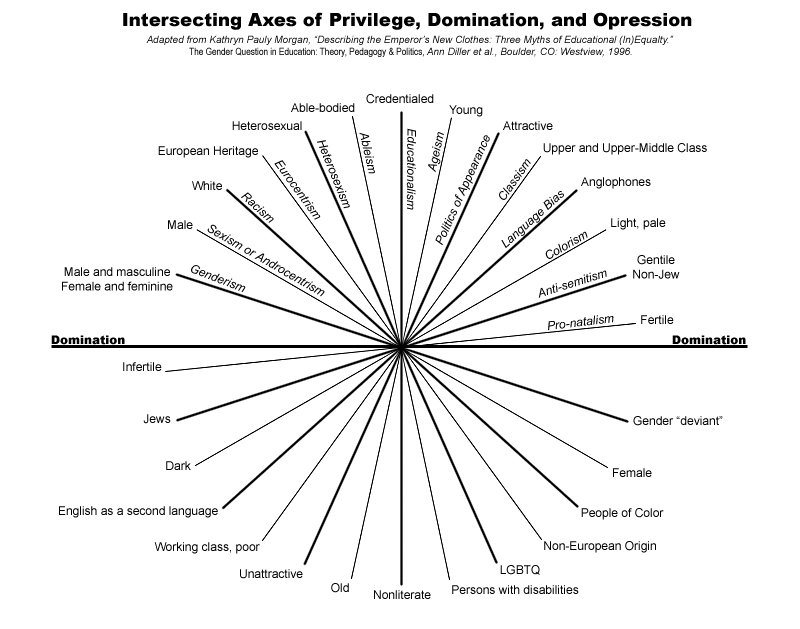
In reality, oppression exists in many ways, at many levels and on many axes at the same time. Drawn out with some sample axes, oppression might resemble something like this:

axis of privilege

When we think about the different forms of oppression that co-exist and how they intersect, influence and interact with one another, we are thinking intersectionally. The concept of intersectionality has been around since the 60’s and 70’s and was first explored by black feminists, in particular bell hooks.

So what?

Thinking about oppression and pursuing justice from an intersectional framework is the best (only?) way to avoid moving forward by throwing other marginalized groups under the bus. When we think in this manner a number of things become clear, of which I want to highlight a few.

First, communities or groups that experience oppression can at the same time benefit from and be complicit in the oppression of other groups.

Second, while the severity, lethality, and historical length of various forms of oppression can be recorded, measured and debated, all oppression is bad and we should be worked against to establish a more just society. Engaging in the “Oppression Olympics,” (where oppressed people argue among each other about who had it worse, and whose causes should get the most attention) is counter-productive and takes energy and attention away from actually addressing oppression.

Third, pursuing the end of one type of oppression by employing, supporting, condoning, ignoring or otherwise enabling another type of oppression is unjust, hypocritical, and privileges your group above others. Ending oppression is important, but how we end it also matters.

Finally, oppression thrives on divisions and in-fighting between the oppressed. When oppressed groups dismiss or diminish the experience of oppression in other groups and focus only on our own experience of oppression we are playing directly into the hands of those truly responsible for creating, maintaining, and benefiting from the racist, sexist, classist, (etc.) systems that govern our society. One article from Salon on #CancelColbert exemplifies this well: it features a black writer criticizing and dismissing Asian offense at Colbert because it undermined Indigenous offense at mascots. In this article, two marginalized groups criticize a third marginalized group, while the writing staff at the Colbert Report and Snyder are defended or go unmentioned.

Solidarity is the Solution

A man who has increasingly become one of my personal heroes, Fred Hampton, once said, “We gonna fight racism not with racism, but we gonna fight it with solidarity.”

The Colbert Report’s segment was at best problematically trying to fight racism with racism. This isn’t what we need to move forward towards a more just society.

Incidents like this and intersectional thinking point us to the solution Hampton and others have identified for years. What we need to move forward to a more just society is a long-suffering, humble and thorough solidarity among oppressed groups.

For the future, my hope is that we center our work around a categorically condemnation of all oppression, not just against the oppression that impact us. My hope is that we commit to supporting one another, instead of working in isolation or only on our interests. My hope is that do not think of our own communities or contexts as somehow categorically incapable of treating others unjustly, even as we ourselves are experiencing oppression.  My hope is that we non-defensively listen to other groups, humbly admitting where we are complicit in their oppression and working to correct our communities, even as we patiently help them see and address issues in their communities that impact ours. My hope is that we do not tolerate gains for our group when they come at the expense of others.

Such robust solidarity will take time and it will be difficult, but it is the only way to avoid stepping on others as we pursue justice for our communities and the only hope we have to create and sustain a just society.

Posted in Personal Commentary, Politics, Race | Tagged , , , , , , , , , | 4 Comments

Bill Nye, Ken Ham, and How We Can Debate Better

Hythlodaeus's avatarHythlodaeus Sayeth

For anyone who has been sleeping under a rock, Ken Ham and Bill Nye the Science gathered for what could be a rehash of popular stereo-types.  About a year ago, I wrote a piece on Bill Nye and Young Earth Creationism (YEC). This blog then will skim over the hits and misses that both men made in the debate.  As a caveat, I only watched the debate up until end of the rebuttals.  This was because that’s where the basic points were laid out, and because I ran out of shots of rum to keep me though this circus.  Without further ado, here’s how I think both men did and why we need to do better next time.

Bill Nye

Bill Nye made it clear throughout his debate that he had an axe to grind with YEC, not with Christianity in general.  This kept the debate from devolving into atheism…

View original post 1,337 more words

Posted in Uncategorized | Leave a comment

The Myth of the Melting Pot: Multiculturalism and the USA

The United States often sells itself as a unique multicultural nation, where waves of immigration have given us the benefits and richness of many cultures, languages and histories. When talking about our culture we often suggest our nation is a metaphorical melting pot where all the world’s cultures meet, get distilled down, and mix together forming a complex culture unique to the U.S.

This is something we would like to believe about our society, but in reality it is simply  not true. The U.S. has consistently pursued the dominance of one culture, namely “whiteness.” Foreign cultures are generally treated in one of three ways that have nothing to do with seeking their unique contributions our fabled unique culture. Overall this entire self-deception serves to hide the fact that U.S. culture is rather empty and avoid the problems that that emptiness brings.

The Culture of Whiteness in the U.S.

The USA has one dominant culture and that culture is “whiteness.” I have written about whiteness at length elsewhere but in short whiteness is an allegiance to ideals, values, beliefs, traditions and systems that have come primarily from Western Europe. While originally this culture was directly to skin color, it has evolved over time and today anyone who adopts these values and is loyal to these institutions and systems, including people of color, can be counted as part of the larger culture of whiteness even if they do not benefit from some of the perks that are still tied to having white skin.

It is whiteness, not some unique eclectic mix of cultures, that shapes our political, economic, education and legal traditions and systems. It is also whiteness that everyone, especially foreign immigrants, are encouraged and expected assimilate to.

If the U.S. acts like a melting pot, it is only to “boil down” the culture of new immigrants and dispose of any aspects of their foreign culture which might conflict with whiteness. Whiteness is the mold every immigrant is poured into and expected to conform to after arriving here and being melted down.

The Treatment of Foreign Cultures in the U.S.

The foreign cultures that immigrants bring with them to the U.S. tend to be treated in one of three different ways that have nothing to do with true multiculturalism. 

Foreign Cultures as a Threat

First, these foreign cultures can be seen and treated as a threat. Foreign cultures arriving and being preserved in the United States have always been a cause for fear. Benjamin Franklin complained about the Germans before we were even a nation and Nativists in the 1800’s complained about the Irish in the same way many today talk about Latin American immigration.

The fear behind these complaints is always that the preservation of foreign cultures in the U.S. will weaken our nation by undermining the cultural dominance of whiteness. The villain is always foreign immigrants who are not assimilating fast enough or even actively  resisting assimilation.

When critics decry the lack of assimilation among new wave immigrants it is important to note that it is assimilation to whiteness that they are talking about. Sometimes this language is hidden behind talk of “American values” or the “American way” but if one explores what people mean by this, one will find behind this language the values, traditions, loyalties and ideology the are whiteness.

Foreign Culture as a Token Proof of Multiculturalism

Second, some use aspects of foreign culture that do persist in the U.S. as proof that multiculturalism exists in the U.S.

Now it is true that some aspects of foreign culture are allowed to continue in the U.S. These are aspects of foreign culture that do not conflict with or threaten whiteness. These are aspects of culture that can be safely relegated to what we could call the private sphere of life. However, I do not believe these remnants of foreign culture prove that we live in a multicultural society.

To claim that we are a multicultural nation because vestigial remnants of these cultures are allowed to exist and even enjoy positive reception within our nation is to ignore how these cultures remain on the margins of our society as a whole.

What I mean by this is that while minor aspects of foreign cultures might be tolerated, displayed or even celebrated in the U.S., this does nothing to actually challenge whiteness’ continued dominance as the shaper and gatekeeper of every significant aspect of our society.

For example, we may enjoy a display of Native American dance, but we do not want a Native American understanding of land to displace our concept of private land ownership. We may rejoice in the spectacle of a parade that celebrates a specific Latin American culture, but that does not mean Spanish language is going to allowed to replace the use of English language anywhere in any significant way.

Foreign Cultures as a Novelty or Commodity

Finally, the third way foreign cultures often end up being treated on our shores is as a novelty or commodity. Various aspects of foreign cultures end up being treated as a buffet of quaint novelties to provide entertainment or commodities and resources that can be consumed or sold by those from the dominant culture of whiteness.  Cultural appropriation or commodification of foreign cultures by those who only knows whiteness serves to satisfy cultural and existential needs not met by whiteness. Examples of cultural appropriation and commodification exist in many aspects of our society but perhaps the entertainment industry offers up the most glaring example on a regular basis.

What is the myth of multiculturalism hiding?

If we are not truly a multicultural nation, then why do we often think of ourselves in this manner?  I would suggest the myth of multiculturalism , and uses of the remnants of foreign cultures as token proof of multiculturalism, novelties and commodities, all serve to hide the fact that the culture of whiteness is empty. But I will leave exploring this claim further in a later post.

Posted in Personal Commentary | Tagged , , , , , , | Leave a comment

Philip Seymour Hoffman, Addiction and Mental Health

A tintype of Philip Seymour Hoffman taken at this year’s Sundance.

Philip Seymour Hoffman was found dead of an apparent drug overdose last Sunday. After having been clean for many years, Hoffman relapsed in 2012 and entered residential rehab in June of 2013. Despite this effort his struggles with addiction continued and ultimately took his life.

Having spent time in 12 Step rooms and therapy dealing with my own issues with addiction and I cannot help but reflect on this incident and what it reminds us about addiction.

Addiction Doesn’t Care Who You Are: Hoffman was one of many wealthy successful people who nevertheless struggled with addiction. Addiction doesn’t if your collar is blue or white. Addiction doesn’t care what color your skin is.  Addiction doesn’t care how old you are. Addiction impacts individuals and families in all segments of our society.

Addiction Is Never Really Vanquished: Hoffman had been clean for over two decades before relapsing. While some do not subscribe to the saying, “Once an addict, always an addict,” it appears that even for those that have achieved many years of sobriety, falling back into the vicious cycle of addiction is always within arms reach. Relapse is a risk no recovered or recovering addict is completely immune to.

Addiction Can Be Lethal: Hoffman’s death was not a suicide or an accident; Hoffman succumbed to a mental health problem that is sometimes lethal. Everyone gets that cancer or a heart attack can kill you, but many people do not consider mental health illnesses in the same way. A number of mental health problems have shockingly low survival rates. For example, roughly 33% of people who struggle with anorexia will die from it, while only 5-10% of people admitted to a hospital for a heart attack die.

Addiction Is Misunderstood: Some people’s reactions to Hoffman’s death expose that mental health is still misunderstood in our society and still carries a stigma. Some suggested Hoffman deserved his death because he was a drug user. Others labeled him as selfish for putting his pleasure above his safety and leaving his wife and children without a spouse or father. These responses show mental illness is still understood by some as a moral defect or weakness rather than an illness. Because of this, instead of treatment and encouragement, those suffering from mental illness are met with condemnation and judgement instead. Can you imagine anyone suggesting that someone who passed from cancer was selfish for abandoning their family?

Addiction Sometimes Wins: Addictions is not a weak opponent. Addiction is not “just a bad habit” that can be overcome with discipline and a positive attitude. I’ve seen it consume entire families. I’ve seen the trauma it leaves in its wake stretch across generations. Even with support, therapy and treatment, sometimes addiction gets the better of people. Hoffman’s death reminds us that sometimes when you fight your demons, you lose. However, that doesn’t make the struggle any less noble.

Posted in Personal Commentary, Uncategorized | Tagged , , , | Leave a comment

Alone But Not Alone and The Christian Imagination of History

Recently the indie Christian film Alone But Not Alone made some waves when it was nominated for an Oscar for best song, a number sung by Joni Eareckson Tada. This was controversial because it was such an obscure film that only grossed $133,000. The nomination has since been rescinded.

The film itself is about a Christian family on the frontier that is attacked by Indigenous people in the midst of the French and Indian war, with a number of them being taken into captivity. One of the adult women is forced into a marriage and the children begin to be raised as Indigenous people before they make a daring escape. You can see the trailer for the movie here.

I came from Christian circles not unlike the one that produced this movie.  I have been familiar with Eareckson Tada’s personal story for some time and it is inspirational. However, I have also been attempting to stand in solidarity with Indigenous people, primarily in the Canada and the U.S., as they attempt to sort out decades of injustice. Because of this I could not help but wince as I watched the trailer for this movie and notice glaring issues with the story.

The movie relies upon a very selective retelling of history in order to pain Christians in a positive light. It reinforces this skewed version of history into its viewers and reinforces racist stereotypes about Indigenous people. In this Alone But Not Alone is another example of what I would call the Christian Imagination of History. In this post I will explore some aspects of the film to explain what I am talking about and why the Christian Imagination of History is problematic and dangerous.

Let’s begin.

alone-but-not-alone

Sexual Violence

As this poster highlights with its composition and content, one of the main sources of tension and fear in Alone But Not Alone is the forced marriage of a white woman to an Indigenous man and that man’s pursuit of the white family when they flee. The narrative of “Scary black/brown man wanting to rape a white woman” is older than the founding of this country. Alone But Not Alone uses this narrative to titillate audiences even as it reinforces stereotypes about men of color.

While Alone but Not Alone might be based on a true story, and the undertones of sexual violence might be an unavoidable part of telling that story, the story of this family is an extremely rare exception to historical reality of the day.

The true history of sexual violence in the U.S. and Canada was basically exactly the opposite of what is present in Alone Yet Not Alone.

White women, even those captured in raids, had little to fear from Indigenous men. Even colonial European sources show that Indigenous people rarely committed sexual violence against their prisoners.

This reality is encapsulated in the words of Mary Rowlandson, who after having been captured by Indigenous people, later said:

“I have been in the midst of roaring Lions and Savage Bears, they feared neither God nor Man, nor the Devil…and yet no one of them even offered the least abuse of unchastity to me in word or action.”

Additionally, instead of fleeing from their captors, 40% of white women captured by Indigenous people between 1675 and 1763 chose to remain with their new communities.

Anyone seeing that number needs to ask themselves why 40% of kidnapped people would voluntarily choose to remain with their captors. Was it a manifestation of what we now known as Stockholm syndrome? Was it that they had nothing in their old lives to go back to?

It has been argued that one of the main reason these women chose to stay is the fact that many Indigenous communities were literally centuries ahead of Western culture when it came to gender equality.

In many Indigenous communities women served as spiritual, political and military leaders and societies were organized according to matrilineal descent. While specific types of work were gendered both types were also valued equally.

It seems white women had more to fear from the oppressive patriarchy of Western culture, which was supported theologically by Christianity.  It was white men who burned white women at the stake as witches in a form of gender violence aimed at culling free thinking women. It was white men who during this era could punish women for expressing their opinion by nailing their tongues to a tree.

On the other hand Indigenous women (and women anywhere European colonialism went) were sexually assaulted and violated in the most heinous of ways by white men. The white men who participated in such acts faced no consequence or censure for their acts. The theological argument put forward by Western Christians that non-Europeans were sub-human and made to serve white people no doubt provided passive support for the routine experience of sexual violence women of color experienced.

Maybe the creators of Alone Yet Not Alone were attempting to be true to the story the film was based on, and they were not intentionally demonizing Indigenous men to provide a villain to counter their Christian protagonists. Regardless, the fact that this story represents the exact opposite of what was really happening in regards to sexual violence during that era cannot, and should not have been, ignored.

Kidnapping Children and Forced Assimilation

The other main source of tension in Alone Yet Not Alone is the that some of the captive white children begin to be raised as Indigenous children. The test these children face is to hold fast to their Christian faith in the midst of Indigenous spirituality and customs and resist the temptation they face to change who they are.

Again, the reality of this narrative and tension is the exact opposite of what is presented in this movie.

First, would it really be bad if a white child was raised as an Indigenous person? I mean would a child socialized into a sustainable culture with gender equality and an inclusive understanding of LGBT people be the worst thing that’s ever happened?

Second, so many Europeans voluntarily adopted Indigenous ways and practices that it actually became a great concern for colonial empires who were attempting to establish cultural dominance over the land they wanted to exploit.

Third, and perhaps most importantly, if taking a child by force and raising them in a foreign culture is immoral or wrong, then the moral high ground on this issue clearly goes to Indigenous people.

Survivors of the Carlisle Indian Industrial School.

Survivors of the Carlisle Indian Industrial School.

The governments of both the United States and Canada, with the support of both Protestant and Catholic Christians, formed Indian schools and later residential schools for Indigenous children aimed at assimilation. Indigenous children were often forcibly taken from their parents in massive numbers and forcibly assimilated into white culture. The infamous attitude of the day was “Kill the Indian, save the man.” These schools were rife with physical, emotional, spiritual and sexual abuse. There are literally residential schools in Canada that have mass graves where child and animal bones were found buried together. These schools operated for many decades with the last one closing in 1996.

Sure, it may have been unjust for the white children in Alone Yet Not Alone to be captured and raised in a foreign culture. However, to employ this tension and ignore how the exact opposite was true and ignore how the forced assimilation of Indigenous people by Christians was far worse in scale, severity and length of time, is a slap in the face to Indigenous people.

The Christian Imagination of History

The makers of Alone But Not Alone highlighted a story that celebrates Christians and the Christian faith. This story conveniently side-steps the much larger systemic injustices of the day perpetrated or supported by Christian communities. By casting Indigenous people as the primary villains of the story, the oppressor is insultingly pretending to be the oppressed.

In employing a selective retelling of history to reverse the true roles and dynamics of injustice Alone But Not Alone is well…not alone. Christian culture in the United States and Canada rely upon a hazy collection of myths, half-truths and narrowly selected stories to form their understanding of these nations and the enduring nature of our societies. By relying on this false understanding, Christians can see themselves in an unblemished positive light. I call this phenomenon the Christian Imagination of History.

The Christian Imagination of History is why films like this get made. It is why family members of mine thanked the Pilgrims at our last Thanksgiving meal. It is why many Christians remain ignorant of a lot of injustices in the world perpetrated by Christians. It is why Christians  become uncomfortable, annoyed, or defensive when the topics side-stepped by their imagination of history, like the genocide and displacement of Indigenous people or slavery, are brought up.

To be fair it is human nature to want to see oneself in a positive light. Because of this many (all?) individuals, families, communities and societies tend to remember their past very selectively.  We all tend to gravitate towards the stories and parts of our past that makes us look good while downplaying or ignoring parts of our past that are embarrassing or outright immoral. Considered in this light, the Christian Imagination of History is not unique and to an extent is to be expected, but that does not make it right nor does it make it safe.

Why this Imagination is dangerous to everyone (including Christians)

The Christian Imagination of History is incredibly dangerous and needs to be addressed. The reliance upon the Christian Imagination of History in Christian culture keeps Christians from admitting responsibility for past misdeeds and maturing. It keeps those in Christian culture from recognizing and ceasing their present-day support or participation in current injustices. It prevents or hinders any sincere effort to preventing future similar issues from arising.

To look at it another way, in what world would watching Alone But Not Alone (or consuming similar Christian books, sermons, movies, songs, etc.) ever incline a Christian in Canada or the U.S. to begin to address the litany of injustices that have occurred since contact with Europeans and persist to this day?

Finally, I would argue that even Christianity as a whole loses when the Christian Imagination of History continues to reign. Those who are called to follow Christ are called to provide justice and aid to the poor, marginalized and oppressed. This is a consisten them throughout the Bible, present in every stage of the Judeo-Christian tradition. Looking at history through such a false and self-flattering lens keeps people unaware, content and inactive when they should be paying attention, pissed off, and active. In its worst manifestations, the Christian Imagination of History serves to keep Christians squarely in the role of the oppressor regardless of if they recognize it or not.

These injustices are also not locked safely in the past.

To that point I want to make it clear to my Christian readers that Indigenous people continue to face racial injustice, most of which is ignored or even sanctioned by the larger Christian communities in the United States and Canada.

In regards to sexual violence Indigenous women face the absolute worst rates of sexual violence in North America. Indigenous women are 2.5 times more likely to experience sexual assault when compared to any other demographic According to the CDC 26.9% of Indigenous women will experience sexual violence in their lifetime. 17% of Indigenous women will be stalked in their lifetime.

The majority of the offenders in these situations are not Indigenous; 57% of the time it is white males who are the committing the sexual offences Indigenous women endure. Often offenders often get away with no penalty, even when identified, due to the complicated legal relationship between Tribal governments and the governments of Canada and the U.SIn 2011, 65% of the rape cases on Indigenous reservations were not prosecuted. This statistic is even more alarming when it is considered that many rapes go unreported.

While these stats present a glaring call to action this issue is largely ignored or even actively worked against. When the Violence Against Women Act of 1994 was put again before Congress in 2012, they House of Representatives attempted to approve this legislation without additional protections for Indigenous women that would close some of these legal loopholesThe majority of the House of Representatives identify as Christians.

It appears society is also content with attempting to reinforce the concept of brown men as violent and prone to sexual violence despite the statistical reality. A search of major news articles regarding sexual violence in Indigenous communities from 1998-2004, found that the coverage was almost completely limited to instances where the suspected perpetrator was Indigenous (or identified as Indigenous) and the victim was a white woman.

The forced assimilation of Indigenous children continues as the residential school system has morphed into the adoption system. Even as heads of state apologize for the residential schools and the abuses that happened within them, the rates of Indigenous children forcibly taken from their parents and put in the foster care system and up for adoption has reached staggering levels. It was reported at Congressional hearings on the subject that 25% of all Indigenous children were either in foster care, adopted homes, or boarding schools. Perhaps this is in part due to the fact that the State makes thousands of dollars for each child it takes from Indigenous families.

Taken in disproportionate numbers and often then placed with white families, the adoption system has become residential schools 2.0. The Indian Child Welfare Act was supposed to end this type of practice, and place Indigenous children with Indigenous families, but the state is largely failing to do so.  This issue was recently highlighted in the controversy that erupted regarding Baby Veronica.

Closing Thoughts

If Christian communities in the United States and Canada are going to do more than live out the status quo of history, a status quo where Christians exploit and oppress other people and then forget about it, these communities must meaningfully own their past. Spinning tall tales, myths and cherry picked stories like Alone But Not Alone that distort or conceal the truth hinder any meaningful progress towards atoning for past mistakes and working with other communities towards ending present injustices. A true and accurate account of history is a necessary first step towards a better present and a better future.

This whole project might be an uncomfortable or even painful process, as Christian communities must lay down their natural defensiveness, listen to other communities, accept responsibility for past issues and allow themselves to be taken down a notch.  However, this process must happen for Christian communities to make tangible progress towards achieving the goals, morals and ethics they themselves espouse.

[Author’s Note: I want to thank the many Indigenous people who have patiently talked to me about many of these topics over the years. Additionally, I am deeply indebted to Andrea Smith as much of my information and references, especially regarding sexual violence and gender relationships during the colonial era, come from her book Conquest: Sexual Violence and American Indian Genocide.]

Posted in Personal Commentary, Politics, Postcolonial, Uncategorized | Tagged , , , , | Leave a comment