Who I will listen to regarding the violence in Gaza and Israel…

Every morning this last week in the group home I work at we have been watching the new regarding violence in Gaza and Israel.  I have heard again the standard array of apocalyptic predictions from Christian friends of mine, and have heard a ton of chatter from all types of media demonizing both or either side.

Certainly the situation and violence in the Holy Land is incredibly complicated.  I used to be, like many American Christians, uncritically pro-Israel but I really did not know why. In the last several years I have become a lot more sympathetic and critical of both sides, as I’ve become increasingly aware of the complex issues that surround the whole situation.

As a follower of the Way of Jesus I am a committed pacifist and am thoroughly convinced violence only breeds hatred and more violence. Any Palestinian who launches a rocket at Israel and any Israeli who fires a missile at Palestine is just participating in and perpetuating this cycle of violence.

Whoever “started it” is now irrelevant and such arguments inevitably rooted in the various one-sided histories both sides are deeply and understandably entrenched in.

For my part, I am a lot more concerned with who will end it.

As an outsider, when I see pictures of dead children I do not see dead Palestinian children or dead Israeli children.

I just see dead children.

When I see pictures of people cowering in fear for their lives, I do not see Palestinians or Israelis living in fear.

I just see people living in fear.

And I wish the world was not like this. I wish it could be different.  I wish the Holy Land could know a lasting peace and true justice.

As I have spoken out, against and for both sides on different issues, people have criticized my stance and suggested I am just participating in propaganda from the IDF or Hamas.  There are many competing voices on this issue and I have to own the fact that I have not studied these issues incredibly deeply, nor do I live in Gaza or Israel.  I live in safe and sunny Pasadena California. I do not know the realities in Gaza and Israel, the only illegal settlement I am familiar with is our state (which resides on stolen Native American land), I do not suffer under a blockade, I do not have terrorist groups threatening my existence, I have not lost loved ones in any sort of bombings or airstrikes and the hardest border crossing I have had to make was into Canada.

There are many people who are more invested and informed than I about these issues, so who should I listen to?

I think I’ve come to a way to filter who I’m willing to take:

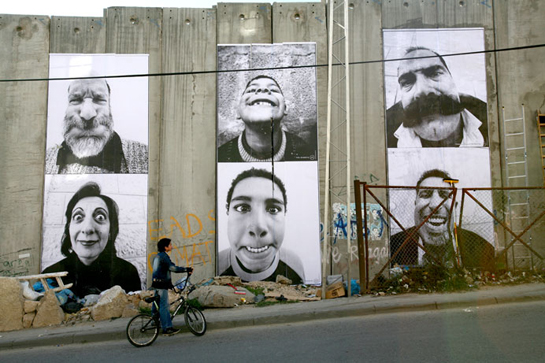
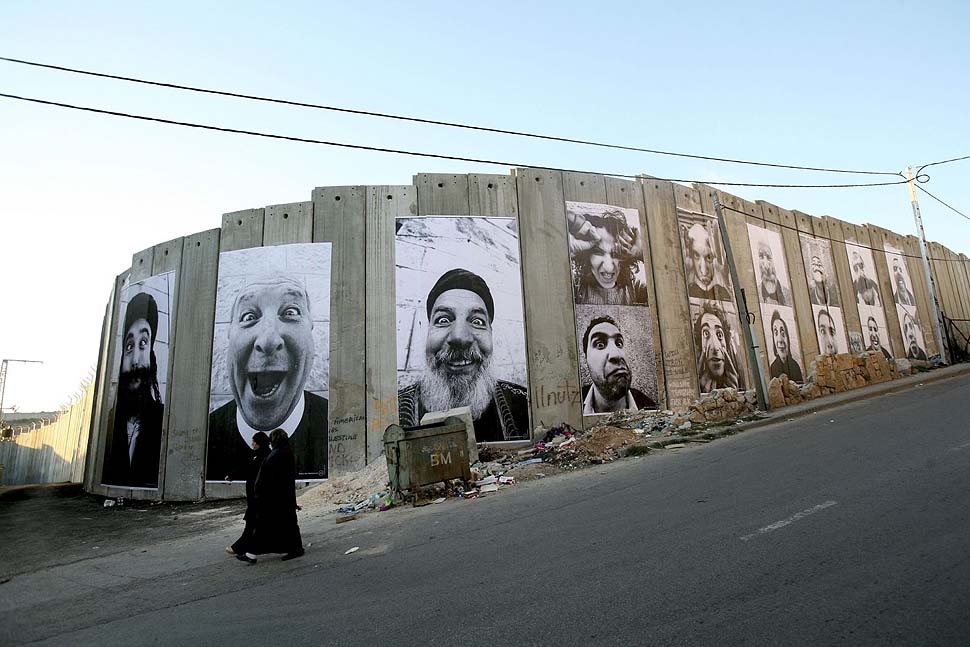
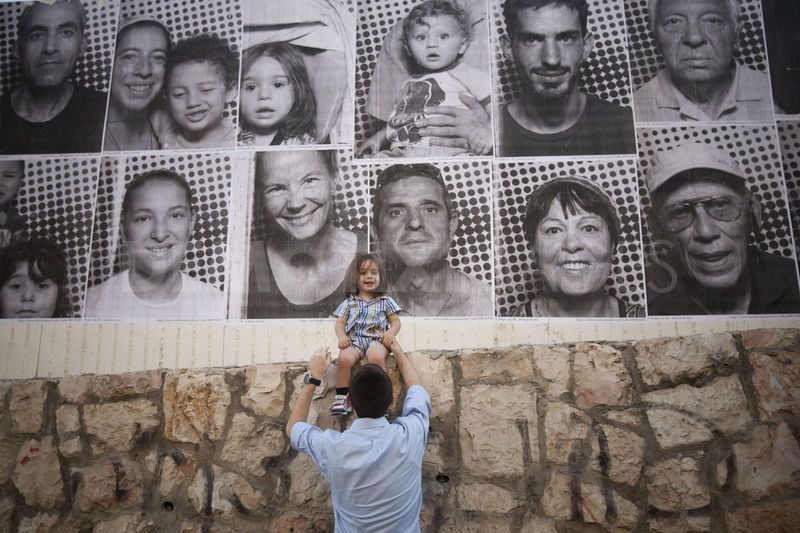
JR, a French street artist and urban activist, did a project called Face 2 Face where he set up gigantic pictures of Israeli and Palestinian citizens.

If you can tell the difference between who is Palestinian and who is Jewish, I’ll listen to you.


P.S. Just a hint, when JR asked many Israeli and Palestinians who live in these cities every day to differentiate between the two groups from the photos alone, most of them could not.

Posted in Uncategorized | Leave a comment

This Black Friday, Boycott Wal-Mart and Buy Native!

Tomorrow is Black Friday, the day after Thanksgiving that has becoming a day in the United States that is infamous for deals and sales leading for Christmas shopping.

This two-day span represents an overdose of two things that are deeply problematic about the U.S.A.: a white-washed history that is ignorant of the consequences of colonialism and mega-corporations running rampant with our economy and politics.

The standard narrative about Thanksgiving celebrates the friendship of the Native Americans and the Pilgrims.  Reality was a lot more messy. The Pilgrims were indeed saved by Native American friendship as they had no clue how to survive in this new land, but the Pilgrims had already raided Native American burial grounds in search of treasure. The arrival of the Pilgrims and other early Settlers also ushered in an era of injustices, betrayals, broken treaties, physical and cultural genocide and oppression that continues to this day. We give thanks for all that we have, but the cost of all that we have has been offloaded to Native American people who were decimated as we took the land we now live on.

Over the last several decades corporations have gotten larger and larger and more and more of the products we use are owned by single corporations.  Also, these corporations also own the politicians we think we vote for.  Money influences public opinion and the candidate with the most money usually wins.  When corporations are donating large sums of money to politicians who will be in charge of regulations that will impact the profits of these corporations…well, I think we can all agree this is at least highly problematic if not an outright perversion of democracy. Buying large numbers of goods from corporations for Christmas gifts only fuels their profits and increases their control over our society.

I encourage everyone two take two simple actions tomorrow in an attempt to address both of these issues and kill two birds with one stone.

First, join and support the workers of Wal-Mart by boycotting Wal-Mart tomorrow.  The family that owns Wal-Mart is in the upper echelons of wealth in the U.S. and they are  treating their workers like crap.

Second, do not buy your gifts at all at Wal-Mart stores or other corporations.  While the cuts these companies take and make might make their prices lower than competitors someone, somewhere is paying for it.  It is probably their workforce or some poor person in a third world country that is getting the shaft. Continuing the participate in the corporate economy is sometimes unavoidable but this time it is.

Instead of buying your gifts there, buy them from a store on the Buy Native campaign’s list.  Buy Native is a campaign started by Beyond Bucksin, and it is essentially a campaign to encourage people to buy from Native American owned and operated stores and/or Native American artists. Not only are these gifts unique and authentic but these gifts will help empower small local communities, businesses and markets here in the United States.

Part of the legacy of colonialism is that Native American reservations are plagued with the highest rates of unemployment in the U.S..  The unemployment rate on reservations usually hover around 70-80% unemployment. And we freak out and complain about 8% unemployment!

Native American artists, craftsmen/craftswomen, and entrepreneurs are taking full advantage of the internet and by buying their good you are helping people and communities that have it much worse than your lowest paid Wal-Mart worker. You would be at least doing something to address the gross inequalities colonialism has led to here in these United States.

Posted in Uncategorized | Leave a comment

Dear TooSoonJunes:

@TooSoonJunes,

I honestly appreciated the fact that you took the time to respond to my accusation of racism so I decided to take equal time responding to your questions and arguments.  I could not do this on Twitter so I hope you don’t mind me writing this post just for you.

@TooSoonJunes: I’m RACIST?! Dude I have Native American ancestry!

I am not outright accusing you of lying but a lot of people have “Native American ancestry” but what they mean by this is that there is family lore about a Native American in their family tree somewhere.  While it would not be my place to suggest how to delineate who is and who is not a Native American if they are claiming it, such a claim by no means indicative of any actual substantial connection to Native American culture.  Someone who was deeply connected to the Native American culture wearing such a costume would be and I know a number who have or who planned to do this.

So let me ask you a few questions. What tribe are you from? Did you grow up on a reservation or a NA community of any sort? Do you participate in ceremony? Do you speak any of your indigenous language?  How have serious issues regarding mental health, poverty, addiction, tribal sovereignty and cultural appropriation impacted you as someone of Native ancestry?

I am not asking these as a litmus test where if you say no I am going to say “Well then you’re not Native!” (Again that is not my place) However, I do want to highlight claiming “Native American ancestry” is not a “Get out of Jail free card” from any racist accusation regarding one’s behavior.

@TooSoonJunes:”How is me going out in a headdress racist? Did I take a tomahawk? NO.”

I’m confused.  Your words imply that if you had a tomahawk it would be racist but because you only had a headdress it is not? Are you suggesting Native American costumes are only racist if specific props are present and others are absent?

As for why I believe going in a headdress is racist I wrote a short post on this.

@TooSoonJunes: So I’m racist because of what I wear. Sure. Because I’ve seen slaves, shackles, and blatant offensive costumes more than a headdress.

If someone dressed as a slave or went in blackface this to me would be equally offensive.  I think we can all agree that costumes that portray specific ethnic groups are in poor taste and should be avoided.

That being said, right now search Twitter for “slave costume.”  Then search “Native American costume.”  When I did this earlier, all I found for “slave costume” were hits to Princess Leia costumes that had nothing to do with black slavery.  When I searched “Native American costume” I got a ton of people, including you.

Dressing up as a Native American is perceived as far more mainstream and socially acceptable than dressing up as a slave. While slave costumes would be instantly criticized for some reason we are okay with Native American costumes?  Why is there a double-standard?

 @TooSoonJunes:But do I troll the fuck outta twitter? No.You can’t call me racist – it doesn’t affect you.

I am not Native American and have never claimed to be.  I am also not going to be personally harmed in some abstract psychological way if you do go as a Native American for Halloween.

However, there are a group of people who will be hurt, minimized, marginalized and stereotyped by your participation in this socially accepted form of racism.

If you doubt me, I suggest you read the American Psychological Association’s condemnation for Native American mascots.  While they are not discussing costumes per say, I think many of the reasons transfer over very well.

@TooSoonJunes:But you won’t try to make me out as a bad person because of a costume choice. not a lifestyle choice of embracing social racism

You are indeed participating in social racism.  The fact that you apparently did not understand how you are is why I commented on your post in a rather gruff manner.

@TooSoonJunes:I know exactly what a headdress means in NA culture, which is why I wore one.

I would never claim to be an expert on various Native American regalia, or the Native American ancestry you are claiming and their particular tradition but from my understanding War Bonnets were not intended to be worn as party costumes nor by women.  I’m fairly certain of that.

@TooSoonJunes:Did I dress up as the ‘sexy indian’ you troll for? No. I’m no insensitive. But you can have a huge heaping of kissing my ass trying to make me feel bad.

You are certainly not insensitive and reacted strongly to being accused of being a racist. That is a good thing.  However, I would encourage you to think about what I have written to you.  We all have blind spots and if you were raised in the mainstream U.S. society I would argue you are basically pre-conditioned to ignore and be dismissive of Native Americans. What we did to them is a dark part of our history that we gloss over and choose to remember only in myth and stereotype because the brutality and evil of what we have done and continue to do is horrendous.

Posted in Letters between friends | Tagged , , , | Leave a comment

Calling Out Socially Acceptable Racism

This pretty much sums up this post in a picture.
Source: @MissGreyDay

Last night I received my first Twitter suspension. I also had some friends on Facebook give me flak regarding the tone of my responses that led to the suspension.

All of my replies were in response to Tweets that came up when I searched “Native American Costume” in Twitter… and was appalled.

The reason I commented enough to get reported and suspended is that dressing up as a Native American or First Nations person for Halloween is inherently racist.  It perpetuates stereotypes. It also trivializes and homogenizes various, cultures, tribes and the injustices they have suffered.

It is also socially acceptable.

Our society accepts racism against Native Americans and the approval of Native American costumes compared with the instant condemnation of other ethnic costumes is evidence of this much larger issue.

But what do I mean by this?

Dressing up as Latino stereotypes for a school rally day?

The Wider Society Says: CONTROVERSIAL! RACIST! UNACCEPTABLE!

Dressing up as a stereotypical Asian man?

The Wider Society Says: CONTROVERSIAL! RACIST! UNACCEPTABLE!

Dressing up in blackface?

The Wider Society Says: CONTROVERSIAL! RACIST! UNACCEPTABLE!

Yet all of this…

Source: @abbzhodoe

Source: @mcsweeneyx3

Source: @frannycescah

Source: @paraproff

Source: @angelasalvagno

Source: @virgotimes2

Source: @alud2011

Source: @mariaorjuela

Source: @l_gibby

Source: @jaynapatweezi

Source: @darkfaerie89

Source: @breezyjunkieee

Source: @aritheheiress

Source: @emilydelrayle

Source: @10sanityFTW

Source: @jvanity00

(All of the above pictures with sources were taken from Twitter tweets that occurred within an hour last night. I have to note that it was shocking to me that so many ethnic minorities wore these costumes.)

And *ALL* of these pictures….

The Wider Society Says: Totally cool. They are honoring Native Americans…they are just having fun…these people claim Native American ancestry…these are not racist costumes…so its okay…

I guess the Civil Rights Movement was only for certain groups and racism only counts against some minorities but not all.

Society as a whole does not condemn these outfits and they are even considered fashionable at the moment. While all hell breaks loose over other racist costumes, these tend to go without notice to the point that many consider it a legitimate or even fashionable option. Seriously, even progressive websites listing racist costumes conspicuously forget Native American costumes. I honestly did not attend a Halloween party yesterday because if I ran into a well-educated white and affluent peer of mine dressed as a Native American I do not know what I would do.

But what do Native Americans think of these costumes?

While the people whose costumes I commented on offered the normal array of defenses and justifications, I wondered what actual Native Americans thought of these costumes.

Native Appropriations has written a number of articles about why these costumes are racist and various appeals to discontinue them. (One, two, three and four posts actually.)

David Treuer wrote a succinct article on the appropriation of Native American culture, stereotypes and myths about Native American culture that Native American people are supposed to fit, and how this has been a common thread throughout U.S. history.

The 1491s have done videos that have highlighted the double-standards with both their content and the reaction to their content.

In conclusion…

I do not believe most people who wear these costumes are malicious in their intent. I honestly think many people would have the same attitude and questions as the women above did in the last video.

We all have blind spots and if one was raised in the mainstream U.S. society I would argue one is pre-conditioned to ignore and be dismissive of Native Americans. What we did to them is a dark part of our history that we gloss over and choose to remember only in myth and stereotype because the brutality and evil of what we have done and continue to do is horrendous.

However, malicious or not, pre-conditioned or not, people who wear these costumes are participating in socially accepted racism.

These costumes are racist because they make a mockery of traditional Native American regalia, which often have spiritual and personal meaning.

These costumes are racist because they are based on stereotypes, not reality.

These costumes are racist because (especially for the female costumes) they contribute to the sexualization of Native American women.  Native American women are 10 times more likely than white women to be victims of sexual assault. Part of this reason is that they are seen as inherently “rapeable” by the dominant society and sadly often even within their own society due to their sexualization and fetishization which these costumes contribute to.

Perhaps most importantly, these costumes are racist because they are worn by people who live on what was originally Native American land.  Physical and cultural genocide and countless injustices were used to take possession of these lands. Making a mockery of the culture that has suffered  so much so our comfortable 1st world existence is rather uncaring and ignorant.

In short, to accept these costumes, but not black face costumes, or slave costumes, or costumes of Latinos, or Asians, or Middle Easterners, or White people is inconsistent and represents a double standard. This double-standard points to the larger issue of socially acceptable racism against Native Americans present in our society.

So stop it.

Posted in Personal Commentary | Tagged , , , , | 101 Comments

Columbus and Contemporary Christianity

Yeah. It’s going to be that kind of post.

Today is the Columbus day, which is a day we celebrate Christopher Columbus for “discovering” the “New World.”  This holiday has been heavily criticized, especially by Native Americans in the U.S.A. It is seen as celebrating the “discovery” of a land that was already known and inhabited by people. It is seen as commemorating an event that led to colonization and all of the evils and injustices that went with it.

There are many efforts and articles around today that suggest we need to think and reflect on colonialism, indigenous rights, indigenous cultures, and a variety of things other than Christopher Columbus. Some have talked about replacing Columbus day with a National Indigenous Day or a National Day of Mourning over the evils of colonialism. I support these efforts and similar ones.

With one exception…

However, there is one group of people that I think still needs to focus and study Christopher Columbus: contemporary Christians, especially those in the U.S.A and Canada.

I say this because the life, faith and exploits of Columbus, when rightly understood, should serve as a cautionary tale to most Christians and be a prompt for some serious personal and communal introspection.

I say this because the faith, theology and beliefs that drove Columbus to commit heinous acts, fully believing he was serving God and his country, are still alive and well today in the U.S. and Canada.

Columbus was an evil person and a sincere Christian

To begin, I want to re-post some of my comments about Columbus from an earlier post. In that post I argued that a sincerity of Christian faith does not make one immune or categorically incapable of participating in evil injustices contrary to the teachings of Jesus Christ. (The full post can be found here.)

From my previous post:

…let us begin by considering Christopher Columbus and colonialism.  Washington Irving wrote of Christopher Columbus, saying:

“He was devoutly pious: religion mingled with the whole course of his thoughts and actions, and shone forth in his most private and unstudied writings. Whenever he made any great discovery, he celebrated it by solemn thanks to God. The voice of prayer and melody of praise rose from his ships when they first beheld the New World, and his first action on landing was to prostrate himself upon the earth and return thanksgivings. Every evening the Salve Regina and other vesper hymns were chanted by his crew, and masses were performed in the beautiful groves bordering the wild shores of this heathen land. All his great enterprises were undertaken in the name of the Holy Trinity, and he partook of the communion previous to embarkation. He was a firm believer in the efficacy of vows and penances and pilgrimages, and resorted to them in times of difficulty and danger. The religion thus deeply seated in his soul diffused a sober dignity and benign composure over his whole demeanor. His language was pure and guarded, and free from all imprecations, oaths and other irreverent expressions.”

Columbus by this and other accounts was sincere in his faith, even to the point of not cussing. He was also completely for the exploitation of the new land and the enslavement of its people.

“After returning to Spain and reporting on the incredible wealth in the islands of the ‘New World,’ the monarchs gave Columbus 17 ships and more than 1,200 men to plunder the Caribbean. His new expedition went from island to island gathering slaves and gold with unprecedented brutality.

Opening the continent to slavery Columbus was the first European slave trader in the Americas. He sent more slaves across the Atlantic Ocean than any individual of his time-about 5,000. He and his men captured and enslaved the Arawak people almost as soon as they landed. Some were sent to Spain and others served Columbus on the islands. In 1496, Columbus jubilantly wrote Spain’s King Ferdinand and Queen Isabella about the possibilities for exploitation in the West Indies: ‘In the name of the Holy Trinity, we can send from here all the slaves and brazil wood which could be sold.’

In Hispaniola, Columbus and the Spanish set up a system that made every Indian over the age of 14 responsible for gathering a certain amount of gold each month. They received copper tokens to hang around their necks if they succeeded. If an Indian was caught without a token, the Spanish cut off their hands and let them bleed to death.” (Source: Banderas News – italics and bolds mine)

This observant Christian was completely fine with participating in these evils. To make it worse, Columbus did not participate in these evils despite his sincere faith, Columbus’ faith was part of the reason he was so rapacious in his desire to exploit the New World. Columbus was not simply an imperfect and sinful but otherwise sincere Christian; Columbus was a sincere Christian, fully shaped by the faith and cultures of his day, and that is why he committed heinous evils believing himself to be righteous.

Writing home to his monarchs Columbus claimed that the Gold he sent back from the New World, which he was claiming was Tharsis and Ophir, would fund 100,000 foot soldiers and 10,000 cavalry for the retaking of Jerusalem. Columbus envisioned the exploitation of the New World would fund the retaking of Jerusalem from the Muslims, which he saw as a Christian duty. (Source: Columbus and the Quest for Jerusalem, by Carol Delaney)

Due to the colonization that followed Columbus’ “discovery” of America the Native American population which had been estimated to number around 8-12 million pre-contact was decimated to around 250,000 individuals at its lowest point in 1900.

Entire tribes, languages and cultures no longer exist.

So what problems did Columbus have that are alive and well today that I think Christians need to think about more?

1. Sincerity of Faith Leading to False-Justification

Columbus was sincere in his faith.  He was also involved in heinous evils.  He also (I would argue) did not believe his actions were justified. I say this because I believe Columbus did not believe his actions needed justification; he truly believed he was doing God’s will and God was showing favor to him for it.

This same faith is practiced today around the world.  The masses, vespers, petitions ad pilgrimages would be recognizable to many Christians the world over.  Sadly, Columbus belief that his actions were inherently good and in no need of justification and representative of the will of God is also widespread.

Many Christians today, in my experience, have the same basic mentality, which is why I wrote my previous post. Many Christians believe they or others are categorically above injustices or evil because, “their hearts are in the right place” or God is on their side, or they are involved in the right kind of Christian sect. They misconstrue the benefits of the injustices and evils they are participating in with the blessing of God and therefore continue to perpetually justify their actions.

Christian history is riddled with examples of gross injustices going hand in hand with sincere Christian faith and Columbus’ example should force us to grapple with the ways in which we may be participating in evil and calling it God’s will.

2. An Odd Obsession with Israel

Christians have an odd obsession and fascination with Israel. I believe this originates from the fact that the Judeo-Christian God being quintessentially the God of Israel, the majority of the Bible is concerned with Israel, and there are prophecies that refer and apply to Israel,  yet Christianity has understood itself as a religion completely distinct from Judaism.  A robust theological definition and understanding of Israel is lacking in Christianity as we have understood ourselves to be a new religion that the God of Israel initiated in Jesus after he apparently gave up on Israel. Yet the scriptures are still deeply rooted in Israel.

This has led to a situation where Christians believe Israel is really important to God, but don’t know exactly what Israel  is or why it is important to God.

This has left Christian beliefs about Israel, Jerusalem and the Holy Land open to speculation, bad theology and widely but dimly held beliefs on the subject. This has led to all kinds of errors in practice and belief whose impracticality, implausibility, and lack of substantiation do not undermine how seriously people take them and how central they believe they are to faith.

This was true for Columbus, who was preoccupied with retaking the Holy Land, and it is just as true, if not more, so today.

In the U.S. especially there is an obsession or preoccupation with the fate of the nation state of Israel that was recognized/created after WWII. In this U.S. this is mostly due to the dispensationalist stream within Christianity and Christian Fundamentalism, about which I have written elsewhere.

For example, here is a screen grab from a recent comment on my Facebook:

Consider this statement: “It is clear in the bible about what happens to those who do not support Isreal which are his chozen people!!”

Notice that the assumption that the present-day nation-state of Israel is equated to the Israel of the Bible.

Notice that the verses or teachings that are “clear” from the Bible are not explained or explored.

Moving on, consider this statement, “Thats why we are in the state we are in.  This president does not stand with Israel. He is a muslim why would he????”

Notice the political blame shifting.  The entire economic and global situation in the U.S. is assumed to be punishment from the Judeo-Christian God because the U.S. elected a stealth Muslim President that does not back Israel. It has nothing to do with capitalism, or bank executives, or our government, or the politicians we have put in power, or the decisions we make regarding finances, or our reliance on the military-industrial complex, it is all the presidents fault for not supporting Israel.  This implication abdicates everyone and everything, so we do not need to stop and consider our ways, admit wrong doing, or change anything.

Columbus beliefs about Israel motivated some injustices.  Our present day beliefs about Israel encourage many Christians to adopt an uncritical pro-Israel stance where the modern-nation state of Israel and all efforts to support it are, by default, above moral questioning.

At the same time I highly doubt this person, or  the vast majority of U.S. Christians who are innately pro-Israel, could articulate exactly why they are pro-Israel but don’t really know why.

Politicians and religious leaders know this. Pro-Israel candidates can garner a large voting block for coming out strong for Israel.  This is why the GOP is heightening their pro-Israel stance in contrast to Obama…

Example?:

Here we see a clear example of a right-leaning news source highlighting the GOP/Romney with Israel/Netanyahu in an effort to increase their pairing for political gain.  The message is clear: Romney is pro-Israel (whereas Obama is against Israel). This taps into any conspiracy theories about Obama’s faith and the dim theology that exists in the imagination of many Christians regarding Israel. It is enough to get many Christians in the U.S.A. to vote for the GOP candidate and it is a reliable strategy used rather routinely.

3. Support for Imperialism

Notice that Columbus was sending money back to his monarchs so they could invade another country and expand their empire.  A sincere Christian was participating in injustice and colonialism for the benefit of the wealthy aristocrats who were pursuing a colonial agenda all the while thinking he was doing God’s will

Much the same continues today.

The continued colonial practices of the U.S., Canada, Israel and other nations are accepted or even supported by well meaning and sincere Christians. In North America especially Christian in both Canada and the U.S. have turned a blind eye or directly supported the continued genocide and colonization of Native Americans and First Nations.  While these efforts have been unjust, evil and incredibly harmful to Native American and First Nations communities, they are ignored, supported or never even discussed.

While I’m on the topic of Israel, sovereignty and sacred land…

To be abundantly clear, I am not anti-Israel anymore than I am anti-Palestinian or anti-South African, or anti-Chinese.  I am pro-justice.  I am not for the death of innocent Israelis or the death of innocent Palestinians.   I decry anti-semitism, specifically pointing out how Christians have nonsensically been involved in that. I believe the Holocaust happened and it was incredibly evil.

However, I do not think these historic injustices against Jewish people give them carte blanche to do whatever they want with moral impunity. Right now many of Israel’s practices are those of a colonial occupier backed by military force. These injustices only aggravate ethnic and religious tensions. I do not think this is just and all nations need to be held accountable for their injustice.

The international rationale behind creating, recognizing and supporting the nation-state of Israel appears to be that the Jewish people suffered injustices, most notably a genocide that raged under Hitler in Germany for several years.  This apparently qualified them to receive the sacred land they held to be historic even though this displaced the people who were already living there.

Native American and First Nations people have suffered various forms of cultural and physical genocide for over five hundred years. Many of these efforts at genocide and colonialism are still ongoing as the U.S. and Canadian governments continue to disrespect tribal sovereignty, leave previous treaties broken, and use Native American land and people as test grounds and test subjects for medical and military tests. This real history is as well documented or more well documented than the Holocaust (which again to be abundantly clear I do believe happened and was real and was evil).

Let’s be consistent now…

Applying the same logic to in North America as we do in the Middle East, should we not then give Native Americans and First Nations their land back, at least the ones they were promised in the treaties or the ground they consider sacred?  Should these nations be internationally recognized as autonomous from the U.S.? Should not this be done regardless of who it would displace? Should the U.N. intervene in the U.S. and Canada as it did in the Middle East?

Native Americans have suffered and are suffering cultural and physical genocide.  They have suffered displacement, broken treaties, mass-murders, religious intolerance, biological warfare, environmental racism, cultural destruction, and have seen their land and their citizens as lab-rats for medical and military tests.

Considering the differences in their population pre and post contact, I do not think it is unfair to call this a genocide. Several million people were killed in the course of claiming this land as our own.

Therefore, I would say yes to all of my rhetorical questions above. I am all for honoring the treaties, giving the land back, and not just offering empty apologies and lump sums of money.

Conclusion: Columbus Day should be a day for Christians to reckon with our colonial past so that we are forced to grapple with our colonial present, both here in the U.S. and Canada, and abroad.

Posted in Faith, Personal Commentary, Politics, Postcolonial | Tagged , , , , , , , | Leave a comment

Fifty Shades of Fundamentalism: A Case-Study

So far I have presented a rough outline of what Christian Fundamentalism is, discussed how it cloaks unassailable ignorance and fear as faith and why that is problematic, and argued that Christian fundamentalism is far more pervasive than Christians are willing to admit.

In this final post I want to take the opportunity to explore a relatively recent controversy in detail. I do this not just to provide support for my claims but to encourage my readers to explore similar situations, controversies, or events and interactions in their life (or their own faith if they are Christians) with my explanation/critique of Fundamentalism in mind.

Et tu, TGC?

The controversy…

Jared C. Wilson is the pastor of Middletown Springs Community Church in Middletown Springs, Vermont and a Christian author. He is also a member of The Gospel Coalition (TGC), a Calvinist/Right leaning Christian organization/movement that is perceived as and models itself as a mainstream.

Riffing off the of the popularity of 50 Shades of Gray J. Wilson wrote a blog post for TGC that argued that sexual violence, rape, and women’s desire for abuse mixed in with sex is the result of a perversion of God ordained order in gender relationships and authority that extends to the bed room. J. Wilson argues men fantasize about rape because they are not allowed to exercise their God-given rights and powers in an “egalitarian” bedroom. (Source: Dr. Kirk)

To support this claim J. Wilson quoted from a book, Fidelity: What it means to be a One Woman Man, by Douglas Wilson (no relation). D. Wilson is the Pastor of Christ Church in Moscow, ID and professor of Theology at New St. Andrew College.

Perhaps the most important part of this lengthy quotation is as follows: (The full quotation can be found here.)

“In other words, however we try, the sexual act cannot be made into an egalitarian pleasuring party. A man penetrates, conquers, colonizes, plants. A woman receives, surrenders, accepts. This is of course offensive to all egalitarians, and so our culture has rebelled against the concept of authority and submission in marriage.” (emphasis mine)

This post led to a lot of criticism and debate within the Christian community. Dr. Kirk, a professor at my school wrote a pointed response, but perhaps the most important critique came from Rachel Held Evans. A good summation or at least source of links to this whole internet debate may be found on this blog post or in Evans final post on the issue. There were calls for the post to be taken down from a variety of sources and it eventually was.

Fundamentalism in detail…

Now what I want to focus on in detail is D. Wilson’s response to this situation as I think it showcases my arguments regarding Fundamentalism wonderfully.

So a book of his was quoted in a recent article on sex, sexual violence, and gender relationships. There was intense criticism of his book and views by other Christians.  His response?

First, both J. Wilson and D. Wilson argued for their point but ultimately dismissed numerous critics, a number of them who were female survivors of sexual assault, by suggesting the reader’s reading comprehension was too low to understand what they meant.  This was essentially a patronizing way of saying “You were too stupid to understand what I wrote, so your criticism is invalid and I don’t need to engage with it.” In other words they chose unassailable ignorance when confronted with someone not convinced by their arguments or when presented with counter-arguments they could not respond to.

Second, D. Wilson asked his daughters to defend him.  This is not exactly a convincing argument to me as they were (I assume) raised by this man and were conditioned to accept patriarchy and all of the arguments that supported this with no alternatives being presented or suggested. In fact, I am fairly certain (from what D. Wilson wrote later) that they were taught to entertain these notions was to fail to be a good Christian and to fall into the hands of “the enemy’s” plans and the devil’s plans, but I admit this is speculative on my part.

Third, he responded with this post.

Take the time to read his summarizing remarks here about the situation here in detail.  Keep in mind this is a pastor and trained theologian who teaches at St. Andrews.

D. Wilson’s short response is somehow rife with the hallmarks of Fundamentalism and a perfect case-study to discuss my argument. (Thanks D. Wilson!) In this post are some of the most common inferred and explicit tactics used by Fundamentalists to dismiss their opponents, reinforce their challenged arguments, encourage everyone in their camp to keep in step with the group rhetoric and beliefs, and ultimately re-define unassailable ignorance, fear and hatred as “faith.”  If you have read my previous posts you can probably pick out a few but I just want to highlight a few themes.

Dismissal:

Unless my reading comprehension is low, the main thrust of D. Wilson’s argument is that the uproar over his beliefs and J. Wilsons article is nothing more than the most recent use of a liberal tactic that they employ in their pursuit of a new world order that leads people away from God’s truth.  The tactic being used is where they (his critics/the liberals) fake being hurt and then act enraged.

D. Wilson dismisses all of his criticisms with a broad brush. Their feelings and words can be dismissed because they are only faking to be hurt as part of a liberal tactic.

D. Wilson writes,

“and not in the midst of a sob sister rugby scrum, with them trying to get us to back away from any particular truth the Scriptures plainly teach.”

Note he has dismissed “them” (his critics) as the enemy attempting to lead people away from the teachings of scripture. His critics are now the enemies of God who are to be fought against.

The “Us vs. Them” mentality:

From the get go, “They/them” has already been set up as a code-word for the vague “enemy” and this enables and feed the “Us vs. Them” mentality Fundamentalism relies on.  It persists throughout the article.

D. Wilson later writes,

They deny the authority of Scripture, they accept as dialogue partners advocates of every abomination that Leviticus contains, they attack those who are seeking to be faithful servants of Christ, they call the holy wars of YHWH genocide, and so on, down the street and around the corner. Other than that, they are good Christians.” (emphasis mine)

D. Wilson clearly equates everyone who agrees with him and who is on his side as people “seeking to be faithful servants of Christ.” Everyone who disagrees with Wilson is a bad person.  Even Christians who disagrees with him are bad Christians. Fundamentalism sees even other Christians are seen as “the enemy” if they are not in-line with Fundamentalist thought enough.

Unassailable Ignorance:

And what makes these bad Christians bad? Dialoguing and criticizing. In other words, engaging with alternative views and thinking rather than just believing everything they are told to believe is the plain teaching of scripture or God’s word. They are not blindly trusting autocratic authority. Having dialogue partners that are not Christian and criticizing the holy wars of YHWH (I have no idea what D. Wilson means by this) is enough to make someone a bad Christian.

More importantly, later D. Wilson suggests that,

“Tender-hearted Christians fall for [the liberal tactic of faking being hurt/offense] repeatedly, like a trout rising on cue whenever the devil goes fly fishing.”

The implication to D. Wilson’s readers is that if one listens to the other side or is pained by the hurt expressed in the criticisms of J. Wilson or D. Wilson’s words, one is falling into a liberal trap and falling into the plans of none other than the devil.

This is good example of re-scripting and re-defining in use and is a type of psychological inoculation. D. Wilson is attempting to provide an internally rational and reasonable way to explain away any pangs of conscience or sympathy his readers might have to the other side. The rationale D. Wilson provides (that their feelings are the result of an evil tactic or trap) gives them an alternative way to interpret their feelings.  With this alternative explanation in hand, D. Wilson’s readers do not need to listen to the other side, they need to avoid this trap of the liberals and the devil.  This allows D. Wilson’s readers and those who support his claims to remain in their beliefs and not feel bad about it. In fact, they are led to believe by ignoring the temptation to be feel sympathy and/or engage in dialogue they are being wise and shrewd believers who just outwitted the liberal enemy, the devil and remained true to God’s word.

Theological Arrogance:

D. Wilson equates his position and his beliefs (at least on this issue) with “the clear teaching of scripture.” While I am certain D. Wilson believes his theology is the plain and clear teaching of scripture, many Christians apparently doubt this. To be fair this post does not contain any additional arguments for his position that he has offered in other posts/blogs.

Regardless of any additional argumentation on D. Wilson’s part, to equate ones beliefs with the clear teaching of scripture is very dangerous. Such a stance is the theologically arrogant and disregards centuries of competing interpretations and applications of scripture as well as the complex nature of the Bible and scriptural interpretation. Even D. Wilson acknowledges in this post that there are words in scripture that present a challenge to his beliefs when he writes,

“Don’t quote Gal. 3:28 at me, sister. I have had a grudge against the apostle Paul ever since he wrote those misbegotten words. Two can play at pick n’ choose.”

Excessive Biblical Literalism:

D. Wilson advocates for an extremely literal approach to the authority of the Bible and obedience to it.

If they don’t believe that man must live by every word that proceeds from the mouth of God, then they should go straight to their home temple and appeal to their true god, which happens to be the way they are currently feeling. (Emphasis mine)

However, he himself does not obey all of the words that proceed from the Bible/”the mouth of God.” Ironically, Rachel Held Evans and others have creatively shown what living this literally would look like in a number of books and no Christian I know of actually lives according to all the commandments and prescriptions of the Bible.

The use/misuse of scripture and religious language:

D. Wilson uses religious language and references scripture in his writing.  Notably he uses Matthew 5 to support his claim regarding the liberal tactic being used against him and even equates Rachel Held Evans, and all feminists in general, with Delilah.

The employment of such language adds a shallow religious coat to his writing that is not truly substantive.  What I mean by this is that Matthew 5 has absolutely nothing to do with a liberal tactic, or the issues in question. I sincerely doubt Jesus raised this person from the dead in order to warn future Christians against the liberal agenda and the tactics the enemy would use. In regards to Delilah, I sincerely doubt a character of a story that happened in the life of Israel during the time of the Judges, has any connection with feminism or the critique of J. Wilson or D. Wilson’s work.

So why employ this kind of language and scripture in this way? While not substantive, using such religious language and referencing scripture is all that is necessary to be persuasive to some Christians. Christians hold to the authority of the scriptures and want to remain true to its teaching.  Co-opting or invoking its language is a powerful tool for pastors and politicians to wield because of this. Using such language automatically claims moral/spiritual/scriptural authority for one’s arguments regardless of the actual moral/spiritual/scriptural merits of one’s arguments.

The Culture-war/Persecution narrative and the defensive posture towards “The Enemy”:

D. Wilsons tone and stance towards his critics and many groups of other people is marked by the defensiveness central to Fundamentalism.  This defensive stance is fueled by an appeal to and reinforcement of the “culture war narrative.” The culture war narrative is again the belief that Christian values/Christianity/Good Christians are under attack by outside secularizing forces that seek to destroy Christianity and lead people away from the teachings of scripture.

This is evidenced in D. Wilson’s writing in the following quotations:

“Say that somebody orchestrates a great ‘taking offense offensive,’ and that somebody else answers them with wit and fire.”

Note that D. Wilson implies that he is under and organized assault and is the victimized party that is fighting back, with “wit and fire.”(Implies he is under organized assault by people who took offense his words)

“and we will never make any progress in halting the advance of their brave new world until we can recognize the tactic at a glance.”

Note the “us vs. them” mentality and the belief that some vague enemy out there is pursuing a brave new world that is apparently inherently evil and anti-Christian.

“They are skilled in this tactic, of course. What is astonishing to me is that we are not equally skilled in recognizing the play whenever it is called on us. Shoot, we’ve had enough practice. It’s the third quarter, and they have scored about ten touchdowns with it. Somebody needs to wake up the linebackers.”

Note that D. Wilson envisions his side as on the defense, and losing tragically and repeatedly to the skilled and deceitful tactic of the enemy. Note again the use of the “them/we” in his writing.  D. Wilson is ultimately styling himself in this piece as a stalwart defender of Christianity who is providing a rallying call for Christians to wake up and join the culture war for the cause of the Bible.

Hatred:

The employment of the culture war narrative leads to a defensive posture. As I have mentioned before this defensive posture mixed with the imagined stakes (the future of Christianity, the teachings of scripture, God’s honor, etc.) paradoxically makes Fundamentalist very ready and eager to attack.

Hatred is produced and justified within the fundamentalist mindset and D. Wilson is no exception.  His words are openly hateful towards anyone who is not within the fold of his brand of Christianity, and he is advocating for their hatred.  He is also a pastor and therefore a default representative of the Judeo-Christian God to many people, so that further complicates things.

Here is perhaps the most blatant example of what I am talking about

“Once you understand that this is their foundational tactic, you will also understand how homosexual marriage has been mainstreamed, how creationists get themselves exiled to Dogpatch Bible College, how women wound up deployed in the Sixth Fleet, why the nation is deep in trillodebt, and how it is that the new bishop is a lesbian dyke from Ecuador.”

From this paragraph we can see that D. Wilson is anti-science, anti-homosexuality, anti-women (at least anti-women-in-the-military), anti-immigrant, anti-homosexual (again), and apparently he concludes that if he and people like him ran the U.S. we would have no debt.

Fundamentalism is in the Mainstream:

I feel I have shown how Fundamentalists attitudes, beliefs, and tactics are rife within D. Wilson’s response. However, D. Wilson, as far as I know does not self-identify as a Christian Fundamentalist. He is not part of Westboro Baptist church or Pastor Terry Jones’ church.

He is pastor of a conservative Reformed evangelical church and is associated with the broader Neo-reformed movement and the Gospel Coalition where he also directly contributes content.

He is followed on Twitter by John Piper, Christianity Today, and Rick Warren among others.

The Gospel Coalition, The Acts 29 Network, Reality churches (Reality LA, Reality London, Reality SF, etc.), Mark Driscoll and his Mars Hill Church, Matt Chandler, Kevin DeYoung, D.A. Carson, Kent Hughes, Tim Keller, Joshua Harris, John Piper, etc. are all names and churches associated with the Neo-Reformed movement, its beliefs and theology.

While I do not believe J. Wilson or D. Wilson accurately represent the attitudes and beliefs of all members of the Neo-Reformed movement exactly, it is alarming.  While J. Wilson apologized, D. Wilson did not and to my knowledge neither Pastors was disciplined, asked to change their theology or stance on this issue, or fired.

That is because the original article was rather representative of the general approach to gender relationships and sex in the Neo-Reformed movement.  I do not say this off the top of my head.  I say this having attended Neo-Reformed churches, having read numerous Neo-Reformed authors, and having friends involved in the Neo-Reformed movement, and having heard a lot of teaching about the role  women and men, “biblical manhood,” “biblical womanhood,” sex, and so forth from this group as a result.

My point in highlighting this is the fact that the Neo-Reformed movement is seen as a rather mainstream or possibly right of center movement within American Christianity and none of its members or those associated with it that I know of would knowingly identify as Christian Fundamentalists.

Yet here is at least one example of the hallmark Fundamentalist attitudes and beliefs being tolerated, accepted, and even instilled in its leadership and membership. D. Wilson might be more extreme than most (he has pretty insane ideas about slavery) but he is not too far from the Neo-Reformed center.

Closing Remarks:

I hope you have enjoyed my thoughts regarding Christian Fundamentalism, the problems with it, and my belief that it goes far beyond those who would self-identify as Fundamentalists.  I encourage you to think about this case-study, reflect on your own experiences, and as always I welcome any feedback and comments.

Posted in Christianity, Personal Commentary | Tagged , , , , , , , , , , , , , , , , , , , , , | Leave a comment

You never really know who is going to be a big part of your life when you meet them…

Aaron Driver – A nerd in his natural habitat. Now he’s getting married. What!?

Aaron,

Hey I am excited to be at your wedding ceremony tomorrow and to see you and family (and finally meet or at least see Daphne) but I cannot stay for the reception because I have other friends getting married in Modesto and I am jamming over to their reception after missing their ceremony.

I won’t be able to offer a toast so I just decided to write this post that contained my thoughts.  I was going to just post it on you Facebook but it got too long. (Me being long-winded? Nothing new there.)

Anyway…

Yesterday night I was thinking about our friendship and realized we have known each other for a long time. I mean we started hanging out in the 90’s. For some reason I actually remember some of our first interactions.  I remember hanging outside of a church event as we waited for our parents to come pick us up early on McHenry. I remember talking about how awesome Fallout (1) was at Modesto Covenant Church.

Little did I know that we would eventually be such good friends and be part of each others lives for many years.

Since we met we have spent a lot of time together and created some great memories. I remember how your family has had a knack for eating cauliflower whenever I’ve been over for dinner, even though it was established early on that this was my least favorite food. I remember swimming in your grandfather’s pool and shooting his guns in your orchards.  I remember listening to Death Cab for Cuties hot new CD, “We Have the Facts and We are Voting Yes” (which was released in 2000) in the upstairs of your old house. I remember going to your parents cabin, getting snowed in, and thinking the roof was going to collapse when all the snow fell off. I remember lighting off fireworks in the middle of the night at your Waterford property.

In fact, as I reflected on it, most of my good memories from middle school and high school are the times I spent hanging out with you, Ian Lawder, Jason Niskanen, Michael Anderson, and the rest of the guys from Modesto High and Beyer High.

We’ve also been there for each other in some not so happy times as well. You, and others, were there for me when I got my heart broken for the first time towards the end of senior year in high school.  I remember being with you and your family at your grandfather’s funeral. Those times are part of life too and I’m glad we’ve at least not gone through them alone.

While for a minute it looked like were going to be roommates at UC Davis, life took us in different directions.  You went to Davis and I went to Canada.  After that you ended up in San Francisco and I headed down to L.A.  While we have kept in touch as we have been able, I think both of us would agree that we have not spent as much time together as we would like to. But I think we crossed that tipping point a long time ago where no amount separation could erase the friendship and memories we have formed over the years.  You and the other guys have been true brothers to me and your family has been a second family. Nothing will change that.

As you prepare for a really happy day tomorrow, may I just say it has been an honor and a blessing to have you in my life and I am grateful we have had the opportunity to grow up together from …well whatever we will in middle school to the young men we are now. I look forward to celebrating your transition into a new phase of life, as a married man, tomorrow with the rest of your friends and family. I wish you and Daphne all the best in the future and I know, regardless of where life takes us from here, know that I will always count you as a true friend. You always have been.

When we just met in middle school I had no idea we would end up hanging out this much or going through a lot of life, and all its ups and downs, together. It just goes to show you never really know who is going to be a big part of your life when you meet them…

…until they are.

P.S. Daphne, I look forward to actually meeting you and I am glad you are not the most elaborate hoax Aaron has ever pulled on me but a real person that Aaron is actually going to marry.  If I may offer a suggestion, if he gets cranky, make him a mix-tape of Dashboard Confessionals and Death Cab for Cutie.  Sometimes that helps.  See you tomorrow.

Posted in Personal Commentary | Tagged , | Leave a comment

Fifty Shades of Fundamentalism: So who is a Fundamentalist?

Rick Warren – A more mainstream Fundamentalist.

So far I have described the basic contours of Christian Fundamentalism and described how the main problem I see with it is that it creates a worldview in which it is impossible to recognize its most fundamental flaw: its widespread reliance upon unassailable ignorance to continue.

The next and final aspect of Fundamentalism I would like to examine is who is actually a Fundamentalist.

Fifty Shades of Fundamentalism

As I have said previously, Christian Fundamentalism is not just a belief in the Five Points of Fundamentalism (which most Christian groups would affirm), but many other attitudes and behaviors beyond that, especially a defensive posture against some imagined hostile secularizing threat.

Because Fundamentalism is more about holding to other attitudes and this defensive posture than a specific set of doctrinal beliefs, estimating who is a Fundamentalist goes far beyond the scope of people who would overtly declare themselves to be Fundamentalist Christians and are direct heirs of the Niagara conference.

From all of this, I would suggest that Fundamentalism is best understood as a spectrum rather than a concrete label.

On one end there are certain groups who embody these values to the extremes and ones who self-identify as Christian Fundamentalist.  However, there are not the only people I would consider Fundamentalists.

Scaling back from this extremes and going towards the other end there are many shades of Fundamentalism. There are many more Christians who, to varying degrees (or shades – see what I did there), approach life and faith from within the Fundamentalist worldview.  The degree to which they exhibit Fundamentalist beliefs, behaviors and attitudes in their life and faith is the degree that I would consider them Fundamentalist.

The question is not so much “Who is a Fundamentalist?” but “How Fundamentalist is this person/community?”

Self-Righteous Labeling

What I am suggesting is contradictory to contemporary practice, especially among American Protestants.

When it comes labeling/admitting Fundamentalism, most Christian communities practice a form a self-righteous labeling.  What I mean by that is that just about every church, denomination or theological stream within Christianity does not want to be seen as Fundamentalist.  They know there is a stigma attached to this label for good reason, and they may even recognize some of the errors I have seen or the problematic use of unassailable ignorance.  Few groups would adopt the label of “Fundamentalist” and they always tend to label other Christian groups that they think are more extreme as Fundamentalists while they themselves are not.

This is done to avoid the stigma of being labeled as a Fundamentalist and also to avoid having to deal with the shades of Fundamentalism that often exist within the community, especially the problematic parts.

This is also inaccurate and deceitful.

In my experience and perception, American Protestantism in general is rife with Fundamentalism, to one degree or another.

There are many Christians who believe in some variation of the “culture war” narrative and believe that Christianity is under attack by non-Christian forces. There are many Christians that take a defensive posture against anything not of their brand of Christianity.  There are many Christians who see the world with a black and white worldview.  There are many Christians who desire to be unchallenged leaders or to have an autocratic leader that will just tell them what to do and believe. There are many Christians who retreat to unassailable ignorance and refuse to engage with or examine anything that will challenge their present worldview.

The people who make up the various shades of Fundamentalism are a diverse bunch. They come from all different Christian groups, ethnic groups and socio-economic positions. While they function as Fundamentalists in many ways, they seek to avoid the label of Fundamentalist, and self-identify in other ways. Many “Main-line churches,” “Mainstream Christians” and “Conservative Evangelicals” in my experience are moderately to highly Fundamentalist in their practice, culture and thought.

Cause for alarm?

To me the people who operate as Fundamentalists in many ways but do not claim the label of Fundamentalism are more dangerous.

What I mean is that the extremists are rather easily recognized, they are in the minority, and they are usually safely ignored by most of society. While they do damage the image of Jesus Christ and Christianity in general, and often garner headlines for their antics, they are at least mercifully small in number.

However, people who are slightly more moderate and avoid the label of Fundamentalist people who slip by the stigma and the association with Fundamentalism, while many of their behaviors and practices remain the same, are far more numerous.  The defensive posture towards the rest of culture persists.  The theological arrogance persists.  The black and white worldview persists. The autocratic leadership persists. The widespread use of unassailable ignorance persists.

And they escape being called to account because they squirm away from the label of Fundamentalism and are at least a couple of steps away from the extreme.

For my Christian readers I encourage you to ask yourself if you are you a Fundamentalist?

Do not just look at your church documents or the name of your brand/sect of Christianity.  Do not just consider the stigma that may be associated with Fundamentalism? Look at the attitudes, practices and beliefs that exist and are fostered in the community’s culture and exemplified in its leadership. Practice some introspection and look at some of your own life and faith.

Ask yourself…

  • Do you believe America was a once great Christian nation and need to come back to its Christian roots?
  • Does your church espouse one model of gender relations and consider all others to be “unbiblical?” (and therefore inappropriate).
  • Have you wanted to question a teaching of the church or a leader but not spoken up because you knew you would be shunned or shamed? Have you seen anyone share a dissenting opinion, criticism or question be “shut down” by church leadership?
  • Do you believe that there are human groups out there actively plotting and attempting to erode Christian morality and teaching in the U.S. and elsewhere?
  • Does your community tend to judge outsiders? Harshly? Fairly? Softly? Depending on their level of repentance?
  • Does your community believe all other Christian sects are wrong?
  • Are there a number of unspoken rules in your community that people implicitly know they must obey?
  • Do you feel that it is your job to defend Christian values in the U.S.A. and elsewhere?
  • Does your community have a fascination with Revelation and predicting “the End Times?”
  • Does your community foster critical thinking or rather uncritical obedience and belief?
  • Does your community have a leader who is clearly the head/face of the church?
  • Are you a Creationist? If so, have you seriously examined the evidence for and arguments for Evolution?  Have you considered a Theistic Evolution stance?
  • How seriously do you consider alternative interpretations of the Bible offered by other Christian groups?  Do you seek to study and understand them, or dismiss them as false automatically out of hand?
  • Have people been kicked out of your church for disagreeing with leadership?
  • Does your community support schools like Talbot, Biola, Liberty, and Dallas Theological Seminary?
  • Does your community believe all other types of Christians are going to Hell and only your group is really saved?
  • Does your community believe only men should be in leadership?
  • Is your community Dispensationalist at all?
  • Does your church talk a lot about the actual contemporary nation-state of Israel and believe our treatment of Israel has some control over when Jesus will return?
  • Does your leadership have any sort of accountability?
  • How literally do you take the Bible?  How do you explain the fact that everyone takes some of the Bible literally and other parts of it not literally?  How do you explain your own practice of this?
  • Is talk about issues within the community discouraged or disallowed completely, often by labeling it as “gossip”?
  • Does your church beliefs about the end of this world in any way resemble the “Left Behind” series?
  • Does your church have (on paper, or in the culture) a number of beliefs that one simply must believe or one is not a Christian?  I am referring to here to things beyond basic fundamental Christian doctrines and more thinking of specific stances towards immigration, homosexuality, abortion, politics, etc?
  • Does your community reach out to other religions or vilify them?
  • Is your community Calvinistic in its leanings?
  • Are you Southern Baptist?
  • Is your leadership and community ethnically, demographically, politically and in other ways diverse or are you all conformed to a rather specific mold?
  • Does your community mock those who think we “Came from monkeys”?
  • Does your community value of education, both theological and non-theological in nature?
  • Are shame and guilt used as controls commonly within your community?
  • Are there clear groups of people who would not be welcome at your church? Are there people who you would identify as “The Enemy” of your church and the Christian faith?
  • Do you tend to go along with the general current in your community or is your faith and beliefs the result of intense prayer, study, engagement with alternative viewpoints and digging into hermeneutics and Greek and Hebrew?
  • Do you or anyone else in your community have a fairly nuanced understanding of the beliefs of other religions and other sects of Christianity?

Compare yourself to what I have said previously about Fundamentalism.  Consider your answer to these questions. Take a moment and do some soul-searching.

You might be more Fundamentalist than you realize.

Posted in Christianity | Tagged , , , , | 2 Comments

Systemic racism is the main reason why we tolerate statistics regarding our criminal justice system.

Yesterday I was reading Conquest by Andrea Smith, you know, to educate myself. I came across confirmation of a stagger statistic that I had heard but never really looked into. I Tweeted this stat and it led to this interaction. It really begins when @MattL3m0n asked, “How is that #racism?”

This was my explanation and the response @MattL3m0n offered.

He’s like a real life @SettlerColonial

However, I felt like this deserved more than a cursory discussion on Twitter and my normal 140 character-limit-induced wisecracks.

The failure of the justice system in the U.S. and Canada

The punitive model for our “justice” system in Canada and the U.S. is deeply flawed.

We incarcerate people at higher rates than any other developed nation.

However, even with tougher sentences, increased police power, and tougher laws that have led to 1:100 U.S. citizens being incarcerated and 1:31 being on parole, this punitive model for justice does not effectively reduce crime.

This justice system is also incredibly racist.

In the U.S.A our jails are disproporitionately made up of Black and Hispanic people.  In Canada, the jails are dispraportioantely made up of First Nations/Native American people. In the U.S.A Native Americans are often represented three to seven times as much in the inmate population than the general population.

While some do suggest the criminal justice system is not racistthis article highlights fourteen ways in which or signs that our justice system is inherently racist.  These are just some highlights I picked out:

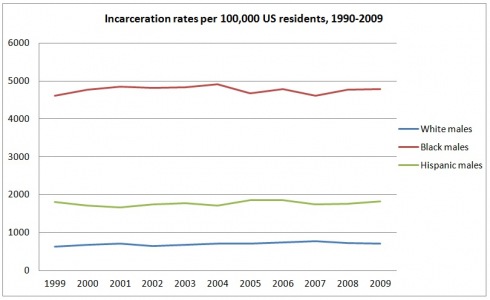
  • Black men are five times more likely and Hispanic men are three times more likely to go to jail than white men.
  • In NYC white suspects are frisked 8% of the time when approached by the police, but Black and Hispanic men are frisked 85% of the time.
  • The American Bar Association has directly stated that many people admit to crimes that they did not commit in plea bargains in order to avoid the risk of losing at trial and serving a much longer sentence. Often armed with only a public defender, and faced with a jury of peers that look nothing like them, this is the only sensible option.

Once you are in the prison system this sets you back in a number of ways.  

It limits your opportunities for employment, and even then race is a factor. Whites with a criminal record get a call back from employers 17% of the time, while black with a criminal record only get a call back 5% of the time.

It disenfranchises you as a felony eliminates your right to vote. This means that you cannot participate in a fundamental way to the democratic process to impact change in the U.S. justice and legal system.  This again disproportionately impacts ethnic minorities so it disenfranchises them the most.

It takes you out of your community, your family and disables you from providing for any family or dependents you have.  This leads to a break down of the family and often and increased reliance on social welfare or other desperate measures that are problematic most commonly some form of participation in the illicit economy (prostitution, loan-sharks, drug-dealing, etc.).

The slow and accepted dissolution of civil rights

The sum result of all of this is that we have effectively re-created a caste system in the U.S.A.. You can read more about this in the book, “The New Jim Crow” but this quotation sums it up well.

“Even in the age of Obama something akin to a caste system is alive and well in America…The mass incarceration of poor people of colour is tantamount into a caste system specifically designed to address the social, political and economic challenges of our time …. We have a school-to-prison pipeline operating in Baltimore and other cities across the nation where young people believe, with some good reason, that their destiny lies behind bars and they too will become members of the under caste.”

– Michelle Alexander, a law professor and author. (Source)

We have also legally sanctioned slavery and lynching. Now this is a provocative statement but it is true.

In jail you can be used for unpaid labor.  This is the very definition of slavery.

The application of the death penalty and the prosecution of these cases is also incredibly racially unjust and slanted against ethnic minorities.

How do we explain these realities and statistics?

These statistics are not new.  Anyone who has been around for a while has most likely heard them used in an argument or referenced at least indirectly?

When confronted with these statistics, we have to explain and interpret them and how we do determines what actions we think need to be taken and if there is any moral imperative that propels those actions.

For me, these numbers point overwhelming point to institutionalized racism.  If we accept these numbers and do nothing to remedy the situation we accept the racist conditioning of Western society and align ourselves with this racist narrative as we must take one of two basic options.

First, we might simply accept or ignore these numbers and move on with our daily lives.  This is burying our head in the sand and ignoring racial injustice which makes us complicit in these injustices. By our inaction, we prove that we do not care about injustices suffered by ethnic minorities because we do not believe they deserve basic human rights or justice because they are not white.

Second, one might suggest that these statistics are justified because ethnic minorities are committing more crimes that whites.  This is a tactic often employed by white people, of which Matthew Lemon is by no means the first. The implicit assumption is that ethnic minorities are more savage, lawless, and barbaric in nature and are more prone to crimes.

If this tactic is employed the justice system is not broken or racist, it is doing its job by incarcerating people who are breaking the laws. There is no need for change and there is nothing for white people to do but shake one’s head at the lawlessness of minorities.

This second option is a gigantic racist cop-out. It relies upon an entire culture that fears and vilifies ethnic minorities, especially male ethnic minorities.  It dehumanize them, and relies upon stereotypes and misinformation.

Instead of rightly seeing the injustice in the system, they use the results of the unjust system to support their theory.  The “logic” is that minorities are in jail because minorities commit more crimes.  Minorities commit more crimes because they are fundamentally/racially inferior as evidenced by their higher incarceration rates compared to whites. This is circular racist logic.

This second option is also a time-honored way for white people (and those that align themselves with them) to dodge introspection and the need to subsequently wrestle with things like white privilege, systemic racism and other aspects of Western society that are aimed at maintaining white people and white culture as the dominant culture in our “pluralistic” society.

The absurdity of it all…

I will never forget the first time I saw it directly employed in real life.  I was in my hometown relating my horror after visiting a local juvenile hall.  There were three hundred youth in the auditorium at this hall and all but five were black. I was telling this story to a middle-class white female colleague of mine and I as I suggested this was a sign of racial injustice in the criminal system she retorted that, “That’s who lives in the area and that’s who is committing the crimes.” She completely dismissed the concept of racially based injustice out of hand.

The mind-boggling fact was that black people are only 2% of my hometown.

To this privileged white woman, it made more sense that two percent of our juvenile population were committing 98.3% of the juvenile crime and the entire justice system was color blind and fair than it did that any other factor related to race might play a role in justice in the U.S.A.

So Matthew Lemon…

Now I admit, there might be statistical variance between the percentage of a population and their representation in the inmate population because we don’t live in an ideal world.  I also am willing to consider the fact that poverty and crime appear to be highly related and ethnic minorities tend to be in the lower-class.  This might skew the numbers as well.  I also think ultimately people are personally responsible for their behavior and cannot simply say, “The factors in my life forced me to turn to crime.”

However, considering all the statistics out there and the complicated issues regarding race, colonialism, tribal sovereignty, poverty, civil rights, etc. it appears to me that the reason First Nations in Saskatchewan represent 75% of the inmate population and only 10% of the general population cannot simplistically be explained by suggesting First Nations commit more crimes per capita than white people. This train of thought is statistically and rationally unfounded and is inherently racist.

P.S. My original quotation was cut off. I did not just hashtag this stat as #racism, I hashtagged it as #cdnpoli as well to indicate that this statistic is a systemic, socially approved form of racism in Canada. This is a notion which your words and attitudes support. 

Posted in Personal Commentary | Tagged , , , , , , | Leave a comment

Fifty Shades of Fundamentalism: Why is Fundamentalism Bad – Unassailable Ignorance and Fear Masquerading as Faith

Jerry Falwell: A more contemporary Christian Fundamentalist.

The main problem with Fundamentalist Christianity is that it disguises its vices as virtues, and those within it truly believe their worst weaknesses are their greatest strengths.

But what do I mean by this? To explain what I mean I need to step back a bit to the bigger picture and talk about worldview.

The existence and purpose of a worldview…

Every human has a web or system of beliefs that they have inherited from our surrounding culture. This collection of beliefs has been formed and reinforced by countless interactions with those around us.  For the most part these beliefs are unexamined and poorly understood. We make use of these webs of belief intuitively all the time in our lives, and they are taken for granted and an assumed part of life.

These beliefs are used to interpret all of our life experiences from the mundane and seemingly inconsequential to the sacred and larger force that drive our lives.  These webs of beliefs dictate how we experience life, what we see as an appropriate response to situations and people and enable us to have meaningful social interaction.

These webs or systems of beliefs have been labeled in a variety of ways and are closely related to culture, religion, and other aspects of our existence but perhaps “worldview” is the simplest and most accurate term as this sum total of beliefs shapes how we view this world and our existence. Regardless of how we label these systems of beliefs, we all have them.

When worldviews are challenged…

There are countless different worldviews and no single worldview apparently can adequately explain all of life’s myriad of experiences.

Often, the first time a person becomes aware of a belief within their worldview is when that belief breaks down. We are exposed to new information or experiences that do not fit our web of beliefs, we run into things that we cannot explain with our current web of beliefs. These experiences go against what should happen according to our beliefs and this causes us distress.  In these times we are unsure of ourselves and how to response, we can become suspicious of other parts of the web of beliefs (because if this one belief was wrong, which other ones are wrong?), and ultimately we do not feel in control.

The process of assimilating new information into our worldview or accommodating new information by changing or modifying our beliefs makes us all uncomfortable.  Humans naturally avoid changes to our worldview if at all possible and take the smallest change possible when we are forced to by specific circumstance and experiences.

Unassailable Ignorance

Now, no one likes to have their worldview questioned or challenged. This is human nature.  However, some take the desire to keep their worldview the same to the extremes.

Occasionally when faced with data, facts, sound arguments, and experiences that contradict their worldview, some people will, instead of changing their worldview, instead knowingly ignore or refuse to acknowledge discordant information completely.  They refuse to engage with alternative beliefs and instead redouble their efforts to hold fast to their current beliefs.

This might be done with one particular belief, a whole system of belief, or somewhere in between.  This might be done temporarily, such as until the evidence becomes overwhelming, or this might be done permanently as the person writes off the conflicting experience or viewpoint permanently.

This is known as taking the stance of unassailable ignorance; one’s beliefs are unassailable because one is willfully choosing ignorance. One’s worldview is protected because you are not considering alternatives that might explain discordant information that your worldview cannot. This is done to prevent ever having to change one’s worldview.

Though it is an immature and fearful tactic, it is employed far too often.

Some obvious problems within Fundamentalism…

With that in hand let us turn back to Fundamentalism.

Practically speaking, Fundamentalists believe they have arrived at absolute truth regarding faith and the Bible. By itself, this is incredibly arrogant stance and it discounts centuries of competing and changing interpretations and applications of scripture within Christian history. Does one really think that after 2,000 some years, a number of American Christians finally figured it all out?

In Fundamentalist culture, this notion of cultural infallibility extends far beyond the Five Points of Fundamentalism or the other aspects of Fundamentalism that I have mentioned. The belief that Fundamentalists have it all figured out extends to a whole system of beliefs that includes the Fundamentalist approach to politics, sociology, gender relations, race relations, humanity’s relationship to the land, culture, etc.

Now far from being absolute “biblical truth,” many of these beliefs are either plainly wrong or debatable when judged by scientific, theological or biblical standards. I personally disagree with the vast majority of what Fundamentalism teaches and I actually see much of what they suggest to be “biblical truth” to be the antithetical to the Gospel of Jesus Christ and the actual biblical narrative, as well as lots and lots of science.

…that continue to go unacknowledged.

From the outside, these errors are plainly obvious and the whole Fundamentalist project looks as stable as a house of cards. How can these errors go unchecked?  How can this level of theological arrogance not cause people to question, even within the community? How does the whole Fundamentalist project keep going on decade after decade?

Unassailable Ignorance and Fear Masquerading as Faith

What makes Fundamentalism so problematic, what enables it to persist despite its many errors, is that within the Fundamentalist worldview unassailable ignorance is re-defined and celebrated as faith. This thinly veiled unassailable ignorance is actually actively encouraged and those within the Fundamentalist worldview are categorically prevented from recognizing their error and the immaturity and absurdity of this pervasive practice within Fundamentalist culture because it is internal justified.

But let me break that down a little bit.

To persist in their beliefs without changing Fundamentalists have had to, as a culture, pervasively adopt a stance of unassailable ignorance. Fundamentalists disregard all other positions about faith, life, God and the Bible categorically. They refuse to engage in discussion and refuse to consider alternative viewpoints.

This blatant and wholesale adoption of unassailable ignorance would appear to be highly problematic to anyone, and I think many Fundamentalists would recognize it themselves and call for change but for some unique twists within the Fundamentalist worldview.

You see, some of the central beliefs and attitudes of Fundamentalism is the notion that they are under attack and “the Enemy” is out to corrupt their faith and their grasp of the truth. This necessitates a defensive, fearful and hostile posture to anything that is not part of the Fundamentalist worldview. Within the Fundamentalist mindset, to entertain alternative beliefs is to consider and entertain heresy that strays from biblical truth. Engaging with these other positions can only corrupt the “biblical truth” Fundamentalists already heave and is unnecessary because Fundamentalists already have it figured out.

Therefore, the default prescribed reaction to information, people and experiences that contradict the Fundamentalist worldview is to treat them not just with suspicion but active aversion and attack. This leads to an incredibly problematic situation where Fundamentalists choose to make uneducated and uninformed judgments (because they refuse to engage with and learn about alternative viewpoints) about everyone and every position that is not part of Fundamentalism’s worldview (because they believe they have arrived at all truth and everything else is false teaching) lest the Fundamentalist Christian be led astray (because “the Enemy” is out there trying to de-Christianize them).

Within the Fundamentalist worldview this practice is not understood as unassailable ignorance or fear, but faith. People who refuse to engage with alternative viewpoints are scripted as “true Christians” who are holding fast to the “Word of God” in the midst of a “corrupt and perverse generation.” It is believed that by choosing to ignore or attack alternative information, they are defending the absolutely biblical truth Fundamentalism already has in hand. On the flip side of things, if people question beliefs within the Fundamentalist worldview they face official or unofficial social ostracization, they are criticized for not holding true to the faith and they run the risk of being pushed out completely and being labelled “The Enemy.”

The bottom line

Christian Fundamentalism, like all expressions and understanding of Christianity, has errors and insights.  What makes it problematic is that its errors are allowed to persist and it remains perpetually immature and in error.  This situation would be seen for what it is, the use of unassailable ignorance rooted in fear, but within the Fundamentalist worldview these behaviors are actually understood to be faith.  Vice is misunderstood as virtue. This entire worldview is then perpetually protected from change (for better or for worse) and this allows the errors to persist and indeed be seen as aspects of true Christian faith and biblical truth, even though they are not.


Posted in Christianity | Tagged , , , , , | Leave a comment