Lone Survivor is Nationalistic War Porn (And That’s a Bad Thing)
Lone Survivor is a movie that recounts the events of an ill-fated Navy SEAL mission that happened in Afghanistan in 2005. While on their mission in support of Operation Red Wings, a SEAL fire team was discovered by innocent civilians. They then had to choose between killing the civilians and ensuring their own security or releasing the civilians, knowing the local Taliban would probably be alerted and this would compromise their mission. The SEAL fire team released the civilians and were consequently ambushed by a Taliban force. All but one of the Navy SEALs were killed.
Now Lone Survivor has done well at the box office and the reviews have been generally favorable. A number of people on my various feeds have lauded the heroic exploits of the SEALs and the fact that they made the right choice in a tough situation.
However, think Lone Survivor is a classic example of nationalistic war porn; it is movie that capitalizes on real life conflicts by turning the utter tragedy and evil that is war into a spectacle and in the end serves to reinforce nationalistic ideology that serves to justify the next real world conflicts.
Nationalistic War Porn is not new.
The tactic of casting war in a positive light despite its brutal reality is nothing new. Nations, politicians and those who seek to profit from war been trying to make war honorable and even sexy in the minds of young men for centuries. After all, Dulce et decorm est pro patria mori (“It is sweet and fitting to die for one’s country.”) was not a slogan from this century. No matter where and when you look, it appears societies have always spun tales celebrating the exploits of their heroes and held such people and such actions as honorable and good. Where ancient propagandists used poems and song, Lone Survivor uses cinema and Michael Bay style explosions.
Nationalistic War Porn makes militarism and imperialism morally acceptable and cool.
The impact of modern nationalistic war porn is the same as ancient war porn: it shapes the values of our society to enable militarism and imperialism. By showcasing the sacrifices and exploits of these men amid the spectacle of a war that can be safely viewed on a screen, Lone Survivor is encouraging viewers to honor and respect similar men and similar exploits. This encourages the viewer to adopt a deferential, even reverent attitude towards veterans and the military in general or fosters this attitude where it is already present. It even subtly instills in the mind of the viewer that if they were ever to perform similar actions (possibly by enlisting in the military and serving in a war) they too would be deserving of this type of recognition and honor. Such movies highlight a clear path to identity and respect that many young men are searching for. The sum total of all of this is a society that increasingly sees wars as a noble endeavor and volunteering to fight in them as a good thing. This is despite the fact that wars have caused untold misery and killed literally millions of people in the last century alone.
Nationalistic war porn identifies and dehumanizes our nations enemies.
Nationalistic war porn also cultivates an “Us Vs. Them” mentality. In the U.S. this vague “Them” has shifted a number of times since the Cold War; we are always looking for an enemy to square off against. War porn makes us fearful of some external threat, which in turn justifies the outrageous spending that goes into our military, all in the name of defense as we invade country after country.
War porn encourages viewers to see members of their nation (in this case the U.S.) as special and set apart from the rest of the world. We begin to see human beings outside the lines of our maps as different kinds of humans, if human at all. This dehumanization of “The Other” allows us to encourage or passively accept whatever is done to them by our nation, especially in war.
This all has a diffuse but real impact on our foreign policy and the lived experience of other people. Because of the place the U.S. has on the world stage, the values and views of our citizens directly contribute to our nations actions on the world stage. War profiteers in the military industrial complex and the politicians in their pockets can rely on our passive acceptance or even favorable views towards war to allow them to get away with sending our military into unnecessary wars for the sake of their profit. The favorable view of war in the U.S., shaped by movies like Lone Survivor, have very real consequences for the lived experiences of people around the world.
Fundamental Problems with Nationalistic War Porn
Some might suggest that there is not a problem with movies like Lone Survivor. After all, even if conceded that war is a moral evil, these men were willing to serve, made the right moral choice in a difficult situation, and some of them paid the ultimate sacrifice for it. Shouldn’t they be honored and respected?
I understand this line of thinking but it hits on one of the fundamental problems with nationalistic war porn: such narratives are always inherently dishonest.
Nationalistic war porn like Lone Survivor always “cherry pick” real or fictional stories while conveniently ignoring the larger realities and contexts of war. Lone Survivor conveniently ignores the larger context of the War on Terror to give our troops and nation the unquestionable moral high ground when this could not be further from the truth.
By conservative estimates over 100,000 civilians died in Iraq and 15,000 in Afghanistan. That number climbs much higher when we discuss people killed by starvation, displacement, crime and disease which are more indirect consequences of war. This death toll also does not reflect psychological trauma, maiming and injuries, and the future cost of wars and conflicts that history has shown will arise from the political instability we have sown in the region.
Lone Survivor also ignores the larger historical context of the war in Afghanistan. Lone Survivor sets up the Taliban as a repressive evil terrorist entity, a sort of War on Terror version of the Nazis. While vilifying the Taliban to act as an antagonist for the heroes of the story (the white Americans) it ignores how the U.S. directly supported the Taliban in the past or contributed to the situation in which they could rise to power.
When considered in an accurate historical and wider context, is this story still something to be celebrated? While I am glad that this SEAL team spared the lives of a handful of civilians the larger context begs me to ask bigger questions. How are those civilians lives now, after we have thoroughly destroyed the entire region?
Our military operations in the War on Terror have directly killed many innocent civilians, even by our own admission. Drone strikes, the standard operating procedure of not slowing down for children in the road (for fear of ambush tactics) and even raids conducted by our elite units have made the deaths of innocent civilians a routine occurrence. Should we only tell the story of the handful of civilians we let live?
While I understand the members of this SEAL team made the right moral choice, and many U.S. service members have made the right moral choice in equally desperate situation, making the right moral choice in war led by the US is like throwing a pot of water on a house fire that you set earlier in the day. Considered by themselves, these right moral choices are the appropriate action to take and even commendable, but are rendered a moot point when considered in their larger context.
Nationalistic War Porn needs to be criticized and stopped.
In short, Lone Survivor and other examples of nationalistic war porn celebrate cherry picked stories, devoid of any historical or wider context. These stories encourage uncritical nationalism and militarism in those that view it. Such stories encourage people to see war as a noble endeavor and volunteering for the military as a high form of service to others. The larger political and military agenda of the United States, which continues to be the largest purveyor of violence in the world, is supported and allowed to continue unabated in part because of the prevalence of these attitudes in our society. After all, the only thing better for a war profiteer than an uncritical populace going along with war, is a populace that actually values war and thinks it is a good thing.
While nationalistic war porn, like Lone Survivor, might be a small cog in a big machine, we should pay attention to it for the production and consumption of such narratives shape our values. Where we do not even think about this dynamic, or attempt to stop it, the status quo will continue and that is bad for everyone.
The moral responsibility of Settlers: What kind of society do we want to live in?
Photo: Ossie Michelin
Earlier today a large force of heavily armed RCMP officers descended on an anti-fracking blockade organized by members of the Elsipogtog Nation in New Brunswick, Canada. The blockade has been in place to protest shale gas exploration and exploitation on their land by a U.S. based company, SNW, for some time. The RCMP were serving a recent court injunction that ruled the blockade illegal. The scene was very tense and violence broke out at several times during the day. (More can be read about the story here.)
As events unfolded today I kept coming back to one simple thought: the indigenous people across North America (and elsewhere) have done enough.
They have offered up enough martyrs. They have protested enough. They have blockaded enough. There have been enough crises like those at Wounded Knee and Oka. They have done enough for contemporary Westerners like me to be held accountable for the society we allow to continue.
Both Canada and the United States are settler colonial empires guided by capitalism. Devoid of any real meaning, our societies are based around unsustainable consumption. While this is rapidly dwindling the earth’s resources, it keeps us distracted enough from our existential emptiness to keep our societies rolling along. Because of this, large corporations have come to dominate our societies as they feed our perpetual hunger for energy, resources, experiences and diversions. With our consent or even encouragement our national governments enable these corporations to exploit anyone and everyone they can for profit. Justice and morality really do not matter as long as there is a supply to meet the demand. Where less aggressive but no less manipulative tactics fail our military and police forces ultimately step in and ensure that our companies have access to every resource and market in the world. Those primarily exploited by our societies are more often than not people of color, either at home or abroad.
The conflict at Elsipogtog today, and on many other occasions, was a direct result of the protest of indigenous people against the larger forces that truly dominate our society that seek to co-opt, assimilate and otherwise exploit them.
The unjust and immoral nature of our societies are sugar-coated under a thin pretense of democracy, nationalistic rhetoric and dishonest narratives about our countries. While false, these devices serve to give us a positive self concept of our nation. We believe lies so that we can feel good about being a Canadian or U.S. citizen.
Now it is not human nature to question what we (and all those around us) have always assumed to be true. It is also not human nature to question our own positive self-image unless forced to do so. So, to a point and to a time, I think Westerners like me can be forgiven for not recognizing the problems in our society and addressing them.
However, that point and time was at least several decades ago. The resistance and protest of indigenous people have provided more than enough to call us to self-reflection. We have read the names of enough martyrs. We have watched enough crises play out on the television. We have witnessed the disastrous costs of our foreign policy several times too many.
We must accept moral responsibility for the unjust and immoral status quo of our societies. We have to recognize the blood on our hands. We can no longer employ propaganda that has proven to be false to alleviate our guilt. We may not be the ones directly exploiting others for benefit, but we are the ones allowing it to happen, we are the ones benefiting, and we are the ones who have no excuse if asked why we were not paying attention.
We have to ask ourselves, “What kind of society do we want to live in?” If it is not the grim realities created by our settler colonial societies, we have to think and work towards change.
Filming Sundance: Tradition, technology, and journalism collide.
A few weeks ago I was invited to help at a sundance ceremony that was being organized and run by friends of mine in the Native American community. Sundance is a sacred ceremony common to a number of Native American tribes (mostly from the Northern Plains) that is held annually during Summer.
True to indigenous form, this was a “learn-by-participating” experience for me and essentially nothing was described or explained to me beforehand. The one thing that was made clear though was that it was forbidden to take pictures or film the ceremony in any way.
So one can imagine my surprise yesterday when I discovered that the Aboriginals People’s Television Network (APTN) was releasing a several part feature on the sundance ceremony. APTN was invited to observe, film and report on the Sprucewoods sundance by its leader, Chief David Blacksmith, and they had accepted. APTN reporter Shanneen Robinson and her film crew attended and filmed the sundance ceremony. APTN is now releasing the feature in a series of episodes.
The controversial decision to photograph and film a sundance and publish this series immediately sparked a lot of conversation in the Native American community. It evoked strong emotions including dismay and outrage from many who were shocked APTN would do this.
As a non-Native I have attempted to generally speaking stay out of this discussion because this is not my culture’s ceremony. However, due to some interactions on Twitter I felt I should articulate my opinions (despite how little they might matter) to clarify what I think and do not think about the situation.
I am aware some will agree with the points I’m going to make, some will disagree with them, and I’m might be wrong in some of my points. As usual I welcome comments and criticisms and am more concerned with discussion than “proving myself right.”
APTN: APTN should have known better than to do this.
I get that teachers teach, and car mechanics fix cars, and reporters report on things and a news organization being invited to report on something interesting and pertinent to their main demographic would naturally agree to do the report. However, just because you can do something doesn’t mean you should and it doesn’t mean you are justified in doing so.
Agreeing to film a ceremony, even though this is forbidden, is a rather serious breach of cultural respect. I do not think the permission of Chief Blacksmith absolves APTN of this because he is only one among many sundance leaders. This would be like freely photographing all Amish people (who refuse to be photographed outside of very specific conditions) given the word, consent and invitation of one Amish community leader. (If there was a tribal level decision to allow for the filming of a sundance, I might feel differently and there is even a precedent for it.)
I would actually be more inclined to be sympathetic if a white/mainstream news organization did this. I would assume such a network simply failed at being culturally aware. But APTN is an indigenous news network. They should have known better and they did but they went ahead with the report anyway.
Was APTN being a brave broadcasting company, unafraid to push the envelope to spark much needed dialogue and conversation?
Now I get that reporters at times push the envelope and make people uncomfortable to spark dialogue (or drive up ad revenue). This is not inherently unethical or in bad taste. Some have suggested APTN’s feature is pressing for much needed conversation regarding ceremony, the origin of the ban on photographing ceremonies, technology and ceremony, how to reach out and include Native and First Nations youth in ceremony, etc. However, I don’t think we can characterize APTN’s decision only in this light for a number of reasons.
First, instead of directly addressing why they decided to participate in the breaking of this protocol, or even address the fact that photographing a sundance is forbidden, APTN coyly hinted at the fact that they knew of the ban but were going on with the reporting anyway. I say this because comments like “unfettered access” and “secret ceremonies” appear in their feature. This taints the piece with a sensationalist and exploitative tone, not the tone of reporting on something held sacred by many.
Second, they have invited people not just to watch their feature but to weigh in on their controversial decision after the fact. In this they appear to be seeking to use the controversy to their advantage (like all news agencies do) presumably to drive up website traffic and ad revenue while advancing careers.
Third, even if the conversations sparked by this feature were necessary for Native American communities to have, a simple article that required no actual photography, reporting or filming of a sundance would have sufficed. APTN could have tapped a writer to write a piece discussing the conundrum of being invited to film a ceremony that is not to be filmed, explaining the reasons for this invitation being extended, and calling for conversation about the issue. This conversation could have happened without actually violating the ban on photography.
Fourth, is it even a news agencies place to determine what conversations should happen around ceremony? Is it their place to decide when and if there is a need to discuss something about ceremony that is so important that it sanctions the breaking of a widely held to ban on photography?
Fifth, the dynamics of the situation appear to be tailor made to absolve APTN of responsibility for a decision they knew would be controversial. APTN will reap whatever benefits come from this “breaking-the-taboo” hype, and as they face well-deserved criticism for their decision they will undoubtedly point to the leader that invited them to film the sundance and hide behind his character and reputation. I have seen a number of their defenders already employ this strategy. Saying, “But we were invited by the reputable leader of this sundance…” is not exactly the cry of a brave journalist who is accepting responsibility for their controversial decisions due to their stalwart conviction regarding the merits of that decision. This sounds like someone angling to get away with what they did and shifting responsibility to someone else.
Chief David Blacksmith: was this his decision to make?
I don’t know Chief Blacksmith but many who do say he is a great man who has devoted his life to serving his people. He has personally prayed with and done ceremony for family members of people I trust who speak for his character. So let me be clear; I’m not contesting these claims about his character or attempting to discredit him in anyway. I have no cause to assume he is not a good man and a good leader. Quite to the contrary, because I’m an outsider, on any Native American issue, including those surrounding ceremony, my default would be to defer to him.
However, what I will say is that good people who serve their communities can still make mistakes and I think Chief Blacksmith did make one by inviting APTN to film his sundance, whatever the merits of his reasons.
I say this because it is one thing for a leader to make a controversial decision that impact the community he or she is responsible to and for. It is an entirely different thing for a leader to make a controversial decision that impacts many communities he she has no relationship with, responsibility to, or reputation with.
If Chief Blacksmith had, with the informed consent of his sundance community, allowed for the filming and recording of their sundance to create material that would not be widely available but used personally be him to reach out to Natives (especially urban Natives) who would otherwise remain disconnected from ceremony on the land, I would have no issue with his decision. Ultimately the community he is responsible to, and the community this decision impacts, would hold him accountable if there were any negative repercussions.
However, this was not the decision he made. Chief Blacksmith invited APTN, a national news organization, to film and report on a ceremony that is held dear to many tribes and many communities. He knew APTN would then take this material and publish it online which inherently creates a number of problems beyond the violation of protocol, such as making it available to those that appropriate native culture, and using this controversial filming of a ceremony to generate ad-revenue for APTN (essentially commoditizing sundance), etc.
In this Chief Blacksmith made a decision that impacted many communities and this was not a decision he had the right to make. Sundance is a ceremony common to many different tribes performed by many different communities within those tribes. While each sundance ceremonies might have idiosyncratic differences, as different sundance leaders do things differently, the ban on filming and photographing the sundance ceremony appears to be universal. To knowingly break this protocol, in this way, a way that literally broadcasts online what many believe should not even be photographed, would require either a widespread consensus, which doesn’t exist, or some type of pan-tribal spiritual leader who was qualified to make such a decision, who also doesn’t exist.
In short, regardless of Chief Blacksmith’s personal character, knowledge and intentions, I think he made a decision he had no right to make because I am fairly certain no one has the right to make this decision unilaterally, even with the advisement of close council and good intentions in hand.
Cloud Atlas and the most Fundamental Tension in Human History
Every great story has to have a source of tension. Without tension, a “story” is nothing more than the description of scenery. Recently I watched and thoroughly enjoyed Clout Atlas. The reason I fell in love with this movie is because the tension at the heart of the movie was the tension at the heart of humanity. In this post I want to take a minute to talk about this tension, why it is a perennial tension humanity faces and how this movie invites us to consider our place within that tension.
The fundamental tension at the heart of Cloud Atlas and human existence…
For those of you who have not seen it, the actors in Cloud Atlas play various roles throughout the movie as small story lines unfold from the South Pacific in 1849 to a post-apocalyptic earth in 2349. These story lines are all connected together thematically and temporally in order to make up the larger story arch of the movie.
Each of the small story lines in focused on a minority that was being exploited or oppressed. Racial minorities, sexual minorities, women, the poor, the elderly, hypothetical fabricants (clones designed to be slaves) and non-violent sheep herders were all faced with injustice and threats that power inequalities prevented them from responding to.
The villains of each story line were the dominant majority (both individuals and the uncritical masses) that was using their place of power to exploit the minority. This exploitation was often done under the guise of “maintaining order” in the world or simply going along with the status quo. Slave traders, heterosexuals, men, the wealthy, retirement home workers, the police state of Neo-Soul, and the warlike cannibal tribe that preyed on the sheep herders all took advantage of those who could not defend themselves. The power differentials in the status quo protected them from facing any reprisals or resistance and they took advantage of this.
The heroes of each story line were those that worked against this exploitation and “the order” it was allegedly protecting. Some of these heroes arose from within the ranks of the oppressed themselves and others were outsiders or those from the dominant group that resisted the temptation to profit themselves at great cost to others simply because they could with impunity.
When finally in full focus by the end of the movie, the larger story arch was built around the tension of exploitation. What was at the heart of Cloud Atlas was “the way of the world,” the way of the strong preying on the weak, the ideology and systems that enable such exploitation, and the efforts of some to resist it.
This tension, the temptation of the strong to exploit the weak, often for no better reason than they can with no real consequences, and the work of a few to resist this perpetual temptation, is perhaps the most fundamental tension in human existence. While the small stories in Cloud Atlas were fictional (if set in historical realities and believable hypothetical ones) human history is filled with small stories and larger arcs of history that revolve around this same tension. Thinking of Western history alone in the last several centuries we can see colonialism, slavery, imperialism, exploitation, sexism and a variety of other problems are all rooted in a dominant or majority group exploiting another with little consequence and the work of a few to turn the tide.
The perennial nature of this tension…
By showcasing this tension across various time periods and featuring different exploited and exploiting groups, Cloud Atlas underscored the perennial nature of this tension. While society might have addressed one form of injustice, there appears to always be inequalities of power that allow the dominant group to exploit the more marginalized in our societies. When those in the dominant group succumb to this temptation a new cycle of injustice starts again.
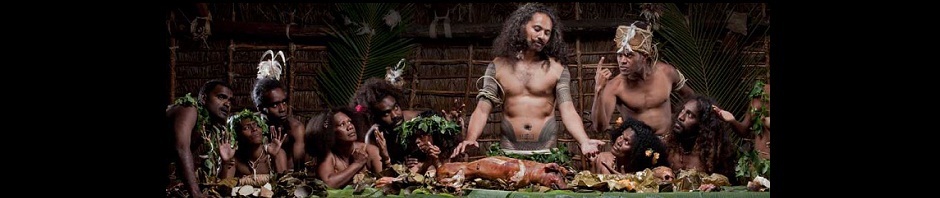
As if to hammer this point home, the writers decided to have the most primitive human community featured in the film set in the farthest future. Contrary to the Modern idea of infinite progress towards a man-made Utopia, in the 2349 of Cloud Atlas we watch a story where humanity has experienced an unexplained apocalypse. What remains of humanity are tribal communities and the most pressing danger humans face in 2349 is not nuclear arms or environmental collapse, but cannibalism. The strong in this story line are quite literally eating the weak. This is perhaps the fundamental tension of humanity expressed in its most basic and symbolic form. Or as a quotation from the movie put it, “The weak are meat and the strong eat.” The point is clear, and I believe true. Humanity is not going to escape this tension anytime soon.
An invitation to introspection…
By highlighting this tension, its historical reality, and its repetitious nature, Cloud Atlas invites us to introspection into our lives and the nature of our society. I believe this introspection is needed as we have fooled ourselves into think we are better people in a better society than we actually are.
Do we want to live in a world where some minorities gain legal equality as other minorities lose them?
Do we want our children to have to work towards resolving an inequality we ignored today?
Do we want to live in a world where underpaying undocumented workers to harvest the food we eat is accepted as just the way of things?
Do we want to live in a world where civilians in other countries who cannot truly defend themselves are killed to ensure our safety?
Do we want to live in a world where workers are subject to dangerous working conditions and earn meager salaries so we can buy cheap clothing and corporations can maximize their profits?
Are we part of the dominant majority succumbing to a passive or active exploitation of the minority, simply because we can?
Do we want to live in a world where the strong exploiting the weak is accepted as the unchangeable if regrettable status quo?
These are the types of questions we need to ask ourselves, and we must be brave enough to envision answers to them we can live out if we are to make this world a better place in any meaningful way.
“Check your Privilege!”: Bidding penguins to fly.
“Check your privilege!”
Recently on Twitter I have seen a lot of people saying, “Check your privilege” to others. Some believe asking someone to check their privilege is just an ad hominem/Marxist fallacy. I do not agree. At the same time, I think it can be (and is) misused as a trump card in an “attempt to close down discussion or restrict the voices in a debate to preferred perspectives.”
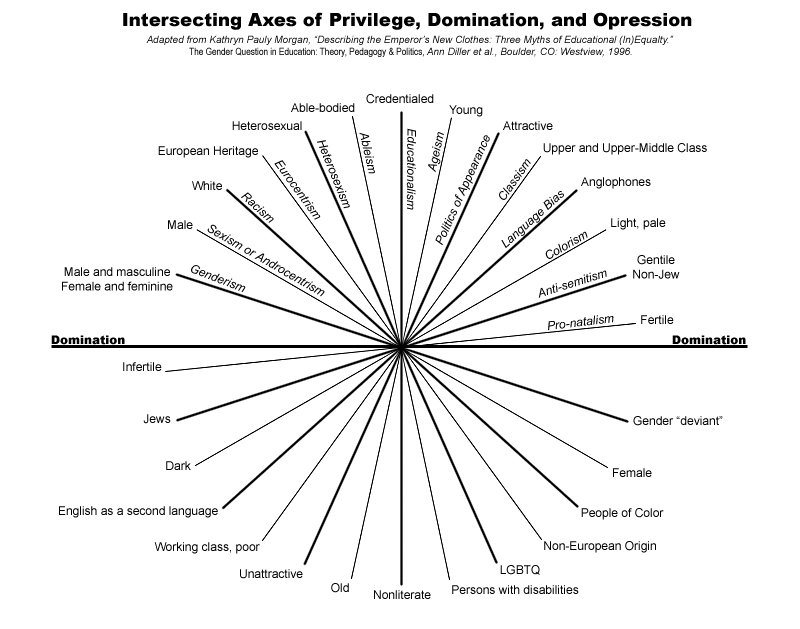
From what little I have experienced of life, I believe that privilege exists, that many types of privilege exist, that privilege shapes our perception of the world, that a disadvantage in one area does not eradicate a privilege in another, that statements made in ignorance from these places of privilege can offend those who lack this privilege or are on the other end of the oppression spectrum on a particular point and that we should work towards understanding our own privilege. In this light it is not unfair to invite someone to check their privilege.
However…
However, the use of this phrase on Twitter, even where I see it is clearly calling out privilege in a previous statement, at times baffles me. I say this for two reasons.
First, I say this because people are by definition blind to their own privilege. By telling people to “Check their Privilege” we are essentially telling someone to do something they by definition cannot do. It’s like telling a penguin to fly. For someone to actually come to understand their privilege they need dialogue with those outside of the specific privilege in question.
This leads me to the second reason this exhortation baffles me. 95% of the time when I have seen this phrase used, it is left as an angry jab to “call someone out” or “put them in their place” for saying something that outsiders have rightly (or wrongly) seen as laden with privilege.
Now maybe this is a legitimate use of this exhortation to a privileged jerk who is not going to change. However, if we really do want people to understand their privilege better and live and speak differently (which I assume we actually do), this appears counter-productive.
Used in this fashion, calls to “Check your privilege” carry the undertone of “I hate you” and “you’re dumb” and not “let us enter into a reasonable discussion about privilege.” This is not the sort of exhortation that invites people into conversation and dialogue, the very thing people need to come to a better understanding of their privilege.
So when dealing with people who do need to check their privilege…
Maybe, even when dealing with a person we assume would be unwilling to actually dialogue about their privilege, we could at least try to engage in a conversation about it or at least invite them to such a conversation in a genuine manner. If we are not willing to talk with someone about privilege because we have no patience with them as an individual or the privilege in question, maybe we should just leave it for someone else to handle?
Speaking of which…
I have never really sat down and listed all of my privileges and the ways in which I have the world slanted in my favor. Would any critical thinkers out there be willing to enter into a dialogue and conversation about my life to at the very least list them down and understand them more? Just comment here or on Twitter if you would be willing to.
Who is Leonard Peltier and why should we care?
Leaders of the Oglala Lakota nation have announced that June 26th would be Leonard Peltier day.
But who is Leonard Peltier and why should you care?
Let’s learn some history…
In the early seventies there was a three year period of very serious political violence on the Pine Ridge Indian Reservation. This small community had the highest per capita murder rate in the state. Much of this was due to the work of the corrupt tribal chairman Richard “Dick” Wilson who used a private militia known as the “Guardians of the Oglala Nation,” or GOONs, to crush political opponents and dissent very violently. His opponents were traditionalist members of the tribe that opposed his election and rule.
These traditionalist members eventually reached out to the American Indian Movement (AIM), a group that Peltier was a member and leader of. Peltier, with other AIM members, set up camp on the Jumping Bull family ranch in order to help protect the traditionalist members from the violence.
On June 26th, 1975, two FBI agents in unmarked cars followed a car into the ranch. In this tense environment a shootout quickly erupted that left both of the initial FBI agents dead as well as the Native American Joseph Stuntz. The FBI agents had been wounded and then were executed at close range. Joseph Stuntz death has never been investigated.
Eventually the AIM members Bob Robideau, Darrell Butler, and Leonard Peltier were brought to trial for the deaths of the FBI Agents. Robideau and Butler were tried together but were acquitted on the grounds of self-defense.
Peltier, who had fled to Canada, was extradited to the U.S. under the false testimony of Myrtle Poor Bear. Poor Bear was coerced by the FBI into testifying that she saw Peltier shoot the FBI agents and that she was Peltier’s girlfriend even though neither claim was true and she was not even present at the shoot-out.
Peltier’s trial in 1977 was tried in what has been recognized by many as a sham of a trial. The FBI description of the vehicle they followed into the compound was changed to match a vehicle Peltier sometimes drove. Poor Bear and others were not allowed to testify. Evidence explaining the climate of fear on the Pine Ridge Reservation at the time of the shooting was severely suppressed. Three teenage Native witnesses testified against Peltier but later admitted the FBI coerced their testimony. More than 140,000 pages of FBI documents were withheld from the defense. A ballistics test proving Peltier’s gun was not a match to casings found near the FBI agent’s bodies was suppressed. The defense argued that they proved Peltier executed the two FBI agents at close range but later admitted they had no idea who executed the two agents at close range.
In this sham of a trial the jury found Peltier guilty and Judge Benson sentenced him to two consecutive life sentences and he is slated for release in 2040. Numerous appeals and even a request for a new trial based on new documents received through the Freedom of Information Act have all been squashed. President Clinton succumbed to heavy pressure from the FBI to not grant Peltier a pardon and President Bush denied it outright.
So why care?
There are many things to be concerned about today. The Supreme Court of the United States just weighed in on a variety of cases that impact the rights of many U.S. citizens, especially gay couples, workers and minorities. So why should we look back at a dying prisoner and an injustice that happened decades ago in an era most of us don’t remember in a community most of us have no connection with?
Who do you think paid for this?
The Civil Rights we enjoy today (and that are now being eroded by a Supreme Court that believes we live in a post-racial USA) were hard-won by people like Peltier who were from groups like AIM.
Part of the difficulty did not come from civilian opposition or a lack of public support but very intentional government suppression. The FBI disruption and tracking of Occupy Wall Street is not something new. The FBI was acting as a force to crush dissent and to maintain the status quo long before our time.
During Peltier’s day many activists groups were intentionally targeted by the FBI in a variety of ways, most notably through COINTELPRO. AIM was certainly no exception to this FBI aggression. During the violence on the Pine Ridge reservation more than 60 traditionalist tribal members and AIM members were murdered and scores more were assaulted. Evidence indicated GOON responsibility in the majority of crimes but despite a large FBI presence, nothing was done to stop the violence. The FBI supplied the GOONS with intelligence on AIM members and looked away as GOONS committed crimes. One former GOON member reported that the FBI supplied him with armor piercing ammunition.
So people better than most of us, people like Peltier, had to endure much to win a variety of victories for their people and ultimately for our nation as a whole. Despite their fellow citizens’ apathy and their governments overt and covert aggression. These victories were earned through suffering beatings, imprisonment, torture, and even death.
In this light, Peltier is not a relic from a by-gone age but an activist that is still enduring the price of his activism. Peltier is still being the symbolic pound of flesh the FBI has demanded for their two agents even though it was they who failed to stop the violence on the Pine Ridge Reservation and were rather clearly fanning the flames of violence themselves.
The bottom line:
Peltier has been imprisoned longer than most of you reading this have been alive. Peltier has been imprisoned longer than most contemporary activists have been waiting for justice or working towards it, while they enjoy their freedom. Peltier has served more than enough of his life for a crime he did not commit and it is far past time we release this activist that is being held as a political prisoner.
Divide and Conquer: What reactions to mass surveillance tell us about the two-party system.
Divide and Conquer
“Divide and Conquer” is a time-honored tradition among oppressive governments and systems since time immemorial. It has been employed countless times to remedy an equally age-old conundrum: how does the ruling class impose its will on the people who are likely to resist and are more numerous than the ruling class?
The simply solution is to divide the people.
This is often done by creating arbitrary divisions or by exacerbating existing ones. The people, thus divided, have their effective numbers and power diminished. More importantly, they will fight other people instead of rightly recognizing how the ruling class is exploiting them, and resisting their true oppressor.
How the Two Party System is an Extension of That
Those in power in the United States have used that same tactic here. The most notable example of this is perhaps the creation of the concept of race and the concept of a “white” race. This was used to pit poor blacks and whites against each other so they wouldn’t band together and fight the wealthy European elite exploiting both of them.
However, the recent response to the mass surveillance scandal has highlighted how the two-party system in the United Sates is another form of divide and conquer being employed in the United States.
How Democrats have reacted…
In response to crackdown on whistle-blowers and journalists and the revelation of the PRISM program, Democrats who supported President Obama are predictably attacking Republicans. The main two response I have seen actually contradict each other. The first takes the revelations very seriously, but them blame them on Republicans and Bush. The second is to downplay the importance of these revelations. I say they are contradictory because if these revelations are not that important, why the concern for blame shifting?
Here are some examples of what I mean.

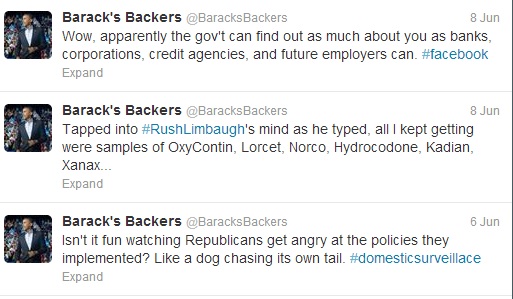
Notice this feed contains both the minimization of the NSA surveillance leaks and then also blames it on Republicans.

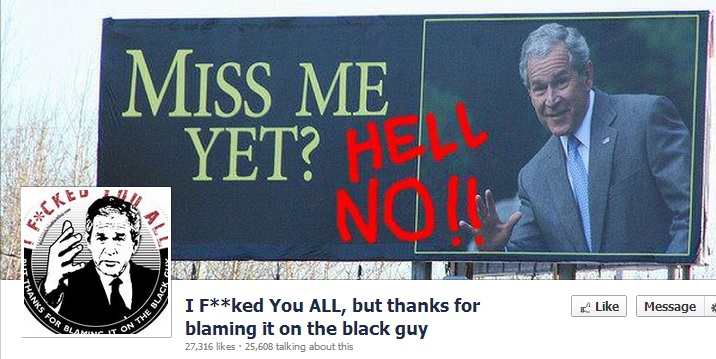
This entire Facebook page is devoted to memes attacking Republicans. While some of these criticism are deserved notice the title. They never acknowledge Obama can do anything wrong and blame everything on Bush.
These tactics are being employed by Democrats to avoid owning the fact their candidate betrayed them. The simple fact is that Barack Obama has failed on a number of major campaign promises. The two that are perhaps most relevant to the recent disclosures were promises to provide a transparent government and an end to the era of warrant-less surveillance.
Even if these programs were started under Bush, Obama has been well aware of the program and its capabilities and continued to use it without the U.S. Citizenry’s knowledge and is arguing for its continued use.
How Republicans have reacted…
Republicans, meanwhile, are shocked at the loss of liberty and privacy under Obama they set in motion under Bush.
The best example of this is Republican Senator Rep. F. James Sensenbrenner Jr. who wrote the Patriot Act. He apparently was shocked and appalled by how the Patriot Act had been interpreted and used by the government. Sensenbrenner has now called for the “abuse” of the Patriot Act to end.
So instead of, I don’t know, learning their lesson about being attacked by the monster they previously unleashed, the Republicans have shown as much common sense as Democrats. While some continue to accuse Obama of being too soft on terror (as Obama unleashes a Reagen-esque foreign policy around the world, utilizes extra-judicial drone strikes to kill people in signature strikes, and is increasingly reliant on a paramilitarized CIA and covert ops) others accuse him of being a tyrant and staging a coup…for taking advantage of the legislation they drafted
Conclusion:
9/11 fear inclined the U.S. Citizenry to tolerate and increasingly secretive and unregulated government. We thought the possible costs to our civil rights would be worth the protection they promised to offer us. After more than a decade the U.S. Government has grown very accustomed to having no real accountability to their citizens. The revelations of the past several weeks and the government reaction have shown how far our power-intoxicated government is willing to go, regardless of if that government is Democratic or Republican.
Instead of rightly recognizing the problems that both parties have created in the last several years, we are content attacking “The Other” party and telling ourselves that if only “our party” got control of the White House and the Congress, then everything would be good because all of our amazing ideas to fix everything would be immediately implemented.
This is a nice ideal but this is not reality. The reality is the U.S. Government does not represent you, regardless of which party is elected. Members of the U.S. Government represents their donors as they accept millions in legal bribes through lobbyists in the employ of mega corporations or more directly work to represent companies they have not so secret ties to. This is not a conspiracy theory or unsubstantiated ramblings. Our elections are essentially controlled by 1% of the 1%. The U.S. is functions as an oligarchy, regardless of who wins what.
The solution in this situation is to not to fall into the trap of partisan infighting. Blaming the other party for the loss of our civil liberties is continuing the status quo of divide and conquer. Blaming the other party is fighting other members of the U.S. Citizenry, not the ruling powers that be. The true solution in this situation is to rethink U.S. politics and enact revolutionary change to our system.
Crowdsourcing Cultural Awareness: An invitation to partner with me on two projects.
Hello, my name is Kevin Gonzaga and I wanted to briefly inform you about two projects I am simultaneously working on regarding cultural awareness and invite you to consider partnering with me on them by contributing content.
The main project…
Currently I am working at the University of North Dakota with the Department of Justice to develop online training materials for death investigators around the United States.
The focus of the training I am developing is cultural and religious competency. Death investigators have extensive contact with the recently deceased and the risk of cultural or religious offense is high, especially if and when they are unfamiliar with the culture and religion the person is from. This training will help ensure death investigators work with the family and community to treat the body with as much cultural and religious integrity as possible as they perform this duty.
This training will be available to death investigators across the United States so I am attempting to cover as many cultures and religions as possible.
The Videos…
As part of this training I am incorporating video interviews of cultural and religious leaders providing additional information specific to the groups they represent. The interviews are provide death investigators with a basic understanding of that groups mortuary rites and any concerns they have about the care of the deceased during a death investigation.
Here are two examples of the videos I have shot and edited:
My side-project…
At the same time I am using this opportunity to work on a side-project of mine. In the interviews I am asking the question: “What are three things you wish everyone in the U.S. knew about your culture/religion?” I will incorporate these answers into the training but I also plan to use the answers I receive to create a mini-documentary of sorts that will highlight the cultural diversity of the United States and hopefully raise awareness and appreciation of other cultures.
How you can contribute…
While I can interview some people myself, I cannot interview everyone and I want as many cultures and religions represented as possible. However, I can edit and incorporate any video footage that is contributed to me.
If you are (or know of) an a leader within your cultural or religious community (an elder, pastor, imam, cleric, priest, rabbi, religious leader, community organizer, civic leader, etc.) that could speak on these issues I am inviting you to participate by contributing interview footage. Contributing in this way will help ensure that people from your culture and religion are treated with respect in their passing across the United States as this training will be nationally available.
If you are interested, all that you will need is a video-recording device (even a good webcam might work), and a quiet, well-lit, place to record. You can either send the footage to us on a USB that we will supply if you need it (we will also take care of postage both ways) or send it to us over the internet. From there I will take it to get edited and incorporate it into the online training.
You will receive a link to the video for yourself and the second project, when it is finally finished, will be available online.
If you would like to participate or want to know more, please just email me at: kevin.gonzaga@med.und.edu


Blackface and Bloodstains
Fall, the season of racism.
Every October people around the world get dressed up and attend various costumed parties or functions, usually in some connection to Halloween. Inevitably stories and pictures emerge of white people dressing up in racial or cultural costumes that some find racist and offensive.
People of many different cultures have been addressing this issue for some time. There are even whole awareness campaigns based around it. Last year I did my part and I received my first suspension on Twitter for calling out numerous people on their racist Native American costumes. However, no matter how many times this is addressed, it happens again every single year.
This year I had not planned on writing anything but stories of racist costumes began to crop up on my news feed.
Colorlines ran an article about a girl in Australia who had an “African” themed party. The result was a bunch of white Australians in blackface, African garb, and even (for some reason) KKK outfits.
Soon, there was the token celebrity blackface scandal. This time it was Julianne Hough (of some reality show or another) who dressed up as a black character from Orange Is the New Black.
(Sidenote: The show Orange is the New Black is taking a problem disproportionately impacting people of color, namely mass incarceration, writing white people in as main characters, and profiting from it. More could be said about that, but I digress.)
Are people of color being too sensitive?
Now when people of color take offense and ask white people not to dress up in this manner the reactions are equally predictable.
“You’re being too sensitive.”
“It’s just for fun.”
“That might have been wrong, but that was just one bad person.”
“There are bigger things to worry about.”
“No one is getting hurt by this.”
“It’s honoring/I love ‘x’ culture!”
Oddly enough, sometimes when white people are confronted about their choice of costume, they assume the role of a persecuted victim. They, the white person, is the true victim of this situation. Their freedom is being limited by an overly sensitive minority or an overly politically correct culture.
“This is political correctness gone too far!” is often a coded, “How dare you (people) tell me what to do!”
I heard variations of these comments when I made waves about the Australian party on Facebook. (I am sure I will hear variations of them in response to this post.)
The cyclical nature of this discussion is discouraging. Truth be told, part of the reason I had planned on not writing about racial/cultural costumes this year was because I was unsure the people who need to think about this more would actually listen.
Then I saw this image on Imgur.
(The full gallery with a handful of additional pictures can be seen here.)
This is a picture of people who thought it would be appropriate and fun to don blackface and go up as Trayvon Martin and his murderer George Zimmerman. This is not an assumption from the context. Their choice of costume is clearly stated in the photo album itself.
(Edit: They were also not the only ones to do this.)
Blackface and Bloodstains
I assume that just about everyone, including many who might defend the use blackface or racial/cultural costumes in general, will deem this specific choice of costume as offensive, inappropriate and too far.
To those who see racial/cultural costumes as viable choices, but recognize this situation as inappropriate, my question is this: if racial/cultural costumes are okay, but this particular costume is inappropriate, what makes it inappropriate? In other words, if blackface is an acceptable Halloween costume choice, why is this specific blackface costume wrong?
I assume that many would respond that it is not blackface in and of itself that is the issue in this situation, but the larger context in which it was used. The reason this costume is unacceptable is because it invoked a tragedy involving the death of a real person, all for the sake of a laugh. While fake bloodstains might be a common sight on Halloween costumes, the bloodstains in this costume point to the death of a real person and it is therefore a callous and inappropriate Halloween costume.
I would agree completely. This costume is out of line because it invokes a real death for the sake of fun. I just wish people who think racial/cultural costumes are an acceptable choice for white people to wear would recognize that every use of racial/cultural costumes invoke real tragedies and real deaths. All racial/cultural costumes have bloodstains on them, regardless of if they are painted on the costume or not.
What I mean by this is that part of the reason that white people should not dress up as other cultures is that they do so in a world where white people have violently repressed the very cultures they are dressing up as.
Blackface is tied directly to minstrel shows and the larger exploitation of black people during slavery and Jim Crow. Native American costumes are based on stereotypes about indigenous cultures that the U.S. and Canada have attempted to eliminate through various programs of genocide, assimilation and destabilization. Asian outfits are patterned after the very cultural outfits that were used by European colonizers to paint Asian cultures as effeminate and in need of Western domination and exploitation. Arab suicide bomber outfits point to dire situations and tragedies, often the result of Western meddling in the Middle East, that have produced the extremism and desperation that are required for suicide attacks to be carried out. Etc.
Racial/cultural costumes invoke this history, a history rife with tragedies and deaths, a history that continues to this day, regardless of the wearer’s intent or even knowledge of this history. I doubt the Australian wearing the KKK outfit knows about the origins and actions of the KKK, but one cannot separate that costume from its associations due to one’s own ignorance.
People of color intuitively remember and recognize this fact. We can see the bloodstains white people are blind to. We see them because it is our ancestors, our bodies, our minds, our family members, and our communities that have suffered and continue to suffer these tragedies and deaths. Some white people from Western culture, with its disdain for history, its selective memory of the past, and its present tense attention span, appear to be blind to any injustices that did not happen within the last year. That is why they can see that this use of blackface is wrong because Trayvon was just recently killed, but they fail to see why blackface in and of itself is equally wrong because they do not see or remember the countless black people victimized by centuries of Western colonialism and white supremacy.
I wish the white people who choose to dress up in racial/cultural costumes this season could see the bloodstains on what they wear as people of color do. Then they might make better choices about Halloween costumes, and many other things in their life.