Fifty Shades of Fundamentalism: What is Fundamentalism and where did it come from?

James H. Brooks – A leading member of the Niagara Bible Conference and leading dispensationalist.

What is Fundamentalism?: A Brief Overview of Fundamentalist’s History and Nature

Fundamentalism has its origins in the U.S. in the close of the 19th century.  A large group of predominantly white Christians got together annually at the Niagara Bible Conference beginning in 1875.  This conference met in reaction to a perceived decline of moral and Christian values in the culture. Many of the leaders of this conference dispensationalists.

(Sidenote: Dispensationalists are Christians who believe in dipsensationalism.  This is a belief that arose in the 19th century that Jesus would return very soon and that God moves in distinct epochs, times marked by different dispensations of God’s spirit, throughout time.)

During these conferences the members developed a statement of fourteen articles of belief and faith that were believed to be the fundamentals of the Christian faith. A person had to believe and live by these truths or they simply were not a Christian. By the 1890s these had been further reduced to the Five Points Fundamentalism.

These five points are…

  1. The inerrancy of scripture. (That every word of the Bible is correct and without error in all matters.)
  2. The virgin birth of Jesus Christ.
  3. The full deity of Jesus Christ.
  4. The Substitutionary Atonement (This is one of a few major models of understanding how Jesus Christ’s sacrifice on the cross enabled/produced the forgiveness of humanity’s sins.)
  5. The bodily resurrection of Jesus Christ and the immanent physical return of Jesus Christ.

Now Fundamentalism is more than believing in these five points of doctrine. There have been many Christian groups throughout history that would affirm the Five Points of Fundamentalism but would not be correctly labeled as Fundamentalist either by themselves or by true Fundamentalists.

Fundamentalism is a whole culture and system of belief that led to the Niagara Conference and has grown around the resulting Five Points of Fundamentalism.  Within this whole culture I would suggest there are six additional hallmarks of Fundamentalism that need to be considered.

First, Fundamentalism is marked by excessive biblical literalism. Reading the Bible as literally as possible is believed to be the one true way to approach scripture.  This means a literal interpretation of scripture is done even when it is not historically, theologically, or textually required. This is why Fundamentalists are pretty much by default  Creationists, or Christians who deny evolution and believe the world was created in a literal six days. Fundamentalists would also affirm that Jonah spent three days literally in the belly of a whale, and so forth. Even with this hard-line stance towards biblical literalism, like all sects of Christianity, this biblical literalism is practiced inconsistently. One part of the Bible is read literally and others are not read literally and there is absolutely no explanation as to why this is done. Science is also inconsistently affirmed as some science (such as modern medicine) is acceptable to believe in and use but anything regarding evolutionary theory is categorically rejected.

Second, Fundamentalists lean towards Calvinism. This is a theological stream of Christianity with roots in the Reformation and the work of Jean Calvin. The leaders and founders of Fundamentalism were shaped by a Calvinism that came out of Princeton seminary and this has been infused into Fundamentalism.

Third, Fundamentalists are often dispensationalist.  This is not surprising given the number of dispensationalists that were at the Niagara Conferences. They look for the soon return of Christ and believe God has acted in different dispensations/ages/epochs throughout history.

Fourth, and perhaps most importantly, Fundamentalism is related to a defensive posture. They insists that the distilled body of fundamental beliefs, without which one cannot be Christian, are under attack and need to be protected.. Fundamentalists believe that Christianity, Christian values, their sect of Christianity, “family values,” etc. are under attack by forces in culture that hope to secularize everything. As a result, Fundamentalists have adopted a defensive posture against…well everyone else. The enemy that is against them, “The Other,” is sometimes left rather vague but has also been commonly identified as the liberals, the media, the LGBT community, the Democratic Party, socialists, communists, other religions (Muslims, Jews, Buddhists, Hindus, New Agers, Wiccans, etc.), feminists, other Christian sects that they see as false, etc. Within the Fundamentalists mindset, “true Christians” are Christians who hold fast to the fundamentalist articles of belief despite this cultural onslaught. And in order to resist this attack, “true Christians” and must be ready to defend their faith by any means necessary.

Fifth, this defensive posture is closely related to a rather black and white and fearful view of people and the world. Fundamentalists tend to live in the extremes and people are rather quickly and simplistically categorized as either “true Christians” or “the enemy.” People are seen as “One of us (Fundamentalists” or “against us (fundamentalists).” This labeling is often done on the basis of if a new person is an identified member of any group or community that has been identified as “the enemy,” if someone fails to affirm the Five Points of Fundamentalism, or if someone fails to adhere to the broader attitudes and beliefs I have just highlighted here.

Sixth, the beliefs and attitudes within Fundamentalism that I have highlighted tend to attract a specific group of people. It attracts people who want to be in control, have the right answers, and tell other people what is right and wrong. It attracts people who want to be controlled and abdicate their responsibility and not think for themselves. It attracts people who want a simple stable worldview where everything is black and white and unchanging.

The result of these beliefs and attitudes is not surprising. This sect is infamous, even within Christian circles, for being ignorant, belligerent and mean. Their defensive posture makes them paradoxically ready to attack.  Their “anti-everything-but-what-we-already-believe” stance and anti-science/anti-intellectual bent makes them poor conversation partners on just about any subject. As a result of this stigma, very few Christians would voluntarily identify themselves as Fundamentalists, even if they agree with some of the basic religious tenants of what self-proclaimed Fundamentalists believe.

Now there are many other groups, religious or otherwise, that have similar problems, attract similar people, and have rightly earned reputations for being ignorant and mean. So what makes Fundamentalism so problematic?

In fact, I do not believe anything I have discussed here is what makes Fundamentalism especially problematic. Every Christian sect, no matter how absurd, has some insights and some problems.  While Fundamentalism has many more problems than insights in my opinion, I still think there is some good in it.  For example Fundamentalists do take the Bible seriously, if they take the literalism too far, and there is an extreme concern for loyalty to God and their zeal (in the abstract sense) is commendable.

So what makes Fundamentalism so problematic and ultimately dangerous? I will explore this in my next post.

(Sidenote: For more on Fundamentalism I would encourage anyone interested to check out Ernest Sandeen’s book The Roots of Fundamentalism.)


Posted in Christianity | Tagged , , , , , | Leave a comment

Fifty Shades of Fundamentalism: Introduction

There are many different groups of Christians and streams of thought and practice within Christianity. One of the most problematic is Fundamentalist Christianity (hereafter referred to simply as Fundamentalism).

Fundamentalism has also recently been at the heart of a global fiasco.  Pastor Terry Jones, a Christian Fundamentalist, has twice incited violence against the United States.  First, he staged a Koran-burning.  Second, and most recently, he supported a anti-Muslim video that has resulted in international tension and contributed to the death of our ambassador and other Americans in Libya.

This has left many asking what is Fundamentalism, what makes it tick and why are its members so…well problematic at times?

Considering the fact that I used to be a Fundamentalist and probably still am in ways I do not understand or acknowledge, to help both Christians and non-Christians understand and reflect on this sect of Christianity, I am going to explore Fundamentalism in a number of posts.

I hope to explain what Fundamentalism is, explain why Fundamentalism is problematic, describe who is a Fundamentalist, before finally exploring a recent post by a Christian Fundamentalist to show how it all hangs together.

Posted in Christianity, Personal Commentary | Tagged , , , | Leave a comment

What kind of man am I?

I, like so many other people in the U.S., am looking for a job.  Recently a job that appeared to be perfectly suited for me came out of nowhere.  It was to help mentor and work with a young adult in recovery from addiction.  This very wealthy family was going to pay me $30,000 for the year and was also going to provide room and board.  This represented a financial windfall for me that would have solved many of my problems, including my worries about rent, not having health insurance, my student debt, and so forth.  It also would have been a meaningful year of work before I head off to my PhD studies in the Fall of next year.

However, it turned out to be too good to be true.  Instead of walking into a situation that was a difficult but rewarding way to spend my gap year before starting my PhD I entered a situation that tested my training at Fuller and ultimately forced me to make a decision about what kind of man I wanted to be.

Without going into too many details I agreed to spend a month to see if it would work out before committing for the remainder of the year.  By the middle of the first day I knew I was not going to stay for the year, but thought I might be able to stick it out for the month as this would mean three months rent for me.  By the afternoon I realized I could not do that and was considering staying on for a week just to make sure my suspicions were true. By the evening I knew I could not stay even the week.

I do not need to go into specifics but this was easily the most dysfunctional family I have ever encountered. They were attempting to hire me to be part of a toxic family system that included untreated mental illness, addiction, violence, wealth, religion, co-dependency, the abuse of psychiatric drugs, quack science, the supernatural and a unlicensed psychologist to boot. This whole system was aimed at controlling uncontrollable addiction and fixing un-fixable mental illness. I knew if I stayed I would simply be enabling an incredibly sick system that was on its last legs and hurting everyone involved.

I am not joking when I say that if there are not major changes I expect the situation to end in a murder-suicide.

So that night I was laying in bed and realized I had a decision to make.  The next morning I could choose to stay, as long as I could handle it, to make as much money as I desperately need as possible, before leaving.  Or I could do the right thing, which would be to confront the mother and father, talk to them about my best recommendations, and quit.

In the financial situation I am in, quitting this job meant that I would most likely mean moving out of Pasadena, moving back in with my parents, and looking for work in my hometown.  This might not sound like the end of the world but for me it also strikes a very deep insecurity.

While I know there is a global depression/recession going on and many people are having a hard time finding work, but I take my inability to find sustainable work very personally. This is for a variety of reasons.  I am a man, and I am told we tend to take our identity in our ability to provide financially more so than women. There have also been past hurts in this area as when I was working in support based ministry I have had family directly say that I was not a “real man” because I was not working a real job.  I also fear that no woman will not want to be with me, no matter how good of a man I am, if I cannot even provide for myself.  While I have worked cleaning toilets at Costco and cut my teeth in a variety of internships, I fear that I might be holding out for a meaningful job when I should really just settle for a job to pay the bills.  I fear my unwillingness to do so is a sign of immaturity and this, not the recession or a lack of opportunity, is the real  root of my unemployment.

In other words, quitting this job did not just mean giving up a ridiculous amount of money and security, nor did it just mean a move back to my hometown, it meant wrestling with a lot of shame and insecurities that I still deal with.

I made my decision very easily and very quickly, possibly even within the prescribed seven breaths of the Bushido code. (“In the words of the ancients, one should make his decisions within the space of seven breaths.”)

I quickly realized that I would much rather go before Jesus Christ and say I had done everything I could do help this young man and do what was right by this family, even if that meant not having money, even if that meant moving home in with my parents, even if that meant dealing with shame and insecurity.

I quit the next day and essentially did an intervention with the family before walking away from the whole situation.  I hope they take my advice and I hope things change.

I write this right after giving my landlord my thirty day’s notice. I don’t regret anything and I am happy with my decision. I do not regret this decision because I know that all the talk, resumes, videos, warm reviews, opinions, blog posts and gossip do not decide what kind of men and women we are. It is the decisions we make that reveal who we are.

And I am happy with what this decision says about me.

Posted in Personal Commentary | Tagged , , , , | 1 Comment

Why is it okay to be racist against Native Americans?

While the United States has come a long way in addressing racial issues in the last several decades it still has a long way to go.  One of the most important areas of change needs to happen in regards to there being equal respect to Native American citizens of the United States.  I say this because as far as I can tell it is completely acceptable in mainstream society to be racist against Native Americans.

Tabling the historical issues related to colonialism, forced assimilation, genocide and the like for the moment I want to talk about three really current realities.

First, there is the issue of names.

I will be honest that I have not thought at length at how racist many of our sports teams names are in the U.S. but now this is a glaring issue for me.

For some reason mainstream society has decided to accept Redskins, Braves, Blackhawks and other similar names as tolerable.

Recently DJ NDN, a member of A Tribe Called Red began calling for a boycott for sponsors of the Napean Redskins, a local football team in his area.  DJ NDN (Twitter: @deejayndn) has been attempting for a year to talk to them very reasonably about changing the name and they have not.

I kid you not, this is a video-clip of a white T.V. announcer arguing with a Native American, DJ NDN, that this name is not offensive or inherently racist.  That’s like telling a black person a sports team called the “Houston N—–s” is not inherently racist.

If this were not enough we have used Native American themed names in many of our tools of warfare.  The Tomahawk missile, the Apache gunship, the Kiowa helicopter and giving Bin Laden the code-name “Geronimo” are just a few examples off the top of my head that I can think of.

Again while some might suggest this is an ode to the strength and ferocity of the Native American warriors in battle, I think it is ultimately disrespectful considering the U.S. army has been used as a tool of genocide to murder Native Americans time and time again throughout history.

Second, there is cultural appropriation.

Cultural appropriation is adopting aspects of another culture, often piecemeal.  While this is in some ways inevitable in our increasingly connected multicultural world, especially in the pluralistic United States, this is still problematic.

Adopting aspects of Native American culture has been in vogue for some time and there are literally entire books and blogs devoted to discussing this issue. More recently it has become part of hipster fashion to sport head-dresses and other fake Native American regalia

There are two prime examples of how out of control this issue has become.

This blog discusses the use of and insulting nature of headdresses at Coachella. Though the entire issue could be summed up by this picture.

Then there was this recent event sponsored by Paul Frank.

Here is a link to pictures from the night.  This party included props where people were encouraged to use to “act Indian” for photos, which resulted in “mock scalpings” and “war whooping.”

Many of these images are ridiculous, absurd, and racist, but this one really takes the cake…

(They have since apologized, but this has only resulted in them removing their photos from Facebook.)

Third, there is continued environmental racism.

Native American lands have been used as testing sites for nuclear bombs for a very long time.  Additionally nuclear waste has for the most part been dumped in Native American lands. If this were not enough continued efforts to mine, oil and access the U.S. natural resources has always led, and continues to lead to, the destruction of Native American land, sacred sites and aspects of the ecosystem that support Native American communities.

And here’s the thing…

The most important thing about all of these issue is the fact that for the most part mainstream society and media could care less.

If there was a sports team named the Atlanta Blackskins, the D.C. the Whiteskins, the San Francisco Yellowskins, the San Diego Brownskins, or the Brooklyn Jews, any sort of team had a direct reference to an ethnic group (least of all via a name that has been pejoratively used for centuries) this would not be tolerated.

If a party had an “African-American theme” with mock lynchings, fried chicken, black-face and watermelon, the media would go crazy.  If it had a “Jewish theme” with fake Bar Mitzvah’s, dreidel and menorahs, the ACLU would be all over it.

If a school had a day where people were encouraged to dress up as Latinos/Latinas there would be a lawsuit in the making.

If toxic waste and nuclear waste was being dumped in all African-American, or all Latino, or all Asian neighborhoods, all Irish, or all Polish neighborhoods this would not be tolerated.

To accept racism towards some of our citizens while decrying it against others is woefully inconsistent.  Either racism, in all its forms, against all ethnic groups is bad, or we are picking and choosing who gets the right to be treated as equals.

Overall the acceptability of racism towards Native Americans is the ultimate form of disrespect and marginalization, especially when compared with how fervently accusations of racism are denied and how fervently racist issues are addressed in this day and age…for everyone else. It is like saying, “You, and all of your people, don’t count.” It is perhaps a final and ultimate insult from the mainstream culture to Native American, First Nations and other indigenous communities, after generations of colonization, oppression and injustice.

And it needs to stop.

Posted in Personal Commentary, Politics | Tagged , , , , | 7 Comments

Why I am no longer a Republican…

This post in a nutshell…

Since I’ve been registered to vote I have been a registered Republican but I am going to be changing that, hopefully in time to vote Democratic in the next election.

I am not a worshiper of Obama any more than I am of Reagan or Bush. Both political parties are filled with liars and cowards who are witting or unwitting pawns of mega-corporations. Obama’s use of unmanned drone strikes in Pakistan (a country we are not at war with) is international terrorism. The American social, political and economic system is headed towards a full-scale collapse within one or two generations and I do not think we can do anything to stop that.  (I’ll write about that more later.)

So why am I switching sides and voting Democratic if I am so pessimistic about both political parties?

The answer is simple: I am convinced that if the Republican party comes to power again they will undo decades of civil rights and civil liberty progress, their economic policies will further ruin the U.S. economy, and their platform is based on hatred and fear has only worked by appealing to the ignorant and inconsistent Religious Right. Whatever the problems of the Democratic party, they are certainly less than this.

First, in regards to civil rights Romney/Ryan are rich white privileged heterosexual Christian males.  This demographic is the person of reference, or the idealized person, in the dominant U.S./Western culture. They are their constituency and to think that they have the best interests of anyone else in mind is naive. They are not for social progress but for the continued privileging, enshrining and protection of people like them. This is directly contradictory of the progress of liberty, common dignity and equal protection and rights for all U.S. citizens, even those who are not rich white privileged heterosexual Christian males.

An example of this is that Romney has openly declared that he wants to ban gay marriage and any sort of civil union and the ability of homosexuals to adopt children. Whatever you think of gay marriage, to deny U.S. citizens the right to be legally attached to their life partner of choice is ridiculous. In the pluralistic democracy that is supposedly leading the world in regards to freedom and civil liberty, how is this even tolerated at this stage?

Second, the economic policies of the Romney/Ryan ticket do not work. Trickle-down economics is a failed policy. Since the 1970’s production in the U.S. rose roughly 80% but the average worker’s wage only rose 5%. The money companies were making did not trickle down but became more and more concentrated in the hands of increasingly few Americans.  These wealthy American individuals and international companies now have billions of dollars to influence U.S. politics and they have done so to further increase their profits, often times at great cost to the American public and people in other countries.

This entire situation is what is destroying the middle-class (contra the Republican claim that this has happened because people have become lazy as they have become dependent on Welfare).  This entire situation has essentially disenfranchised everyone as it directly undercuts the basic tenants of democracy. Do we really believe a poor single mother has the same political power as a billionaire? It is part of the reason we are in this mess and even addicts know that to try the same thing over and over again expecting a different result is the definition of insanity.

Romney/Ryan economics would continue this failed economic agenda and pursues the traditional economic agenda and ideology of the Republican party.  It cuts social spending that would help the poor, it increases taxes on the poor, it decreases taxes on the rich, it cuts spending on education and the like while increasing our debt and increasing our already outrageous spending on defense.

The greatest evidence against the the Romney/Ryan economic plan for helping the U.S.A is that it is currently being implemented in other places, such as Ireland, with grave consequences and no economic growth.

Third, the Republican party has been for the last several decades run on a platform of hatred and fear and appealing to the ignorance and inconsistency of the Religious Right.  The Religious Right and Fundamentalist Christians especially have envisioned real or imagined enemies that want to physically attack America and secularize this one “Christian Nation.”  The Republican party has happily encouraged this fear-based mindset and promised to protect American from both physical attack and secularizing enemies. By saying the right things (“I am against gay marriage.” “I am against abortion.” “I am against other religions.” “I am against illegal immigration.” “I am against our enemies.” etc. and “I will protect you from these things.”) the Republican party have assured themselves the vote of a large number of ignorant and inconsistent religious persons.

I say this because the Republican party is styling themselves as the protectors of freedom, but are staying in power by hoping to impose religious laws of Christians on all people.

I say this because while Romney and Ryan claim to be Christian, their economic policies directly hurt the poor, people who Jesus clearly taught we should help.

I say this because the Republican Party is against abortion, which appeals to many Christians, but is also pro-war and pro-capital punishment. This, to me, is a wildly inconsistent stance and not one that is based on Christian teaching.

I say this because being a soldier is seen as a patriotic and brave thing to do…unless your gay.

I say this because relying on the, “If you just work hard you will make money. Don’t be jealous of the rich.  Why are you punishing those that are successful?” logic for defending the rich only really works if the playing field is level, which it is totally not.

I say this because all of this has been pointed out time and time again, and is easily accessible to any Christian who wants to, but many Christians continue endorsing the Republican party and believe it is the only right and Christian thing to do.

Republicans want every American to hate and fear other Americans, other political parties, and other ethnic and national groups.  They want this because they have stayed in power by promising to protect us from these evil boogeymen that they themselves have conjured up, either through their sowing of fear or through their very real foreign policy which has made us many enemies. This reliance upon hatred has only become more and more blatant in recent years, to the point where this man was actually running for President and people who spend millions on research realized that his words would actually resonate with many Americans.

So while I am by no means a fan of either political party, nor do I idealize Obama, I think we’ll survive a little longer and progress a little further without Republicans in power.

Posted in Personal Commentary, Politics | Tagged , , , | 2 Comments

An outsiders not so serious reflections on my first pow wow experience…

So yesterday I went to the a pow wow held at the Barona Indian reservation with a couple of friends.  It was the first pow wow I have actually attended. These are some not-so-serious reflections, highlights, and thoughts I had regarding this experience.

Frybread: Where have you been all of my life.


Jingle Dresses: The movement of the jingle dresses reminded me of hulu grass skirts in that they really accentuate motion. Native girls are known for having no, shall we say, “junk in the trunk” so this is probably a good thing. Wear jingle dresses ladies.

Cultural Fusion: Anytime this kid walked by in full-regalia except for his Shark’s baseball hat I was just like, “Pick a side and go all in!  Don’t go half-way!”

Men’s Fancy Dance: When the men’s fancy dance was featured I was reminded of a flock of peacocks all vying for the attention of the females.  Peacocks with neon feathers that is.

I also thought to myself, “How many neon birds must die for you to look fly!?” in my best Dave Chappelle voice.

Quotation of the Night:

Emmy: “Kevin, you should nail down a Native girl (as a wife) and then grown out your hair long again.”

Chelsea: “Not necessarily in that order.”

Kevin’s Inner Monologue: #wisdom, #lifegoals, and then…


Host Drummers: These men have titanic vocal strength and endurance. I might be able to beat them in a round of Karaoke (especially due to my Filipino ethnic advantage) but I would definitely not be able to sing that loud for that long. So…


65+ Women’s Dancers: An equal tie for my favorite group of dancers in the night it was fun watching the elder women dance.  Also, this is probably the only group of dancers that I could have kept up with.  I have a Dutch handicap when it comes to dancing.  I kind of dance like Buster from Arrested Development.  I’m not even kidding.

Jingle Dress Winner: She was from Manteca (30 minutes from my hometown) and Emmy and Chelsea were trying to get me to hit on her.  I pulled a “Shy Ronnie” and just snapped a picture of her when she was not looking.  Brave I know. My courage knows no limits.


Non-Native People at Pow Wows: There were a lot of non-Native people at the pow wow and being around this culture that was so foreign to me I really felt like an outsider.  It struck me as sort of odd and I could see how this dynamic could feel very touristy in a kinda of weird way.  Like, “Hey we took all your land and stuff, but wow your culture is amazing!”

Can I pass as Native?: As the night progressed and my friends saw more Native American people my ability to pass as Native was initially downgraded, but then upgraded. The Jingle-Dress winner could have easily passed for Filipino.

And I shall close with this…

Dances with Wolves: I know there is like a massive eye-roll among Natives when Dances with Wolves is the only point of reference mainstreamers have in regards to Native culture, but there was a tame wolf at the pow wow.  Not helping yourself out there too much. Just saying.

Posted in Personal Commentary | Tagged , , , | Leave a comment

Do you suck at your religion?

Recently a friend linked this comic  on Facebook and then asked me for my opinion. The initial comments, points and criticisms the comic starts out with are rich material for discussion.  However, I have written about some of these elsewhere and I feel it would be too long to address all of them in one post.  So I will focus on the main thesis or moral of the comic which comes at the end where it says this…

“Would you kill for your religion? Would you hurt, hinder, or condemn, in the name of your God? Yes? Then you probably suck at your religion.  You should give it up… However, does your religion inspire you to help people?  Does it make you happier? Does it help you cope with the fact that you are a bag of meat sitting on a rock in outer space and that someday you will die and you are completely powerless, helpless and insignificant in the wake of this beautiful cosmic shitstorm we call existence?  Does it help with that? Yes? Excellent! Carry on with your religion! *Just keep it to your fucking self.”

From this comic as a whole, especially its concluding moral about evaluating the worth of a religion, there are three comments and reflections I want to make.

First, I caution people against scapegoating religion.

While the authors probably have a more nuanced opinion, I fear this comic exhibits a problem that I see in many agnostic/atheistic/irreligious peers and that is the scapegoating of religion.

We are all shaped by a complex set of beliefs that guide our behavior. This set of beliefs have been called a culture, a worldview, a religion, a mental grid, or a web of belief. However you conceptualize it or understand it, its function is the same.  We use these webs of belief to interpret our experience in this world.  These webs of belief govern our social relationship and interactions in this world and guide our own behavior.  The word runs on these beliefs.

We all inherit this web of beliefs from those that come before us and thousands of small interactions in our life. Everyone has their own web of belief and no one can escape them. These beliefs show up in everything. Even this comic strip contains and is shaped by many beliefs held by its authors.

Spiritual or religious beliefs are but one part of these mental grids. Spiritual and religious organizations and interactions are just some of the things that shape our shared social and political realities, and drive our motivations for actions, both good and for evil.

There certainly is evil done in the name of religion or by explicitly religious people, but this is always only one part of the picture. The Norwegian shooter and the terrorists of 9/11 were religious persons (Christian and Muslim respectively) but their actions were motivated by a complicated set of national, historic, and personal factors. A number of these were not explicitly tied to or espoused by their religion. If this were not the case, every Muslim and Christian would be mass-murderers, which clearly they are not.

When we blame religion for the evil religious people do, when we wax philosophical like John Lennon did in Imagine, we over simply our incredibly complex world, we over simply incredibly complex people, we exhibit prejudice, we view things from a very limited scope and we excuse ourselves of examining ways in which we might be responsible for the evils blamed on religion.

For example if we simplistically blame Islam or the conflict between Christianity and Islam for 9/11 and pretend that without these things such an evil would never have happened we are being ridiculous. There are millions of Muslims who do not commit acts of terror. and while the terrorists were Muslims their actions were shaped by variety of forces things that had absolutely nothing to do with the spiritual beliefs of Islam and everything to do with a complex interplay of colonialism, terrorism, ideology, and U.S. foreign policy.  We also fail to recognize the vast historic and present contributions Islam has made and continues to make to this world. We also fail to recognize how we might be complicity in system that contributes to international terrorism.  I am not condoning or excusing their actions.  What they did was evil.  I’m suggesting blaming evil simplistically on religion is easy, but it is also short-sighted, wrong and a way we seek to excuse our own complicity in all of this.

Second, this comic brings up the issue of “private truth” vs. “public truth” and the problems with that regarding religion.

In a Western pluralistic societies shaped by the Enlightenment, Modern and Secular Humanism we have come to truth in two.  There is private truth and public truth. Public truth is “truth” or “fact” that is verifiable with the hard sciences. Private truth is anything that cannot be verified with the hard science. Public truth is seen as truth that can be fairly entered into public discourse and guide our public policy that shapes our shared existence. Private truth is seen as a free area that people can believe whatever they want, so long as it only really impacts them or their family.

Religion in this paradigm is seen as a private truth. It is argued that religion and spiritual beliefs are not scientifically verifiable so they should remain at the private sphere of truth and therefore we should “keep it to our f*king self.”

Now, in theory this makes sense and I agree with it in many ways. I do not think Christians should impose their religious views on other citizens in the U.S. that do not share their religious convictions any more than I believe Muslims or Hindus should.  However, I also realize that the current situation is one where secular humanism, capitalism and other ideologies and webs of belief run our nation and are given a privileged position. But that is another post altogether.

The problematic tension I want to highlight is that I do not think this works too well in the real world. Religion cannot be so easily separated and compartmentalized from all that we are. Compartmentalizing religion as distinct from the rest of our culture, worldview and identity is a very Modern and very Western notion. Hinduism did not exist as a world religion until Westerners “discovered” it.  This does not mean Hindu practices and beliefs did not exist, it means Hindus did not conceptualize religion the way Westerners do.

In many (most?) cultures, the line between what it means to be a member of a religion and what it means to be a person from that nation/culture/ethnic group is very blurry if it exists at all.  Cultures almost always have an official or unofficial state or cultural religion. Separating the beliefs, loyalties, and practice in a given culture from the religious beliefs commonly held in that culture, often for centuries, is not an easy task.

So what this means is that if you tell someone, “You’re religion is fine, but keep it to yourself and do not let it dictate your public actions or opinions that might influence the experiences of people who do not share your religious views.” You are problematically asking them to not be themselves in often fundamental ways as they live life. You are also saying the only valid opinions for public discourse and public policy are non-spiritual ones which may eliminate the vast majority of who they are and what they believe and why they do what they do.

To ask a Kuwaiti man to not be a Muslim in the public sphere is to ask him to not be himself.  To ask me to not act like a follower of Jesus where it may contact others is to ask me to not be myself.

I have no solution to this, I am just saying this is the messy situation we find ourselves in our pluralistic society and global village.

This leads to my third comment which is more of a question really. Is there a way to judge between religions/worldviews/cultures/webs of belief?

How can we tell if someone’s religion/worldview/culture/web of belief sucks? How could anyone ever tell anyone else that their religion/worldview/culture/web of beliefs is better or that someone else’s is inferior?  Which religion/worldview/culture/web of beliefs is the right one (if there is a right one) and which one has the right to be heard in our public discourse and shape our public policy? By what criteria do we appeal to as there are no criteria that we can form that escapes our own cultural/religious/worldview bias.

I, like every other human being on the planet ever, can only attempt to answer this question from the web of beliefs that has been shaped by my religious, spiritual and cultural experiences and teachings.

In one respect, I would actually agree with the comic on this one.

I am a committed follower of Jesus Christ.  Jesus’ teachings are recorded in the Bible, which I understand to be authoritative in my life at the very least regarding spiritual matters and the teachings of Jesus.  I want to highlight two of Jesus’ teachings.

First, Jesus taught that all of the commandments in the Bible and the teachings of the Prophets (that would be all of the things God tells His people to do and all of the things God has correction and discipline He has offered through human intermediaries) can be summed up in two things.

Love God.

Love your neighbor as yourself. (Matthew 22)

It should be noted that Jesus was actually only asked which was the greatest commandment, and then Jesus voluntarily added the second.  The inference I make is that Jesus was essentially saying, “You won’t be able to do the first, without doing the second.”

Second, Jesus often taught in parables, or hypothetical stories that pack a very real and concrete teaching.  The most pertinent one in this situation is the parable of the good Samaritan which I will leave posted here followed by my concluding arguments.

The Parable of the Good Samaritan

[Some basic background information so this parable makes sense:  Priests and Levites were important religious officials and leaders in Jesus’ day. They did the right things and had the right heritage, training and status in society to act as representatives for God and leaders of God’s people. Samaritans on the other hand were people Jews whose heritage had been mixed when Israel was conquered and their religious practices were now equally mixed. Jews, like Jesus, those in his audience, and the victim in this story were not supposed to associate with or even touch Samaritans.]

On one occasion an expert in the law stood up to test Jesus. “Teacher,” he asked, “what must I do to inherit eternal life?”

“What is written in the Law?” [Jesus] replied. “How do you read it?”

He answered, “‘Love the Lord your God with all your heart and with all your soul and with all your strength and with all your mind’; and, ‘Love your neighbor as yourself.’”

“You have answered correctly,” Jesus replied. “Do this and you will live.”

But he wanted to justify himself, so he asked Jesus, “And who is my neighbor?”

In reply Jesus said: “A man was going down from Jerusalem to Jericho, when he was attacked by robbers. They stripped him of his clothes, beat him and went away, leaving him half dead. A priest happened to be going down the same road, and when he saw the man, he passed by on the other side. So too, a Levite, when he came to the place and saw him, passed by on the other side. But a Samaritan, as he traveled, came where the man was; and when he saw him, he took pity on him. He went to him and bandaged his wounds, pouring on oil and wine. Then he put the man on his own donkey, brought him to an inn and took care of him. The next day he took out two denarii and gave them to the innkeeper. ‘Look after him,’ he said, ‘and when I return, I will reimburse you for any extra expense you may have.’

“Which of these three do you think was a neighbor to the man who fell into the hands of robbers?”

The expert in the law replied, “The one who had mercy on him.” Jesus told him, “Go and do likewise.”

In this parable on what it means to love our neighbor Jesus teaches two things.  First, the person who is deemed to have helped their neighbor is the person who has helped their neighbor.  Having the right lineage, believing the right things, doing the right rituals, having the right kind of position, having money, etc. do not count.

Second, Jesus defines our neighbor as everyone, no matter how different from us, especially and including those we have been taught to hate, fear or shun.

From all this, as a follower of Jesus, I have to conclude that there are two fundamental ways to judge a culture/religion/worldview/web of beliefs. The first is if  it aims at shaping people to worship and love the one true God of Israel (the comic obviously does not agree with this). The second is where I believe the comic and the teachings of Jesus would actually coincide: you can judge between different cultures/religions/worldviews/web of beliefs by how effectively they shape people into humans that actually and concretely love others, especially those who are not like them.


Posted in Faith, Personal Commentary | Tagged , , , , , , | 1 Comment

Pe’ Sla Fundraiser update and thanks!

Thank you to everyone who contributed to my birthday fundraiser for Pe’ Sla!  I want to update everyone on what is going on in regards to Pe’ Sla, and how the fundraiser went.

First, the Pe’ Sla land is not going to auction today. The private owners of the land pulled it off of the auction a few days ago and have not spoken to anyone as to the reason for this. This may be a bad or good thing and everyone is still waiting to see how this pans out.  What that means for us though is that there is a lot more time to get organized, spread the word, and donate this fund.  So please, even though my birthday event is over, this issue is still unresolved.  Consider how you may want to participate.

(Sidenote: If you want some motivation or are asking yourself why you should care about some land in South Dakota, read my most recent blog entry and ask yourself, “How responsible am I for colonialism?”)

Second in regards to the fundraiser a few things should be noted.

Roughly 90% of the donations came in from non-Native American friends of mine who had no idea about Pe’ Sla. What this means to me is that while most mainstream people may not get why this land is sacred, they might not know all about the history of the treaties and colonialism, they “get” that it is wrong that people should have to raise money to buy back their own sacred land to preserve it and maintain access to it…most people have just not heard about it.  I am normally not into awareness campaigns but I think this is one worth spreading.

Second, my brother donated $100 to Pe’ Sla to force me to cover a song of his choice on YouTube. What a generous dick. Tweet him suggestions at @lupesopacus for what song he should make me sing and then I will upload the results to YouTube and post it here.

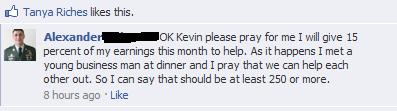
Third, we were at $385 at 11:56 p.m. last night and then I went to bed.  I was planning on just donating enough to make it an even $500 but then I woke up and saw this.


Now I read this at 8:40 a.m. Technically this means that the $500 goal was not broken as it was not in before midnight and the money has not yet been donated.

However, this whole fundraiser was not about technicalities, nor could I let this donation and the heart behind it go unacknowledged. This donation is from my friend who is a U.S. military vet who is just starting his own business.  He is by no means infinitely or independently wealthy and his giving is not just charity but risk for him.

So even though the goal was not reached I have decided to match all $500. This will have to wait a bit as I got hit unexpectedly by a several hundred dollars of car repair bill and several hundred dollars of dental bills this week, but since the auction has been brought down, I have some time to get the money together.

Again thanks for everyone for contributing! Please continue to pray for a just resolution to this whole situation, spread the word about Pe’ Sla, stay tuned for additional updates for me, and wish me a happy birthday this Sunday!

-Kevin

Posted in Personal Commentary | Tagged , , , , , , , | Leave a comment

How responsible am I for colonialism?: Why Kevin Gonzaga exists.

[Introduction: This is a several page post that I began writing as I wrestled with considering my personal responsibility in regards to European colonialism which “settled” the nation I grew up in. It ended up being about why I exists in more ways than one. I hope you enjoy it.

On this page I will begin by asking the question “Where did this all come from?” and explain what I mean by that question and why I started asking it.]

My name is Kevin Gonzaga. I grew up in Modesto, California which is a farming town that grew to 200,000 in the heart of the Central Valley of California. I was never really interested in Native American issues and my only exposure to them really was two things.  In elementary school I did a “Missions project” where I studied a Spanish mission and the Native Americans tribes they “helped.”  Later, I took a few trips to a place known as the Miwuk village, where a small museum and some land had been sent aside to inform people about the Miwuk tribe, the people who originally lived in the Central Valley.

I lived life, grew up and eventually went to college in Canada. This was where Native American or First Nations (as they call Native Americans in Canada) came back on my radar in a big way.  While serving in the Lower-East Side of Vancouver, one of the worst sides of Vancouver, the poor, the homeless and the addicted were more often than not First Nations.  I have written about one experiences with a First Nations named Bev in another post. 

On a whim I joined a trip to serve Ft. Babine. This was a First Nations reservation for the Carrier Band in the heart of British Columbia. My time in the community deeply impacted me.  I saw first-hand the ravages of alcoholism, abuse and poverty but also saw first-hand the beauty and strength of the First Nations people. I saw Native youth who had adopted hip-hop urban culture and saw elders who were worried about the disappearance of their language. One unexpected turn of events was that people mistook me to be First Nations descent.  I assured them I was not, as I did not want to be a “fake indian” but this could not be dodged, especially in contrast to the rest of the team which was all white.

One of these things is not like the other…

Here is a link to a gallery of some photographs from my time in Ft. Babine and Smithers, BC. Take a minute and look through them, especially if the only Native Americans you have ever seen were in Westerns.

After seeing a slim picture of the issues and challenges the Carrier Band faced, I was forced to ask a simple question:

“Where did this all come from?”

Since then I have been always interested in Native American and First Nations issues. I have always felt my time on the reservation was not a coincidence and that Native American communities would be a larger part of my life. Over the last several years it has always been in the back of my mind and my heart.

As I began learning about Western culture I realized how much that culture shaped who I am, how this culture shaped my experience of faith, and the pitfalls of both. As I served urban youth in the poorest part of my hometown I realized some of this experience would track with a lot of urban Native youth who have adopted the same hip-hop/rap/gangster culture as their own. As I entered a Twelve Step recovery in 2008 for my own addictions, I realized dealing with my own addictions was the first step towards helping any other addicts, including those in Native American communities. As I began to wrestle with my family issues and struggle with the abuse that went on in my home and worked towards forgiveness and reconciliation, I began to have a better understanding of what these words meant and what it means to work through painful memories in your family and community. As I embarked upon my spiritual journey last year after having radical encounters with the Holy Spirit I became more in touch with the spiritual realm and began to take the spiritual realm far more seriously, something Native American communities have always done.  As I studied at Fuller I have come to a very different understanding of the Gospel, what it means to follow Jesus and a fresh perspective on the intersection of culture, religion, justice, faith, and our relationship with the land.

Perhaps most importantly, as I have studied here at Fuller I have time and time again applied my research papers and assignments to Native American culture and communities as best I can.  This was a thinly veiled excuse to study Native American culture and history more. This has made more increasingly aware of the history of colonialism and its impact upon Native American communities.

I began to understand, perhaps for the first time, how large and complicated the answer is to my simple question, “Where did all of this come from,” in regards to issues I saw in Ft. Babine, really was.

“This,” meaning the challenges faced by those in Ft. Babine and many other Native American communities, came from a complex web of events that involved countless injustices.  Genocide, broken treaties, attempts at forced assimilation, the ecological destruction of the ecosystems the Native Americans depended upon, government paternalism, environmental racism and injustice, forced conversions, forced relocations and internal displacement, and culturally appropriation (like this)  are just some of the reasons for the challenges faced by Native American communities.

Perhaps most confusingly of all, all of these issues are essentially invisible to the mainstream dominant culture of the United States.  People act and think as if Native Americans no longer exist and racism and discrimination that would not be tolerated against any other group in the United States is for some inexplicable reason acceptable when applied to Native Americans.

Perhaps most insulting of all, when faced with these issues, some in the dominant culture simplistically blame Native Americans and suggest there is something morally, spiritual or intellectually inferior with Native Americans, and this is what has led to their present challenges.

[On the next page I start asking the question, “How responsible am I for colonialism?”]

Posted in Personal Commentary, Postcolonial | Tagged , , , , , , , , , , , , , , , , | 2 Comments

Speakfaithfully’s Birthday Fundraiser: Raising support for Pe’Sla!

All I want for my birthday is a little bit of justice…

[TLDR Version: 

To support this: http://www.indiegogo.com/PeSla-LakotaHeartland

I created this: http://www.facebook.com/events/418179661562608/

And am asking people to donate to this fund on my behalf instead of sending me presents or cards.

If you help me raise $500, I will contribute $500 of my own money to the Pe’ Sla fund and not cut my hair for two years.  If you contribute a total of $1000 I will do both of those things and learn my own native language, Tagalog, within a year.

Please consider participating by donating, sharing or spreading the word as the auction is THISFriday.]

Hey everybody, my birthday is less than a week away! I turn 28 on August 26th! I plan to have a party at some time in the near future in Pasadena but I want to do something a little non-traditional regarding presents and gifts.

Some of you may know that I am committed to serving Native American communities long-term. I hope to integrate my training as a pastor, my gifts as a writer and leader, and my (Lord willing) future training as a psychologist to this end.

This might seem like an odd goal as a person of Dutch and Filipino heritage, but it is where I fit and where Jesus has led me. After spending a brief amount of time on the Ft. Babine First Native Reservation in Canada with the Carrier Band, I fell in love with Native culture and have always felt called to work with indigenous people.

As I have continued my studies and studied history it has become clear to me that Native American/First Nations communities are some of the most under-served, over-looked and oppressed communities in the United States and Canada. While I do not think I can solve the issues facing these communities by myself, nor am I naive to the fact that outsiders with good hearts have often been less than helpful, I simply cannot believe in the God of Israel, a God that demands justice for the poor and downtrodden, a God that calls us to love others, a God that has created all people in the image of God, and not take the path I am on.

Some of you may also know (especially if you have been reading my recent Tweets and Facebook updates) that I am getting very serious and practical with my concerns regarding the history and legacy of colonialism and related injustices that has plagued the Americas, Africa and Asia. I am especially concerned with the fact that while Christians have at times been a voice for peace and progress, Christians have also participated in many of the injustices that have been perpetrated in history and continue to this day. We at times have sanctioned colonialism with our theology and have been direct participants in colonialism and attempts at forced cultural assimilation. We cannot undo this past, but we should seek to admit it and reckon with it as best we can.

One small way, almost a token really, that I would like to contribute to these issues now even before I finish my educational plans, is to help raise support for the buying of Pe’ Sla.

The short story is that Pe’ Sla is land in South Dakota that is sacred to the Lakota people. The religious ceremonies performed by the Lakota are tied to the land and they simply cannot do these ceremonies elsewhere. The land is going up for auction in five days. The family that owes Pe’ Sla has been amiable to the Lakota, and have allowed them access to this land, but once it is sold it may be divided up into less than amiable people. Perhaps worst of all the state of South Dakota has plans to build a highway right through it. I’m fairly certain no one would tolerate a highway through the sites sacred to Christianity, or Islam, or Hinduism, or Judaism, so why are we comfortable with the same thing happening to others?

The Lakota, in a twist of fate that exposes the irrationality of colonialism, are raising money to buy back the land that was taken from them in an effort to maintain their land.

This initiative is being undertaken by the Lakota and they are appealing to help from anyone and everyone that can. While most Lakota live below the poverty line, one tribe has already committed $50,000 to this fund, whose goal is 1 million dollars.

More information can be found here:
http://www.indiegogo.com/PeSla-LakotaHeartland

My goal is to help raise $500 dollars for the Pe’ Sla fund. So…

In lieu of gifts or cards for my birthday I would appreciate it if instead you donated to the Pe’ Sla fund on my behalf.

If I reach the $500 goal in the next several days before the auction I will do two things.

First, I will commit to matching this $500 with $500 of my own money.

Second, I will (possibly starting at a later date) not cut my hair for at least two years and grow out the majestic Filipino hair once again. (Seen here: http://tinyurl.com/95npzcd)

If by some odd fluke of chance (or the generous donations of my gigantic Filipino family *nudge nudge*) we raise $1,000 I will commit to learning Tagalog within one year, in honor and respect to my own ethnic heritage.

You don’t have to prove you donated (we’ll be on the honor system here friends) just report what you donated on the Facebook event page. I’ll keep a running tally there and let everyone know.

I invited over 1,000 Facebook people to this event. if you all gave $1 we would raise $1,500, I would have to grow my hair out again, and I would have to learn a language in a year and you would contribute to cultural revitalization and preservation. That’s a lot for $1!

This is a very time sensitive project as the auction is only five days from now! Please contribute in whatever way you can, either by donating as much as you see fit, inviting others to this page, sharing this event on Twitter, Facebook and other social media sites, or sharing about this issue in general for the next several days.

Thanks for your time!

-Kevin

Posted in Worth Reading | Tagged , , , , , | Leave a comment